Largemouth Bass vs Smallmouth Bass Identification
You're out on the water, you feel that familiar tug, and after a good fight, you reel in a beautiful bass. But wait a minute… is it a largemouth or a smallmouth? Many anglers, from seasoned veterans to enthusiastic beginners, sometimes find themselves pausing, rod still in hand, trying to figure out which species they've just landed. It’s a common moment of confusion that can have implications for regulations, bragging rights, and even how you approach fishing certain waters. This comprehensive guide will meticulously break down the differences between Largemouth Bass and Smallmouth Bass, helping you confidently identify your catch every single time you’re fishing in Ontario's abundant waters.
Why Accurate Bass Identification is Crucial for Ontario Anglers
Understanding the difference between a largemouth and a smallmouth bass isn't just about showing off your fish knowledge (though that's certainly a bonus!). It's a fundamental aspect of responsible and successful angling in Ontario, impacting everything from legal compliance to your fishing strategy and even your enjoyment of the sport. The provincial regulations are clear, and misidentification can lead to unexpected issues.
Navigating Ontario's Fishing Regulations
Ontario has a robust set of fishing regulations designed to protect fish populations and ensure sustainable angling for everyone. These rules often include specific size limits, catch and possession limits, and even season dates that can vary significantly between species. For instance, the daily catch limit for Largemouth Bass might be different from that of Smallmouth Bass in the same Fisheries Management Zone. If you mistakenly identify a largemouth as a smallmouth (or vice versa) and keep a fish that's out of season or over the legal limit for its actual species, you could face penalties. It's a common oversight, especially for those new to a specific area or new to bass fishing altogether, but ignorance of the law is rarely an excuse. Taking the time to learn these identification markers can save you a lot of headaches and potential fines down the road. You can always refer to resources like Ontario Bag and Possession Limits by Species for specific numbers once you've made your identification.
Enhancing Your Angling Strategy and Experience
Beyond the legalities, knowing exactly what kind of bass you're targeting or have just caught is incredibly empowering for your overall fishing strategy. Largemouth and smallmouth bass, despite both being members of the sunfish family, have distinct preferences when it comes to habitat, forage, and even how they react to different lures and techniques. If you're consistently catching one species when you're targeting the other, understanding why you're doing so, based on their individual traits, allows you to adjust your approach. You might switch to different depths, try different types of cover, or even alter your lure presentation. This precision not only makes you a more effective angler but also deepens your understanding and appreciation of these incredible sport fish. It truly transforms a simple fishing trip into a more engaging and analytical experience.
Key Physical Characteristics: Telling Them Apart at a Glance
When a bass comes boatside or is flopping on the bank, a few key visual cues will immediately tell you whether it's a largemouth or a smallmouth. These are the "tells" that experienced anglers look for first, and once you know them, they become second nature.
Mouth Size and Jawline Extension
This is arguably the most reliable and easiest indicator to spot. The clue is right there in their names!
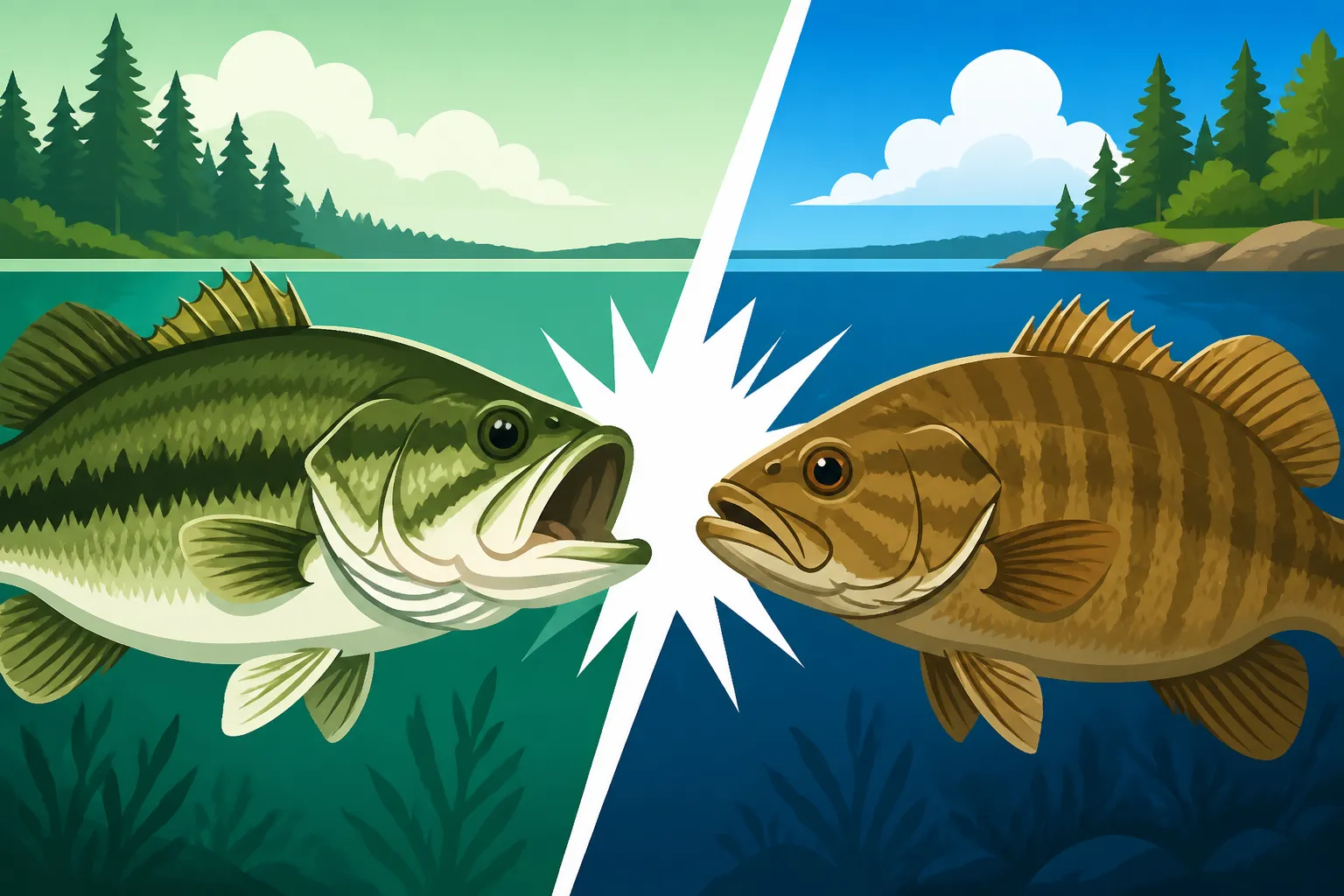
- Largemouth Bass: As the name suggests, the largemouth bass has a noticeably larger mouth. The key is to look at how far back the corner of its jaw (the maxilla) extends when its mouth is closed. On a largemouth, the jawline will extend beyond the back edge of its eye. Imagine a vertical line dropping straight down from the back of the eye – the largemouth's jaw will clearly pass that line. This gives its face a more elongated, almost lizard-like appearance.
- Smallmouth Bass: In contrast, the smallmouth bass has a more modest mouth. Its jawline, when closed, will typically not extend beyond the middle of its eye, and certainly not past the back edge. Often, it only reaches to about the pupil or slightly behind it. This gives the smallmouth a more compact, "punched-in" face compared to its largemouth cousin. It's a subtle but consistent difference that becomes incredibly clear once you know what to look for.
Dorsal Fin Separation
Another excellent anatomical identifier lies in their dorsal fins – the fin on their back. Both species have two dorsal fins, but how they connect (or don't connect) is distinct.
- Largemouth Bass: The largemouth bass has a deep, almost complete division between its spiny (front) dorsal fin and its soft-rayed (rear) dorsal fin. If you run your finger along the top of its back, you'll feel a clear, noticeable notch or separation, making it look like two distinct fins. This separation is often quite pronounced, almost as if someone took a knife and cut between the two sections.
- Smallmouth Bass: The smallmouth bass, on the other hand, has a more continuous dorsal fin. While there's still a slight dip or indentation between the spiny and soft-rayed sections, they are clearly connected, forming one long, continuous fin rather than two separate ones. The membrane connecting the two parts is intact, giving it a smoother, more unified appearance along the fish's back. This is a subtle difference that might require a closer look but is very consistent.
Body Shape and Coloration
While mouth and dorsal fin are paramount, the overall body shape and coloration also provide strong clues, though these can sometimes vary more depending on the fish's specific environment, diet, and even its mood.
- Largemouth Bass: Largemouths tend to have a more elongated, somewhat cylindrical body shape. Their most distinguishing colour mark is a prominent, irregular, horizontal dark stripe or series of blotches running along their lateral line, from the gill plate to the tail. This stripe can be very dark and distinct in some fish, while in others (especially those from murky water), it might be more faded or broken. Their overall colour can range from dark green to olive or even brownish on the back, fading to lighter green or white on the belly. Sometimes they have a yellowish tint on their underside.
- Smallmouth Bass: Smallmouths typically have a more robust, "bronzed," and compact body shape. They are often described as being more football-shaped or having a more streamlined appearance, which makes sense given their preference for currents. Their coloration is usually more uniform, often golden-brown, olive, or even bronzy-green on the back and sides, fading to a creamy white belly. Instead of a single lateral stripe, they often display vertical bars or bands along their sides, especially when stressed or in clear water. These bars can sometimes be faint or broken, but they are distinct from the largemouth's horizontal stripe. Their eyes also tend to be a striking red or amber, which adds to their distinctive look.
Here's a quick comparison table for these key features:
| Feature | Largemouth Bass | Smallmouth Bass |
|---|---|---|
| Jawline | Extends beyond the back edge of the eye | Does not extend beyond the middle of the eye |
| Dorsal Fin | Deep, noticeable notch/separation between sections | Continuous, with only a shallow dip |
| Body Shape | More elongated, somewhat cylindrical | More compact, robust, "football-shaped" |
| Coloration | Distinct horizontal dark stripe/blotches | Vertical bars or bands on sides, often bronzy-gold |
| Eye Color | Typically dark or yellowish | Often reddish or amber |
Habitat and Behavioral Differences
Knowing where each species prefers to hang out can be just as helpful for identification as their physical traits, especially before you even make a cast. Largemouth and smallmouth bass are adapted to different environments, and understanding these preferences will guide your fishing strategy and help you anticipate what you might hook into.
Preferred Water Types and Cover
The "address" a bass chooses tells you a lot about its species. These preferences are hardwired and reflect their evolutionary history.
-
Largemouth Bass: These are the quintessential "green bass" of warm, shallow, vegetated waters. Think of lily pads, dense weed beds, submerged logs, docks, brush piles, and shallow bays with plenty of cover. They thrive in lakes, slow-moving rivers, ponds, and reservoirs where the water is often warmer and perhaps a bit murkier. They are ambush predators, using the dense cover to hide and dart out at unsuspecting prey. If you're fishing a weedy back bay on Lake Simcoe or a calm section of the Kawartha Lakes, you're most likely in prime largemouth territory. They love to patrol the edges of emergent vegetation, waiting for a meal to swim by. This means your best bets for finding them are often in water less than 15 feet deep, particularly where there’s a distinct transition from open water to dense structure.
-
Smallmouth Bass: In stark contrast, smallmouths are the "brown bass" of cooler, clearer, rocky waters. They prefer areas with currents, clean gravel or rubble bottoms, rocky points, shoals, drop-offs, and river systems. You'll find them in the Great Lakes, major river systems like the French River or Ottawa River, and many of Ontario's deep, clear shield lakes. They are more active hunters, chasing down prey in open water or along rocky structures. If you're drifting a clear, rocky point on Georgian Bay or casting into a strong current on the Niagara River, you're almost certainly targeting smallmouths. They are less dependent on dense overhead cover and more on rocky breaks, ledges, and current breaks. They will often be found in deeper water than largemouths, especially during the heat of summer, using depth and current as their protection. Knowing What water temperature smallmouth bass prefer can also help narrow down your search.
Forage and Feeding Habits
What these two species eat and how they eat it also reflects their habitat and body design. Their diets are remarkably diverse, but there are distinct tendencies.
- Largemouth Bass: Given their preference for weedy, shallow environments, largemouths feast on a wide variety of prey that lives in and around that cover. This includes baitfish like minnows and perch, frogs, crawfish, insects, and even small rodents, ducklings, or snakes if the opportunity arises. Their large mouths are perfectly adapted for engulfing larger, slower-moving prey, and their ambush tactics mean they often wait patiently for a meal to come to them. They'll often hit topwater lures with explosive force, mimicking a frog or a struggling rodent on the surface. When they hit, it's typically a violent, all-encompassing strike meant to swallow the prey whole.
- Smallmouth Bass: Smallmouths, living in rockier, clearer waters, have a diet that leans heavily on crawfish, which thrive in rocky environments. They also consume various baitfish, aquatic insects, and sometimes leeches. Their smaller, more compact mouths are efficient for picking crawfish off rocks or chasing down quick-moving baitfish. They are known for their aggressive, hard-fighting nature, often striking lures with a sharp "thump" and then making powerful runs and acrobatic jumps. Their hunting strategy is more active, involving chasing and cornering prey, which is why they respond so well to fast-moving baits and jigs that mimic fleeing crawfish or minnows.
Geographic Distribution Across Ontario
Understanding the general distribution of Largemouth and Smallmouth Bass across Ontario can further help you identify your catch, or at least predict what you're more likely to encounter in certain regions. While there's overlap, particularly in the southern parts of the province, each species has its stronghold.
Southern Ontario's Mixed Waters
Southern Ontario is where you'll find the most overlap, offering fantastic opportunities for both species. The region's diverse geography—from the Great Lakes to countless inland lakes, rivers, and ponds—provides ideal habitat for both green and brown bass.
- The Largemouth Belt: Many of the smaller, shallower, and weedier lakes in Southern Ontario, particularly in areas like the Kawarthas, Lake Scugog, or the slower sections of the Trent-Severn Waterway, are prime largemouth factories. These waters warm up quickly, sustain abundant vegetation, and have the kind of sheltered bays that largemouths love. Anglers often target these areas specifically for their largemouth potential, using a range of tactics from flipping jigs into heavy cover to throwing frogs over mats of lily pads. You'll also find them in reservoirs and even farm ponds that meet their habitat requirements. For a deep dive, check out Best Largemouth Bass Lakes in Ontario.
- Smallmouth Strongholds: Yet, Southern Ontario also boasts some of the world's premier smallmouth fisheries. The Great Lakes (Erie, Ontario, Huron, and Georgian Bay), with their vast, rocky expanses, deep drop-offs, and cooler, clearer waters, are legendary for their trophy smallmouths. Major river systems like the St. Lawrence, Niagara, and parts of the Ottawa River also offer incredible smallmouth action, thanks to their currents and rocky bottom compositions. Even many of the deeper, clearer inland lakes in areas like Muskoka or Haliburton can hold significant smallmouth populations. In these areas, anglers will often find themselves targeting rocky points and shoals, using finesse techniques or aggressive power fishing to entice these bronze beauties. Smallmouth Bass Habits on Lake Erie is a great resource if you're fishing those waters.
Northern Ontario's Smallmouth Dominance
As you head further north into Ontario, the landscape changes dramatically, becoming rockier, with more clear, deep lakes and fewer large expanses of warm, shallow, weedy water. This shift in environment directly impacts bass distribution.
- Prevalence of Smallmouth: Northern Ontario is predominantly smallmouth bass country. Lakes like Lake Nipigon, Lake of the Woods, Rainy Lake, and countless other pristine, rocky Canadian Shield lakes are renowned for their abundant and often very large smallmouth populations. The cooler water temperatures, rocky shorelines, and limited weed growth naturally favour the smallmouth's preferred habitat. While largemouths exist in some isolated pockets or warmer, shallower bays in northern lakes, they are far less common and less widespread than their smallmouth cousins. If you're venturing into the remote wilderness lakes of Northern Ontario, chances are high you'll be primarily encountering smallmouths. Anglers often plan entire trips around the incredible smallmouth fishing found in these pristine, clear-water environments.
- Limited Largemouth Presence: It's important to understand that while largemouths can be found in some northern waters, their presence is usually restricted to very specific micro-habitats – sheltered, shallow bays with substantial weed growth that can warm up sufficiently. These spots are often isolated and don't represent the widespread distribution seen in Southern Ontario. So, if you're pulling a bass out of a typical clear, deep, rocky Northern Ontario lake, you can be fairly confident it's a smallmouth.
Angling Considerations: Tailoring Your Approach
Once you can tell these bass apart, your fishing game will become much more precise. The distinct physical characteristics, habitat preferences, and fighting styles of largemouth and smallmouth bass mean that successful angling often calls for different gear, lures, and techniques.
Rod and Reel Selection
Matching your tackle to the species you're targeting makes a huge difference in effectiveness and enjoyment. You wouldn't use a heavy deep-sea rod for panfish, and similarly, bass often demand specific setups.
-
Largemouth Bass Setups: For largemouths, especially when fishing heavy cover, you often need gear with more backbone. Medium-heavy to heavy power rods, typically 6'6" to 7'6" in length, are common. These rods provide the leverage needed to pull fish out of thick weeds, flip heavy jigs, or set the hook on a big frog bite. Baitcasting reels are very popular for largemouth fishing, especially when throwing heavier lures or managing thicker lines. They offer more power and control for casting into tight spots and muscling fish. You'll often see anglers using braided line (30-65 lb test) for its strength and no-stretch properties, or fluorocarbon (12-20 lb test) for its abrasion resistance and low visibility, especially when targeting Largemouth Bass Fishing in Ontario in clear water. When looking for a new setup, checking reviews on sites like Amazon can give you insights into different brands and models that excel in these conditions.
-
Smallmouth Bass Setups: Smallmouths, particularly in clearer, deeper waters, often respond better to lighter presentations and finesse techniques. This often means favouring medium to medium-light power spinning rods, usually 6' to 7' in length. These rods offer the sensitivity needed to detect subtle bites in deeper water or when using lighter baits. Spinning reels, paired with lighter lines (6-12 lb fluorocarbon or braided line with a fluorocarbon leader), are ideal for casting lighter jigs, drop shots, tubes, and small crankbaits that are often crucial for enticing smallmouths. While baitcasters can certainly be used, especially with reaction baits, many dedicated smallmouth anglers prefer spinning gear for its versatility with lighter lures and its ability to handle line-peeling runs from these powerful fighters. Consider a versatile Best Rod and Reel Combo for Beginners if you're just starting, as many can handle both species with appropriate adjustments.
Lure Choices and Presentation
Just like their preferred habitats, the lures that consistently catch largemouths and smallmouths often differ. While there's overlap (a jerkbait or a spinnerbait can catch both), optimizing your selection for the target species will yield better results.
- Largemouth Bass Lures: Given their ambush predator nature and preference for heavy cover, largemouths often respond well to lures that imitate their larger prey or that can be worked effectively through weeds and wood. This includes plastic worms, jigs (especially Texas-rigged or Carolina-rigged), spinnerbaits, chatterbaits, topwater frogs, poppers, buzzbaits, and crankbaits that dive into cover. Flipping and pitching techniques, where lures are precisely dropped into small openings in heavy cover, are highly effective. The presentation is often slower, allowing the lure to sit in the strike zone longer. You might even find specialized tackle boxes for Best Tackle for Ontario Walleye often have some crossover with bass, but specific largemouth tackle focuses on weedless options.
- Smallmouth Bass Lures: Smallmouths, being more active hunters in open, rocky water, typically respond to lures that mimic crawfish or baitfish and can be retrieved effectively over structure or through current. Tube jigs, drop shot rigs, finesse jigs, hair jigs, blade baits, small crankbaits, jerkbaits, inline spinners, and swimbaits are all popular choices. Presentation often involves working lures along rock piles, points, and drop-offs, mimicking fleeing prey. Vertical jigging or subtle drag-and-hop retrieves are common in deeper water. Smallmouths will often hit fast-moving baits with an aggressive chase, so presentations can be more active than for largemouths. Many anglers find excellent selections of these specialized lures available on platforms like Amazon. If you're looking for specific tactics, resources like How to Catch Smallmouth Bass in Ontario can be incredibly insightful.
Fighting Characteristics
Even once hooked, a bass’s fight can offer clues to its identity, especially if you're still uncertain. They both fight hard, but they do it differently!
- Largemouth Bass Fight: When a largemouth hits, it's often a solid, thumping strike, and their initial reaction is usually to bury themselves back into the thick cover they came from. They'll make powerful, short runs, pulling hard to tangle your line in weeds or wrap it around a submerged log. They tend to stay deeper in the water column and will shake their head violently in an attempt to dislodge the hook. While they can jump, it's less common than with smallmouths, and their fight is more of a brute-force battle.
- Smallmouth Bass Fight: Smallmouths are renowned for their incredible, acrobatic fights. Once hooked, they typically make longer, searing runs, often stripping line from the reel. They are famous for their aerial displays, leaping clear out of the water multiple times, shaking their heads vigorously, and performing tail-walks across the surface. Their fight is characterized by speed, power, and relentless energy. They fight right to the boat, making them a thrilling adversary on light tackle. When you feel that initial hard thud and then the line starts screaming and a fish launches itself into the air, there's a good chance you've hooked an Ontario smallmouth.
Common Misconceptions and Tricky Situations
While the key identification points are generally reliable, there are a few scenarios that can throw even experienced anglers for a loop. Understanding these tricky situations helps you make an accurate identification every time.
Juvenile Bass Identification
Younger bass, regardless of species, can sometimes have less pronounced features, making initial identification a bit more challenging. Their colors might not be as vibrant, and their patterns might not be fully developed.
- The Fading Lateral Line: A common pitfall with juvenile largemouth bass is that their prominent horizontal lateral line can sometimes be less distinct or appear more blotchy than in mature fish. Conversely, young smallmouth bass might display more prominent vertical bars that could, at a quick glance, be mistaken for an attempt at a horizontal line. The key here is always to fall back on the most reliable indicators: the jawline and the dorsal fin separation. Even in juveniles, these anatomical differences are consistent. The jaw of a juvenile largemouth will still extend past its eye, and its dorsal fin will still have that deep division, even if the body coloration is muted or slightly ambiguous.
- Coloration Variability: Remember that coloration can be influenced by the environment. Bass living in dark, tannic water might be much darker overall, making patterns less visible. Bass from very clear, sandy-bottomed lakes might be lighter. Don't rely solely on color or pattern, especially for juveniles, but always cross-reference with jawline and dorsal fin. Observing fish in varying conditions will eventually make these subtle differences more apparent.
The Myth of Hybrid Bass
Occasionally, you might hear talk of "hybrid bass" – a cross between a largemouth and a smallmouth. While other types of hybrid bass (like wiper, a cross between striped bass and white bass) exist, a natural hybrid between a largemouth bass and a smallmouth bass is extremely rare, if not virtually non-existent in the wild.
- Different Genera: Largemouth bass (Micropterus salmoides) and smallmouth bass (Micropterus dolomieu) are distinct species within the Micropterus genus (the black bass). While they share the genus, they are reproductively isolated to the point where natural hybridization is not a recognized phenomenon. Any fish you catch that looks like a "mix" is almost certainly just an odd-looking individual of one species or the other, or perhaps a fish whose features are distorted by injury or environmental factors. If you’re ever truly stumped, it's best to err on the side of caution and consult the Ontario Fishing Regulations Explained for your zone, or safely release the fish.
- Environmental Factors Mimicking Hybrids: Sometimes, a smallmouth might pick up a darker, more ambiguous stripe if it lives in a largely vegetated area for a long time, or a largemouth might appear more bronze if it spends time over rocky structure. These are environmental adaptations, not genetic hybrids. Trust the fundamental anatomical differences, especially the jaw and dorsal fin, as they remain consistent.
The next time you pull a bass from the cool, clear waters of Lake Huron or a weedy bay in the Kawarthas, you’ll have all the tools you need to confidently identify your catch. Knowing the difference isn't just about following the rules; it's about deepening your connection to the sport and the incredible fish that call Ontario home.
Disclaimer
This article is for general informational purposes only and does not constitute professional advice. Laws, prices and regulations vary by location and change over time. Consult a qualified professional for guidance on your specific situation.