Best Fish Finders for Ontario Lakes
Oh, the sheer frustration of staring at a vast, beautiful Ontario lake, knowing there are fish somewhere below, but having absolutely no idea where to even start! We've all been there, casting blindly, hoping for a nibble, and often coming up empty-handed. Ontario's waters are incredible, but they can be incredibly challenging to decipher. That's where a good fish finder comes in, transforming your fishing experience from a guessing game into a strategic hunt. This guide is all about helping you navigate the world of fish finders, so you can choose the perfect companion for your adventures on Ontario's diverse lakes.
Why a Fish Finder is Essential for Ontario Anglers
Let's be real, a fish finder isn't just a fancy gadget; it's practically a necessity for anyone serious about consistently finding and catching fish in Ontario. Our lakes aren't uniform, and the fish aren't always conveniently schooling in plain sight. This technology bridges the gap between what we see on the surface and the bustling aquatic world beneath.
Decoding Ontario's Diverse Waters
Ontario boasts an incredible variety of lakes, from the shallow, fertile waters of the Kawarthas to the vast, deep, and rocky expanses of the Canadian Shield, and let's not forget the sheer magnitude of the Great Lakes. Each type of water presents its own unique challenges when it comes to locating fish. Without a fish finder, you're essentially exploring a dark room blindfolded. Are you drifting over a perfect weed line where bass are ambushing baitfish? Is that subtle depth change a hidden rock pile holding walleye? Is there a deep break where lake trout are lurking in the cold water? It’s impossible to tell with the naked eye.
Imagine yourself on a sprawling body of water like Lake Nipissing, trying to find elusive walleye or muskie. Without a fish finder, you’d spend hours trolling or casting over unproductive water, feeling that familiar pang of disappointment. A fish finder instantly shows you the contours of the bottom, the presence of structure like submerged trees or boulders, and most importantly, the echoes of fish themselves. It takes the guesswork out of the equation and replaces it with informed decisions, allowing you to focus your efforts where the fish are actually holding.
Beyond Just Marking Fish
While "fish finder" might suggest its sole purpose is to point out fish, the reality is that these devices offer so much more. They are powerful sonar and navigation tools that provide a comprehensive view of the underwater environment, helping you understand why fish are where they are. This knowledge is gold for any angler.
For instance, a good fish finder will reveal the exact depth of the water you're fishing, allowing you to present your lure at the optimal level. It can identify subtle changes in bottom composition – distinguishing between soft mud, hard rock, or gravel – which are critical details for certain species. You can pinpoint submerged humps, drop-offs, and even the thermocline, that crucial depth where warmer surface water meets colder deep water, often a preferred zone for many game fish. Furthermore, the integrated GPS in many units means you can mark those productive spots, saving them as waypoints to return to again and again. It’s not just about catching fish today; it's about building a database of knowledge for future trips, ensuring you can revisit those honey holes even years down the road. This also plays a crucial role in safety and navigation, especially on unfamiliar or foggy waters. Ontario Boating Laws for Anglers often emphasize safe navigation, and a reliable GPS on your fish finder definitely contributes to that.
Key Technologies in Modern Fish Finders
The world of fish finders has evolved dramatically over the years. What started as basic depth sounders has transformed into sophisticated sonar systems that paint incredibly detailed pictures of the underwater world. Understanding these core technologies is vital to choosing the right unit for your Ontario fishing adventures.
Traditional Sonar (2D)
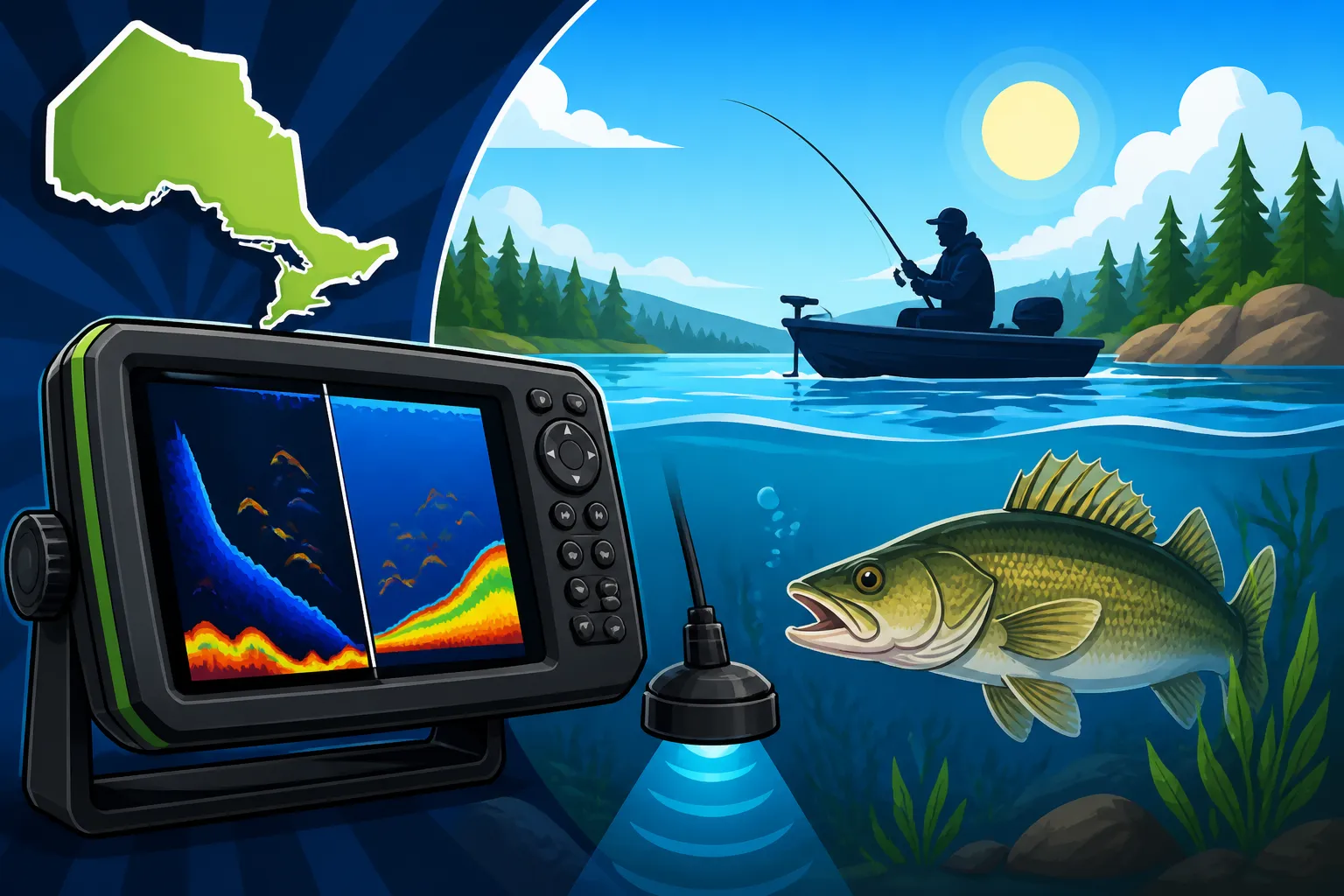
Traditional 2D sonar is the foundation of all fish finders, and it's what most people picture when they think of these devices. It works by sending a single, focused sound wave into the water from a transducer, and then listening for the echoes that bounce back from the bottom, fish, and other objects. The unit then interprets these echoes and displays them as an image on your screen.
On a traditional 2D sonar screen, fish typically appear as "arches" – the classic fish symbol you might recognize. The shape of the arch tells you about the fish's movement relative to your boat and the sonar cone. You'll also see a representation of the bottom contour, indicating depth changes, humps, and drop-offs. While it might not offer photographic clarity, 2D sonar is excellent for determining overall depth, identifying dense schools of baitfish, and marking larger individual fish. It's fast, reliable, and still a critical component of even the most advanced units, often providing the widest coverage for quick scanning.
Down Imaging and Side Imaging
These technologies take traditional sonar to a whole new level by providing much clearer, photo-like images of what's beneath and beside your boat. Down Imaging (often called DownVü or DownScan Imaging by various brands) uses a very narrow, high-frequency beam that essentially "scans" directly below your boat, creating detailed, almost photographic images of submerged structure and objects. This means you can distinguish individual rocks, sunken logs, and even discern the species of fish in some cases, rather than just seeing an arch. It’s incredibly helpful for understanding the structure you're hovering over, like a brush pile or a rocky ledge, and seeing how fish are relating to it.
Side Imaging (also known as SideVü or SideScan Imaging) expands on this by sending beams out to the left and right of your boat. This allows you to scan vast areas of water on either side, often up to hundreds of feet, much faster than you could with 2D or Down Imaging alone. Imagine cruising along a shoreline on Lake Simcoe and being able to see submerged weed beds, docks, or rock formations extending far from your boat, all while covering water efficiently. Side Imaging is a game-changer for finding hidden structure, identifying subtle bottom changes, and locating schools of fish that might be off to the side, rather than directly under your boat. It allows you to "see" what's important without having to drive directly over it, making your search for Best Walleye Lakes in Ontario or other species much more efficient.
CHIRP Sonar: The Game Changer
CHIRP stands for Compressed High-Intensity Radiated Pulse, and it's essentially an advanced form of 2D sonar that provides significantly better detail and clarity. Unlike traditional sonar, which sends out a single frequency pulse, CHIRP sonar sends out a continuous sweep of frequencies, from low to high, in each pulse. When these broader range of frequencies return to the transducer, the fish finder’s processor interprets them, resulting in a much more accurate and detailed image.
The benefits of CHIRP are enormous. It offers superior target separation, meaning you can distinguish individual fish even when they are tightly schooled or very close to structure or the bottom. This is incredibly valuable when you’re trying to pick out a trophy walleye nestled among smaller baitfish, or discern fish from a rock pile. CHIRP also provides much clearer images at greater depths and at higher boat speeds, reducing clutter and interference. This technology is a must-have for serious anglers on Ontario's larger, deeper lakes, where target separation and deep-water performance are critical for species like lake trout or deep-holding smallmouth. It truly brings a new level of precision to your underwater view, making a profound difference in your ability to pinpoint elusive fish.
Live Sonar Technologies
Now, if you want to talk about truly revolutionary, game-changing technology, we have to talk about live sonar. Brands like Garmin, Humminbird, and Lowrance have introduced technologies that provide real-time, live views of what's happening underwater. Imagine seeing your lure descend, watching how fish react to it, and even seeing them follow or strike it – all in real-time, just like a video game.
These systems use incredibly high-frequency sonar beams to deliver near-photographic, live-action images. While the specific names vary by brand (e.g., Garmin LiveScope, Humminbird MEGA Live Imaging, Lowrance ActiveTarget), the core concept is the same: they offer an unparalleled ability to observe fish and structure in dynamic, real-time motion. This means you can adjust your presentation instantly based on how fish are behaving, whether they're shy, aggressive, or just curious. For sight fishing in deeper water, tracking schools of bait, or understanding how individual fish relate to cover, live sonar is an incredible tool. It comes with a higher price tag, no doubt, but for those who want the ultimate edge in terms of underwater visibility and interaction, it's a truly transformative experience.
Essential Features for Ontario Fishing
Beyond the core sonar technologies, several other features can significantly impact the effectiveness and enjoyment of your fish finder on Ontario's lakes. These are the practical considerations that will make your time on the water more productive and less frustrating.
Screen Size and Resolution
When you're out on the water, especially in bright sunlight or with spray hitting the screen, a clear, sizable display makes all the difference. Screen size, measured diagonally in inches, determines how much information you can see at once. While a smaller 5-inch screen might suffice for basic depth and fish arches, a 7-inch, 9-inch, or even larger display becomes incredibly valuable when you start using advanced features like split-screen views (e.g., 2D sonar, Down Imaging, Side Imaging, and a GPS map all at once). You don't want to be squinting to interpret crucial details.
Resolution, expressed in pixels (e.g., 800×480, 1024×768), is equally important. A higher resolution means more pixels per inch, resulting in sharper images, finer details, and clearer distinctions between fish and structure. Think of it like comparing a standard definition TV to a high-definition one; the difference in clarity is profound. On a vast lake, being able to clearly distinguish a lone walleye from a small rock or a subtle weed line can be the difference between a productive day and a slow one. A good balance of size and resolution ensures you get the most out of your fish finder's advanced sonar capabilities, letting you maximize your time finding the best spots on Lake Erie Fishing Guide or elsewhere.
GPS, Mapping, and Waypointing
For navigating Ontario's expansive and sometimes complex waterways, an integrated GPS and robust mapping capabilities are absolutely non-negotiable. Whether you're exploring new territory, finding your way through a maze of islands, or just ensuring you can get back to the launch in fog, GPS is your best friend. Modern fish finders often come with detailed base maps pre-loaded, and many are compatible with high-definition mapping cards from providers like Navionics or LakeMaster, offering incredible contour detail for specific lakes.
The ability to waypoint is another critical feature. As you cruise, your fish finder will reveal hidden humps, submerged shoals, brush piles, or active schools of fish. With GPS, you can instantly mark these "hot spots" with a waypoint, saving their precise coordinates. This means you can return to them later, whether it's an hour, a day, or a year from now. Imagine marking that exact rock pile on the French River where you caught a monster smallmouth, or that deep break on Lake of the Woods that held a school of walleye. Without waypoints, these spots would be lost to memory. Furthermore, mapping helps you stay within Ontario Fishing Regulations Explained by showing you fishery management zone boundaries or specific sanctuaries if they are overlaid on your chart. It's not just about finding fish; it's about navigating safely and effectively. In fact, many anglers find the mapping features so detailed they can often identify potential fish-holding structure even before deploying their transducer, simply by studying the contours on the map. You can even sometimes overlay your tracks to see where you've been and where you still need to explore. How to use the Fish ON-Line interactive zone map is another great resource that can complement the mapping capabilities of your fish finder, allowing you to cross-reference regulations and zone details right from your boat.
Transducer Quality and Frequencies
The transducer is, quite literally, the "eyes and ears" of your fish finder. It’s the component that sends and receives the sonar waves, and its quality and placement are paramount to getting clear, accurate readings. Transducers come in various forms: transom-mount (the most common, attaching to the back of your boat), through-hull (drilled through the bottom of your boat for optimal clarity but permanent), and trolling motor mount (integrated into or attached to the lower unit of your trolling motor, great for precise targeting).
Different transducers operate at various frequencies, each with its advantages. Higher frequencies (e.g., 200 kHz, 455 kHz, 800 kHz, or MegaHertz ranges) provide more detail and better target separation, but penetrate less deeply into the water. These are excellent for shallower water, identifying structure, and discerning individual fish. Lower frequencies (e.g., 50 kHz, 83 kHz) penetrate deeper and offer wider coverage, making them ideal for deep-water fishing and scanning large areas quickly, though with less detail. Many modern transducers are multi-frequency or CHIRP-enabled, allowing them to utilize a broad spectrum of frequencies to give you the best of both worlds – deep penetration with excellent detail. Matching your transducer to your fishing style and the depths you typically fish in Ontario is crucial for maximizing your fish finder's performance.
Power Output (RMS)
Power output, usually measured in Watts RMS (Root Mean Square), dictates how powerfully your fish finder can send and receive sonar signals. In simple terms, higher RMS power generally means better depth penetration and the ability to maintain a clear signal in deeper water or at higher boat speeds. Think of it like shouting: a more powerful shout travels further and is heard more clearly, especially if there's a lot of background noise.
For anglers tackling Ontario's deeper lakes, especially those targeting lake trout or suspended walleye in big water, a fish finder with higher RMS power is a significant advantage. It ensures that your unit can send a strong enough signal to reach the bottom and detect fish at considerable depths, and then receive those faint echoes clearly. Low power units might struggle to provide a clear picture beyond a certain depth, displaying a lot of clutter or losing the bottom signal entirely. While you might not need extreme power for shallow, weedy bays, venturing into the deeper sections of Lake Superior or Lake Huron Fishing Spots will certainly benefit from a more robust power output. Always check the RMS rating when comparing models, as it directly impacts performance in challenging conditions.
Types of Fish Finders for Different Ontario Fishing Styles
Just as there are countless ways to fish in Ontario, there are various types of fish finders designed to suit different boats and angling approaches. Choosing the right form factor is as important as selecting the right technology.
Portable Fish Finders for Small Boats and Kayaks
For many Ontario anglers who prefer smaller watercraft like canoes, kayaks, jon boats, or even rental boats, a portable fish finder is an absolute game-changer. These units are designed for easy setup, removal, and transport, making them incredibly versatile. Typically, they feature a compact display unit, a small battery pack (often rechargeable), and a transducer that can be temporarily mounted to the transom, hull, or even deployed directly into the water using a suction cup or clamp.
The beauty of portable fish finders lies in their convenience. You can effortlessly move them from one boat to another, or take them on those remote portage trips into Crown land lakes. While they might not boast the largest screens or the most powerful sonar of their console-mounted counterparts, many modern portable units still offer excellent 2D sonar, Down Imaging, and even basic GPS functionality. This makes them ideal for finding subtle structure on a small river while Best Kayak for River Fishing in Ontario or locating schools of panfish in a quiet bay. They are a fantastic entry point for anglers who aren't ready to commit to a permanent installation or who fish from a variety of watercraft.
Console-Mounted Units for Power Boats
For those with larger power boats, whether it's a dedicated bass boat, a deep-V walleye rig, or a comfortable cruiser for the Great Lakes, a console-mounted fish finder is the standard. These units are permanently installed, often featuring large, high-resolution screens that are flush-mounted into the dash or mounted on a sturdy bracket. They are typically powered directly by the boat's electrical system, ensuring consistent performance.
Console-mounted systems are where the most advanced technologies truly shine. You'll find multi-function displays that integrate multiple sonar technologies (2D, CHIRP, Down, Side, Live), detailed GPS mapping, radar, engine data, and even autopilot controls into a single, comprehensive network. These setups often utilize multiple transducers strategically placed around the boat for optimal coverage and clarity. For serious tournament anglers or those who spend long days covering vast distances on Lake Erie Walleye Fishing or Georgian Bay Muskie Fishing, a robust console-mounted system provides the power, screen real estate, and networking capabilities needed to maximize efficiency and success. The larger screen allows for multiple split-screen views, enabling simultaneous monitoring of sonar, mapping, and other vital information at a glance.
Ice Fishing Flashers and Sonar Units
Ice fishing in Ontario is a unique beast, and the gear you need reflects that. While some portable open-water fish finders can be adapted for ice fishing, specialized ice fishing flashers and sonar units offer distinct advantages. Traditional flashers display a real-time, circular view of what’s directly beneath your ice hole, showing your lure and any fish interacting with it in vibrant colours. This immediate feedback is invaluable for jigging, allowing you to see if fish are approaching, hesitating, or striking your bait.
Modern ice fishing units combine the real-time flasher display with traditional 2D sonar or even sophisticated CHIRP and live sonar capabilities. These all-in-one portable kits often come with a protective carrying case, a specialized ice transducer (which typically floats in the hole), and a powerful battery designed to withstand cold temperatures. The ability to see your lure and fish simultaneously, in real-time, is absolutely critical for successful Ice Fishing in Ontario, especially when targeting finicky panfish or deep-dwelling lake trout. Many units also have features like zoom, target separation, and even mapping for navigating frozen lakes, ensuring you can find those productive humps and drop-offs even when they're hidden under several feet of ice and snow.
Choosing the Right Fish Finder: Budget vs. Performance
Deciding on a fish finder often comes down to balancing your budget with the features and performance you genuinely need. It's easy to get overwhelmed by the sheer number of options, but by understanding the different tiers, you can make an informed choice that suits your fishing style and wallet.
Entry-Level Options
For anglers just starting out, or those who fish occasionally from smaller boats or shore, entry-level fish finders offer a solid introduction to underwater electronics without breaking the bank. These units typically feature a smaller screen (e.g., 4-5 inches), basic 2D sonar, and sometimes rudimentary Down Imaging. They'll give you a reliable depth reading, show you bottom contours, and indicate the presence of fish with simple arches or fish symbols.
You can expect basic GPS functionality, allowing you to mark a few waypoints, but don't anticipate highly detailed mapping or advanced networking capabilities. The power output will be moderate, suitable for shallower lakes and rivers. While they might lack the photo-like clarity or advanced features of more expensive units, they are perfectly capable of helping you locate structure and fish in many of Ontario's smaller or shallower bodies of water. For someone who simply wants to know how deep it is and if there are fish around, an entry-level unit is a smart, economical choice. They are excellent for boosting confidence and helping beginners understand the basics of underwater topography. Many good starter options can be found at retailers like Bass Pro Shops or through online platforms like Amazon.
Mid-Range Workhorses
This is often the sweet spot for many dedicated recreational anglers in Ontario. Mid-range fish finders strike an excellent balance between cost and performance, offering a significant upgrade in features and technology compared to entry-level models. You'll typically find larger, higher-resolution screens (7-9 inches are common), and robust CHIRP 2D sonar for superior target separation and clarity. Crucially, most mid-range units include both Down Imaging and Side Imaging, providing those clear, photo-like views of structure and fish directly below and to the sides of your boat.
Mid-range units also boast more advanced GPS and mapping capabilities, often supporting detailed mapping cards for specific lakes, and allowing for a greater number of waypoints. They usually have better power output for deeper water performance and some even offer basic networking features, allowing you to connect to a trolling motor or a second display. These are the workhorses that can handle a wide variety of Ontario fishing scenarios, from targeting smallmouth on Georgian Bay to chasing walleye on the Bay of Quinte. They provide the necessary tools for serious fishfinding and navigation without pushing into professional-grade price points.
High-End Professional Systems
For the most ardent anglers, tournament competitors, or professional guides, high-end fish finders represent the pinnacle of marine electronics. These systems offer the largest, brightest, and highest-resolution displays (often 10 inches and up, some even reaching 16+ inches), designed for maximum visibility in all conditions. They integrate the most advanced sonar technologies, including multi-frequency CHIRP, hyper-detailed Down and Side Imaging (sometimes in MegaHertz frequencies), and the revolutionary live sonar systems that show real-time underwater video.
Beyond sonar, high-end units feature sophisticated networking capabilities (NMEA 2000, Ethernet), allowing them to connect seamlessly with multiple displays, trolling motors, radar, autopilot systems, engine monitoring, and even shallow-water anchors. They boast superior processing power, allowing for incredibly fast redraw rates and complex split-screen configurations. The mapping features are often 3D, highly customizable, and compatible with the most detailed charts available. While the investment is substantial, these systems provide an unparalleled competitive edge, offering the clearest, most comprehensive view of the underwater world available. For those who demand the absolute best in technology and performance to consistently find and catch fish in challenging environments, a high-end system is the ultimate tool.
Here's a quick comparison of what you can expect across these different tiers:
| Feature | Entry-Level | Mid-Range | High-End |
|---|---|---|---|
| Price Point (Approx.) | Budget-friendly | Moderate | Premium |
| Screen Size | 4-6 inches | 7-9 inches | 10-16+ inches |
| Sonar Technology | 2D, basic Down Imaging | CHIRP 2D, Down/Side Imaging | Advanced CHIRP, Down/Side (Mega Imaging), Live Sonar |
| Resolution | Basic SD | Good HD | Excellent HD/Full HD |
| GPS & Mapping | Basic GPS, limited charts | Advanced GPS, detailed mapping, chart card compatible | Advanced GPS, 3D mapping, highly customizable, networking |
| Power Output (RMS) | Lower (e.g., 250-500W) | Mid-range (e.g., 500-1000W) | High (e.g., 1000W+) |
| Networking | Limited or None | Basic Ethernet (trolling motor, second display) | Advanced NMEA 2000/Ethernet (multi-display, radar, autopilot) |
| Target Angler | Casual, small boat, kayak | Dedicated recreational, serious amateur | Tournament, professional guide, tech enthusiast |
Installation and Maintenance Tips
Getting the best performance out of your fish finder isn't just about buying a good unit; it's also about proper installation and diligent maintenance. A poorly installed transducer or neglected software can severely impact even the most advanced system.
Proper Transducer Placement
The transducer is the most critical part of your fish finder, and its placement is key to clear, uninterrupted sonar readings. The golden rule for transducer placement is to ensure it has a clear, unobstructed "view" of the water below, free from turbulence or air bubbles caused by the boat's hull or motor. For transom-mount transducers, this usually means mounting it slightly to one side of the engine, in a spot that remains submerged and in clean water even when the boat is on plane. If it's too close to the prop, or if it's too high or too low, you'll get a lot of "noise" or lose your bottom reading at speed.
For those with trolling motor mounted transducers, which are increasingly popular for their precision in targeting, ensure the cable is properly routed and protected from getting pinched or cut. Through-hull transducers, while offering the cleanest signal, require drilling through the hull and are a more permanent solution, often best left to professional installers. Before finalizing any mounting, it's often a good idea to temporarily hold the transducer in place and test the readings at various speeds to find that optimal "sweet spot." A few minutes spent getting this right will save you countless hours of frustration on the water.
Power and Wiring Considerations
Just like any electronic device, your fish finder needs a clean, stable power supply to perform optimally. It's highly recommended to wire your fish finder directly to your boat's battery, or to a dedicated fuse block, avoiding shared circuits with other electronics that might introduce electrical interference. Using the appropriate gauge of wire for the length of the run is also crucial to prevent voltage drop, which can cause intermittent problems or reduced performance. Always include an inline fuse near the battery to protect the unit from power surges.
Another common issue is electrical interference, which can appear as lines or clutter on your screen. This often happens when power cables for your fish finder run too close to other electrical wires, such as those for your trolling motor or bilge pump. Try to route your fish finder's power cable as far away as possible from other wiring harnesses. If interference persists, specialized suppression filters might be needed. A clean, dedicated power source ensures your fish finder receives the consistent energy it needs to send and receive clear sonar signals, giving you the best possible picture of the underwater world.
Software Updates and Care
Modern fish finders are essentially specialized computers, and like any computer, they benefit greatly from regular software updates. Manufacturers frequently release updates that improve performance, fix bugs, add new features, or enhance compatibility with accessories. Most units can be updated by downloading the latest software from the manufacturer's website onto an SD card, which is then inserted into the fish finder. Checking for these updates a couple of times a year, or whenever you notice a new feature or slight glitch, can keep your unit running at its peak.
Beyond software, physical care is also important. Always use a screen cover when your boat is not in use or during travel to protect the display from scratches and UV damage. Clean the screen with a soft, damp cloth and avoid harsh chemicals that could damage the anti-glare coating. If you're fishing in saltwater (unlikely for most Ontario lakes, but good general advice), always rinse your transducer and exposed connections with fresh water after each trip to prevent corrosion. During the off-season, especially if you store your boat outdoors in Ontario's harsh winters, it's a good practice to remove the fish finder head unit and store it indoors in a warm, dry place. Taking these simple steps will extend the life of your investment and ensure it's ready to perform when the fishing season kicks in again.
Top Brands and Where to Find Them
When it comes to fish finders, a few key brands have established themselves as industry leaders, consistently innovating and offering a wide range of products for every type of angler. While I won't pick a "best," I can certainly highlight what makes them popular and where you might start your search.
Industry Leaders
You'll find that brands like Garmin, Humminbird, and Lowrance dominate the fish finder market, each with its loyal following and unique strengths.
Garmin is renowned for its user-friendly interfaces, powerful CHIRP sonar, and exceptional mapping capabilities. Their LiveScope technology has revolutionized real-time sonar, allowing anglers to see fish and structure in stunning detail. Garmin units often boast bright, crisp displays and intuitive menus, making them accessible even for those new to fish finders. They offer a robust ecosystem of marine electronics that integrate seamlessly.
Humminbird is famous for its groundbreaking Side Imaging and Down Imaging technologies, particularly their MEGA Imaging series, which delivers incredibly high-resolution, photo-like sonar views. Many anglers swear by Humminbird for its ability to pick out subtle structure and individual fish with unmatched clarity. They also have a strong presence in the ice fishing market with their ICE HELIX series. Their units are known for being rugged and reliable.
Lowrance has a long history in marine electronics and is celebrated for its powerful broadband sonar, high-resolution screens, and advanced mapping, often featuring excellent C-MAP charts. Their ActiveTarget live sonar technology is another popular option, and their HDS series of units are mainstays in many pro anglers' boats. Lowrance offers a wide array of products across all price points, with a strong focus on advanced features and customizability.
While these three are prominent, you might also encounter quality units from brands like Raymarine or Simrad, particularly in the higher-end, networked marine electronics space. Each brand has its unique approach to features and user experience, so it's worth exploring their specific offerings.
Shopping for Your Fish Finder
When you're ready to make a purchase, you have several excellent avenues to explore. For many, visiting a dedicated outdoor or marine retailer offers the advantage of seeing units firsthand and getting expert advice. Stores like Bass Pro Shops typically have extensive displays of various fish finders, often with knowledgeable staff who can answer your questions and demonstrate features. This allows you to compare screen sizes, interface layouts, and even get a feel for the build quality. They often have promotions or package deals that can save you a bit of money, especially on mid-range and high-end units.
Online retailers, such as Amazon, offer an incredibly vast selection, competitive pricing, and the convenience of shopping from home. You can often find detailed product specifications, comparison charts, and hundreds of user reviews, which can be invaluable for making an informed decision. While you can't physically touch the unit, the sheer volume of information available online can help you narrow down your choices significantly. Don't forget to check the specific model numbers and ensure you're getting the transducer and mapping options that are right for your needs. Whether you prefer the hands-on experience of a brick-and-mortar store or the extensive choices of online shopping, take your time, do your research, and choose a fish finder that will truly enhance your Ontario fishing adventures.
Disclaimer
This article is for general informational purposes only and does not constitute professional advice. Laws, prices and regulations vary by location and change over time. Consult a qualified professional for guidance on your specific situation.