Best Fly Rods for Ontario Trout Streams
Choosing the right fly rod for Ontario's incredible trout streams can feel like navigating a maze, especially with so many options out there. It's easy to get overwhelmed by jargon like "fast action" or "3-weight," leaving you wondering what's truly best for those skittish brook trout in a small creek or the robust rainbow trout in a bigger river. This guide is designed to cut through the confusion, helping you understand the key characteristics of fly rods and how to match them to the unique challenges and opportunities presented by Ontario's diverse trout fishing landscape.
Understanding Ontario's Diverse Trout Stream Environments
Ontario is a vast province with an incredible array of trout waters, from tiny, brush-choked creeks flowing through dense forests to wide, open rivers that tumble over rocks and create deep pools. Each of these environments demands a slightly different approach, and your fly rod is at the heart of that approach. It's not just about casting; it's about feel, presentation, and durability in conditions that can range from pristine wilderness to more accessible, well-fished areas.
The Nuances of Small, Intimate Creeks
When we talk about small, intimate creeks, picture those hidden gems tucked away in the backcountry or winding through conservation areas. These streams are often narrow, sometimes no wider than a couple of steps, and usually have dense canopy cover or thick brush lining their banks. Casting here isn't about distance; it's about precision, often with very little backcasting room. You'll be making a lot of roll casts, bow-and-arrow casts, or short, accurate flips into tight pockets. The trout in these waters, typically brook trout, are often smaller, but incredibly feisty and require a delicate touch to avoid spooking them.
A longer, heavier rod in such an environment would be a nightmare. It would constantly snag on overhead branches or bankside vegetation, making accurate casts nearly impossible and turning what should be a peaceful outing into a frustrating battle with your equipment. The joy of these creeks is in the stealthy approach and the delicate presentation of a small dry fly or nymph, and your rod needs to facilitate that subtle dance.
Navigating Medium-Sized Rivers and Freestone Streams
Stepping up from creeks, Ontario offers a wealth of medium-sized rivers and classic freestone streams. Think of places like the Grand River or the Credit River, which offer more open casting lanes, but still present challenges with varying currents, deeper runs, and sometimes a need for longer casts. These waters often hold a mix of brook, rainbow, and brown trout, with fish that can grow significantly larger than their creek-dwelling cousins. Here, you might be throwing anything from a small dry fly, to a heavier nymph rig with multiple flies and split shot, or even modest streamers.
The demands on your rod change considerably. While delicacy is still important, especially for presenting dries, you also need the backbone to handle heavier rigs, fight larger fish in current, and make longer casts when necessary. You're not just flipping a fly; you're mending line, controlling drifts, and potentially battling wind. A rod that's too light might struggle with these tasks, making accurate presentation difficult and tiring you out when fighting a strong fish.
Tackling Larger Rivers and Great Lakes Tributaries
Finally, Ontario boasts some truly magnificent larger rivers and the tributaries that feed into the Great Lakes. These can be wide, powerful flows where you might be targeting steelhead, migratory brown trout, or even large resident rainbow and brown trout. Here, long casts are often essential to reach feeding lanes, and you'll frequently be dealing with strong winds, heavy currents, and large, powerful fish. You might be throwing large indicator nymph rigs, heavy streamers, or even spey casting if you're targeting migratory species.
In these environments, a rod with significant power and length becomes your best friend. It needs to be able to punch through wind, turn over heavy flies, and provide the leverage needed to land a truly impressive fish. Trying to fish a tiny creek rod in these conditions would be akin to bringing a butter knife to a sword fight – it simply wouldn't be up to the task, leaving you under-gunned and likely frustrated. Understanding these different scenarios is the first step in choosing a fly rod that truly fits your Ontario trout fishing adventures.
Key Fly Rod Characteristics for Ontario Trout
When you're standing in a fly shop, or browsing online at Bass Pro Shops or Amazon, you'll encounter a dizzying array of numbers and terms. Don't let them intimidate you! These characteristics are simply ways to describe how a rod performs and for what applications it's best suited. Understanding fly rod weight, action, and length is fundamental to making an informed decision that will enhance your time on the water.
Fly Rod Weight: Matching the Tackle to the Fish
The "weight" of a fly rod, typically expressed as a number followed by "wt" (e.g., 3-wt, 5-wt), refers to the size of fly line it's designed to cast effectively. This number is your primary guide to matching the rod to the size of fish you're targeting and the flies you'll be throwing. It's all about balance; the rod, line, and reel are designed to work together as a system.
-
Light Rods (0-wt to 3-wt): These are the ultra-light specialists, perfect for delicate presentations on tiny creeks. A 2-wt or 3-wt rod is fantastic for targeting small brook trout with tiny dry flies or delicate nymphs. The advantage here is extreme sensitivity and the ability to protect light tippets, making even a small trout feel like a trophy. However, they struggle with wind, heavy flies, or larger fish, offering little in the way of casting distance or power. If you're looking to explore remote, pristine Brook Trout Native Range in Ontario, a light rod is often the key to success.
-
Medium Rods (4-wt to 6-wt): This is the sweet spot for general-purpose trout fishing in Ontario, especially on medium-sized rivers and streams. A 5-wt rod is often considered the most versatile "do-it-all" trout rod. It can handle delicate dry fly presentations, yet has enough backbone to cast heavier nymph rigs, modest streamers, and manage larger rainbow or brown trout in moderate currents. A 4-wt offers a bit more delicacy, while a 6-wt provides more power for larger flies, wind, or bigger fish. If you're fishing a variety of waters, or just starting out, a 5-wt is usually a fantastic choice.
-
Heavy Rods (7-wt to 9-wt and above): While primarily used for saltwater or targeting large predatory species, rods in the 7-wt or 8-wt range become essential when you're pursuing aggressive migratory trout like steelhead or large Atlantic salmon in robust rivers. These rods have the power to cast heavy lines, large weighted streamers, and fight exceptionally strong fish in powerful currents. They are overkill for typical resident trout, sacrificing delicacy for sheer stopping power and casting distance.
Rod Action: The Bend Defines the Cast
The "action" of a fly rod describes how much and where the rod bends when put under load. This characteristic significantly influences casting style, feel, and the ability to fight fish.
-
Fast Action: A fast-action rod bends primarily in the tip section, leaving the butt and mid-sections stiff. These rods are powerful, capable of generating high line speed, making long casts, and punching through wind. They offer excellent control for tight loops and turning over heavy flies. However, they are less forgiving for beginners, requiring precise timing, and can make delicate short-range presentations more challenging. Many dedicated streamer or long-distance nymphing rods fall into this category.
-
Medium-Fast Action: This is arguably the most popular action for trout fishing, striking a balance between power and feel. A medium-fast rod bends further into the mid-section, offering more feel than a fast-action rod without sacrificing too much power or casting distance. They are more forgiving for a wider range of casting strokes and excel at both dry fly and nymph fishing. They often provide a better "sweet spot" for various fishing situations on Ontario's diverse streams.
-
Medium (Progressive) Action: A medium-action rod bends smoothly throughout the entire blank. These rods offer incredible feel, excel at short-to-medium casts, and are very forgiving for beginners. They protect light tippets exceptionally well, making them ideal for delicate presentations of small dry flies. However, they lack the power for long casts, heavy flies, or windy conditions. Many classic fiberglass rods exhibit a medium action, offering a delightful "feel" when fighting fish.
-
Slow Action: These rods bend deeply into the butt section, feeling almost like a "noodle" compared to fast-action rods. They are excellent for very short, delicate casts, often in brushy environments. They are incredibly forgiving for tippet protection and offer a unique, slower casting rhythm that some anglers adore. However, they are generally poor for distance, wind, and heavier flies. You'll rarely see a slow-action rod above a 4-wt.
Rod Length: Reach, Leverage, and Cover
Fly rod length typically ranges from 7 feet to 10 feet or more, and this choice is highly dependent on the environment you're fishing and the techniques you'll be employing.
-
Short Rods (7' to 8'6"): Shorter rods, like a 7'6" 3-wt, are fantastic for tight, brushy streams where overhead obstacles are a constant concern. They are easier to maneuver, make close-quarters casting simpler, and reduce the chance of snagging. However, their short length limits reach for mending line and overall casting distance. For exploring tiny, overgrown creeks, a shorter rod is often the only practical choice.
-
Medium-Length Rods (8'6" to 9'): The 9-foot rod is the standard length for most trout fishing applications. It offers a great balance of casting distance, line control, and fighting leverage. A 9' 5-wt rod is a quintessential choice for versatility on medium to larger rivers. It provides sufficient reach for mending line over varied currents and can handle a wide range of casting situations.
-
Long Rods (9'6" to 10'+): Longer rods excel in specific situations. A 10-foot rod, particularly in a 4-wt or 5-wt, is invaluable for Euro nymphing techniques or indicator nymphing on larger rivers where superior line control and reach are paramount. The extra length allows for longer, drag-free drifts and helps keep more line off the water. They also provide additional leverage for fighting fish. While excellent for these specialized techniques, they can be cumbersome in very brushy environments. For an in-depth look at this technique, check out Euro Nymphing Ontario Trout Streams.
| Rod Weight | Typical Length (Feet) | Primary Use Case (Ontario Trout) | Ideal Trout Species |
|---|---|---|---|
| 0-3 wt | 6'6" – 8'0" | Small, brushy creeks; delicate dry fly presentations | Brook Trout (small); panfish |
| 4 wt | 7'6" – 9'0" | Medium creeks/small rivers; dry flies, light nymphing | Brook, Rainbow, Brown Trout (small to medium) |
| 5 wt | 8'6" – 9'0" | All-around versatile trout rod; dries, nymphs, small streamers | Rainbow, Brown, Brook Trout (medium) |
| 6 wt | 9'0" – 9'6" | Larger rivers, modest streamers, heavier nymph rigs, light bass | Larger Rainbow, Brown Trout; Smallmouth Bass |
| 7-8 wt | 9'0" – 10'0" | Great Lakes tributaries, steelhead, large predatory trout, heavy streamers | Steelhead, Large Brown Trout, Atlantic Salmon (migratory) |
Matching Your Fly Rod to Ontario Trout Species and Techniques
Now that we understand the core characteristics of fly rods, let's tie it all together by looking at common Ontario trout species and the techniques typically used to catch them. Your ideal rod choice will often be a blend of these factors, ensuring you have the right tool for the job, whether you're chasing native brookies or migratory steelhead.
Brook Trout: The Native Gems of Small Waters
Brook trout are Ontario's only native stream trout, celebrated for their stunning colours and willingness to rise to a dry fly. They typically inhabit smaller, colder, and often more secluded creeks and headwater streams. These waters are frequently choked with alders, cedars, or other vegetation, making wide-open casting a rarity.
For brook trout, delicacy and precision are paramount. You'll want a rod that can load quickly for short, accurate casts without much backcast, and one that protects light tippets when a brooky makes a sudden dash. A 2-wt or 3-wt rod, typically 7 to 8 feet long, with a medium or medium-fast action, is often the perfect choice. This setup allows you to present tiny dry flies like an Adams or a Caddis naturally, or small nymphs under an indicator. The soft action ensures that a sudden headshake from a feisty brook trout won't snap your fine leader material. Imagine sneaking through a tangled stream bed, barely able to glimpse the water, and then making a perfect flip cast into a tiny pool – this is where a short, light rod shines.
Rainbow and Brown Trout: The River Dwellers
Rainbow and brown trout are prevalent in Ontario's medium to larger rivers, often coexisting and offering a diverse angling experience. Rainbows are known for their acrobatic fights, while browns can be more elusive, growing to impressive sizes and often preferring larger meals. These rivers generally offer more casting room, but also present stronger currents and larger fish that demand more from your tackle.
For general-purpose rainbow and brown trout fishing, a 4-wt or 5-wt rod, 8.5 to 9 feet long, with a medium-fast action, is an excellent all-rounder. This provides enough power to cast dries, indicator nymph rigs, and even small streamers, while still offering the sensitivity for delicate presentations. If you're primarily fishing dry flies on more open water, a 4-wt might offer a touch more enjoyment. However, if you're frequently dead-drifting nymphs with split shot or stripping modest streamers, a 5-wt will provide better versatility and fighting power. For advice on specific fly patterns, consider reading Fly Patterns for Ontario Trout Streams.
Steelhead and Large Migratory Trout: The Powerhouses
When it comes to steelhead (migratory rainbow trout) or large migratory brown trout found in Great Lakes tributaries, you're stepping into a different league altogether. These fish are powerful, often reaching impressive sizes, and they fight with incredible strength, using the heavy currents to their advantage. Targeting them requires a rod with serious backbone and the ability to cast heavy indicator rigs, large weighted nymphs, or big streamers designed to imitate baitfish.
For these bruisers, a 7-wt or 8-wt rod, 9.5 to 10 feet long, with a fast action, is essential. The extra length aids in line control, crucial for mending your line through strong currents to achieve a drag-free drift. The fast action provides the power needed to punch heavy setups through wind and to effectively set the hook on a hard-mouthed fish. Most importantly, the robust butt section of these rods gives you the leverage to turn a strong fish and prevent it from running downstream or diving into snags. If you're planning on fishing the lower sections of rivers that connect to the Great Lakes, especially during spring and fall runs, this is the kind of horsepower you'll need.
Fly Rod Materials and Construction
Beyond weight, action, and length, the materials used to construct your fly rod play a significant role in its performance, durability, and even its feel in your hand. While graphite dominates the modern market, fiberglass and even traditional bamboo still hold a special place for many anglers. Understanding the pros and cons of each will help you choose a rod that not only performs well but also resonates with your personal fishing style.
Graphite: The Modern Workhorse
Graphite, or carbon fiber, is by far the most common material used in modern fly rod construction. Its popularity stems from its incredible strength-to-weight ratio and its versatility in manufacturing. Graphite rods can be engineered to have a wide range of actions, from ultra-fast and powerful to more moderate and forgiving, making them suitable for virtually any fishing scenario.
The primary advantages of graphite include its lightness, which reduces casting fatigue during long days on the water, and its responsiveness, allowing for excellent line speed and casting distance. High-modulus graphite rods are particularly stiff and light, delivering very fast actions perfect for battling wind or throwing heavy rigs. However, graphite can be brittle, especially the higher modulus versions, making them susceptible to breaking if struck sharply or overloaded. Nonetheless, for the majority of Ontario trout fishing, from delicate dry fly work on small streams to launching streamers for aggressive browns, a well-chosen graphite rod will serve you exceptionally well.
Fiberglass: The Resurgent Classic
Fiberglass rods enjoyed their heyday before graphite took over, and they've seen a strong resurgence in popularity in recent years, particularly for lighter line weights. Modern fiberglass blanks, often made with S-Glass or E-Glass, are a far cry from the heavy, noodly rods of yesteryear. They offer a unique, smooth, and more "traditional" feel that many anglers find deeply satisfying.
The hallmark of fiberglass is its durability and its typically slower, more progressive action. This makes them incredibly forgiving for casting, especially for short to medium distances, and exceptional at protecting light tippets. When a fish strikes, the entire rod absorbs the shock, reducing the chance of a break-off. For intimate stream fishing, say a 3-wt for brook trout on a small creek, a fiberglass rod can provide an unparalleled blend of fun and functionality. While they are generally heavier than comparable graphite rods and less adept at long-distance casting or cutting through strong winds, their soulful action and robust nature make them a joy to fish in the right scenarios.
Bamboo: The Artisanal Masterpiece
Bamboo fly rods represent the pinnacle of traditional craftsmanship and artistry in fly fishing. Each rod is meticulously handcrafted from split bamboo culms, often taking hundreds of hours to complete. These rods are not just fishing tools; they are functional works of art, imbued with a rich history and a unique character.
Fishing with a bamboo rod is an experience unto itself. They typically have a deep, full-flexing action that demands a slower, more deliberate casting stroke. This "rhythm" is often described as soulful and meditative, making the casting process itself as enjoyable as catching fish. Bamboo rods offer incredible feel and sensitivity, superb tippet protection, and an aesthetic appeal unmatched by synthetic materials. However, they are significantly heavier than graphite or fiberglass, require more careful maintenance, and come with a substantially higher price tag. For the angler who appreciates tradition, craftsmanship, and a slower pace on the water, a bamboo rod for delicate dry fly work on a pristine Ontario trout stream can be an unforgettable experience.
Essential Accessories to Complete Your Setup
A fly rod is just one part of your fishing system. To truly be effective and enjoy your time on Ontario's trout streams, you'll need a few other key pieces of gear. Pairing the right reel, line, and leader to your chosen rod is crucial for optimal performance and a seamless fishing experience. Don't overlook these components; they work in harmony with your rod to deliver the fly and land the fish.
Fly Reels: The Balance and the Brake
While often perceived as merely a line holder for trout fishing, your fly reel plays a vital role in balancing your rod, protecting your line, and providing the drag necessary to fight larger fish. For most trout applications, a high-performance drag system isn't as critical as it would be for saltwater or big game fish, but a smooth, consistent drag is still beneficial.
When choosing a reel, the most important factor is matching its weight to your rod. A properly balanced outfit will feel comfortable in your hand, reducing fatigue and improving casting efficiency. Most manufacturers will specify the line weights a reel is designed for (e.g., "for 3-5 wt lines"). Look for a reel that's lightweight, durable, and has a smooth retrieve. A "large arbor" reel is often preferred as it retrieves line faster and reduces line memory, minimizing coils and tangles. You can find a good selection of balanced reels at your local tackle shop or online through retailers like Bass Pro Shops. Remember, the reel mostly serves to hold your line, but a poorly balanced reel can throw off the entire feel of your rod, making casting feel awkward and tiring.
Fly Lines: The Engine of Your Cast
The fly line is the engine that drives your cast. Unlike conventional fishing where the lure's weight carries the line, in fly fishing, it's the weight of the fly line itself that loads the rod and propels the fly. Matching your line weight to your rod's weight rating is paramount for proper casting performance.
Fly lines come in various tapers and designations:
- Weight Forward (WF): The most popular taper, with a heavier, tapered front section that helps load the rod quickly and cast longer distances, especially with wind.
- Double Taper (DT): Tapers on both ends, allowing it to be reversed when one end wears out. Excellent for delicate presentations and shorter casts, often favored for dry fly fishing on smaller streams.
- Level (L): A simple, inexpensive line, but rarely used for casting due to lack of taper.
For most Ontario trout fishing, a WF line is a versatile choice. You'll also encounter different densities: floating lines (F) are standard for dry flies and nymphs with indicators, while sink-tip or full-sinking lines (S) are used for streamers or deep nymphing. For a deeper dive into line selection and how it impacts your casting, remember that the right fly line truly makes your rod sing.
Leaders and Tippet: The Invisible Connection
The leader and tippet are your nearly invisible connection between your fly line and your fly. They are designed to be thin and transparent to avoid spooking fish, while still transferring casting energy from the heavier fly line to the lighter fly.
- Leaders: Tapered leaders, usually 7.5 to 12 feet long, gradually thin out from the thick butt section that attaches to your fly line, down to a finer tip. The taper helps to straighten out your fly and present it delicately. Choose leader length based on water clarity and fish spookiness – longer leaders for clear, calm water, shorter for choppy water or wind. For delicate dry fly work, a longer, finer leader will ensure a natural drift.
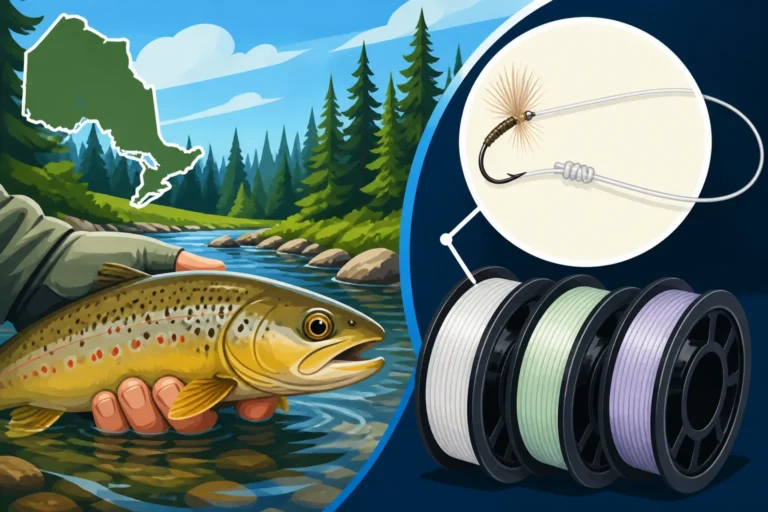
- Tippet: Tippet is the thinnest section of your leader, which you tie your fly to. It's typically sold on spools and is added to the end of your tapered leader. The tippet allows you to change flies without shortening your main leader and helps protect your leader from wear and tear. Tippet size is denoted by an "X" rating (e.g., 5X, 6X), with higher numbers indicating finer diameters. For small dry flies on clear creeks, 6X or 7X tippet might be necessary. For larger nymphs or streamers, 3X or 4X might be appropriate. Having a selection of tippet spools is essential for adapting to different fly sizes and conditions. Proper leader construction and tippet selection are crucial for achieving Dry Fly Fishing Ontario Rivers success.
Caring for Your Fly Rod
Investing in a good fly rod for your Ontario adventures is a big step, and like any valuable tool, it deserves proper care and maintenance. A little bit of attention after each outing can dramatically extend the life of your rod, keeping it performing at its best for years to come. Neglecting your rod, however, can lead to premature wear, damaged components, or even breakage – and nobody wants a broken rod when you're miles into the wilderness.
Cleaning and Storage Best Practices
After a day of fishing, especially if you've been on larger rivers or near the Great Lakes where there might be grit or salty residue (even freshwater has minerals that can build up), it's a good idea to give your rod a quick wipe-down. Use a soft, damp cloth to gently clean the blank, paying special attention to the ferrules (the joints where the rod sections connect). Grit in the ferrules can cause them to wear down, leading to loose connections or even breakage.
Once clean, make sure your rod is completely dry before storing it. Moisture trapped in a rod sock or tube can lead to mildew, which not only smells unpleasant but can also degrade materials over time. Always store your rod in its cloth rod sock and then in its protective hard tube. This prevents scratches, dings, and accidental breakage. Store your rod horizontally or vertically in a place where it won't be exposed to extreme temperatures or direct sunlight, which can weaken the blank over time. Avoid leaving your rod assembled for long periods, as this can put stress on the ferrules.
Handling and Transportation Tips
The most common way fly rods get damaged isn't from fighting a big fish, but from improper handling and transportation. When assembling your rod, make sure the ferrules are firmly seated by gently pushing and twisting them together. Never force them or overtighten, as this can cause them to bind. When taking your rod apart, use a gentle twisting motion while pulling, avoiding any harsh jerking. If ferrules get stuck, a little bit of paraffin wax can sometimes help, but never twist too hard.
During transport, especially in a vehicle, always secure your rod in its tube. Placing a loose rod on a car seat or in the bed of a truck is an open invitation for it to be stepped on, slammed in a door, or bent against another object. If you're using a roof-mounted rod carrier, ensure the tips are protected and the rod is snugly held. When walking through brush or dense woods, collapse your rod into two sections (if it's a four-piece rod, for example) and carry it vertically, tip-down, to avoid snagging the delicate tip section on branches. A broken tip is a frustrating end to any fishing trip, and usually, it's preventable with a bit of care.
Disclaimer
This article is for general informational purposes only and does not constitute professional advice. Laws, prices and regulations vary by location and change over time. Consult a qualified professional for guidance on your specific situation.