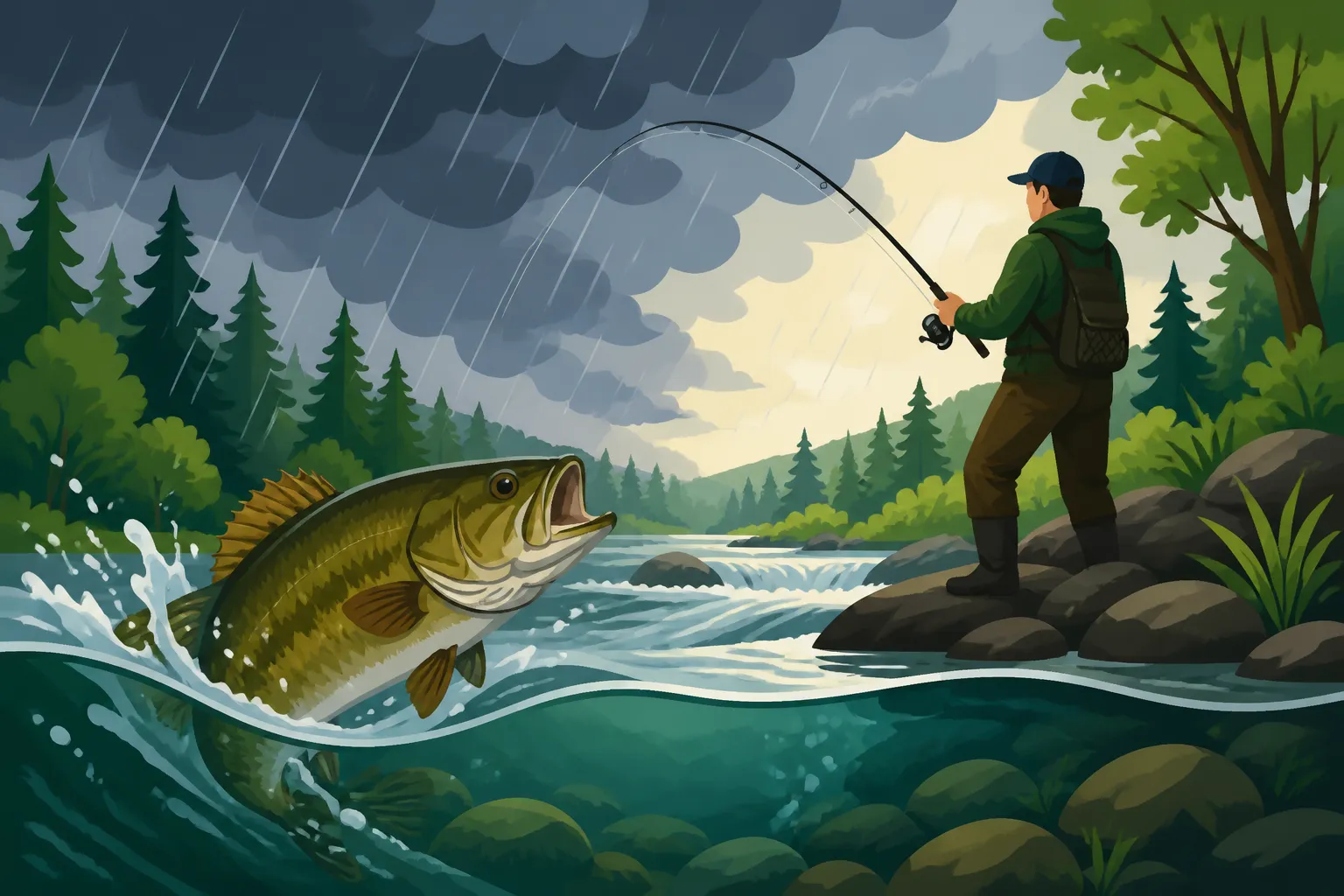
Fishing after a heavy rain on Ontario rivers
There’s nothing quite like the sudden downpour of an Ontario summer storm, or the days of relentless rain that swell our beautiful rivers in spring. While it’s easy to feel a pang of disappointment, thinking your fishing plans are washed out, the truth is that heavy rain often creates unique, fantastic fishing opportunities. This guide will walk you through exactly how to adapt your approach, find the fish, and stay safe when fishing Ontario rivers after a significant rainfall.
Understanding the River's Transformation After Heavy Rain
A river is a dynamic ecosystem, constantly changing, and never more so than after a good soaking rain. It's a completely different environment than what you might be used to, and understanding these changes is the first step to successful post-rain angling.
Water Levels and Current Speed Changes
When the heavens open up over Ontario, all that precipitation has to go somewhere. Rivers become the natural conduit, and this means a noticeable increase in water levels. Creeks, streams, and drainage ditches that were barely a trickle before the rain can become raging torrents, all feeding into the main river system. With this increased volume comes a significant surge in current speed. What was once a gentle flow can turn into a powerful, almost unmanageable force.
This rapid change presents a few immediate challenges for us anglers. First, simply getting to your favourite bank fishing spot might be tricky, as access points could be submerged or banks made unstable. Second, if you're fishing from a boat or kayak, maintaining position against the stronger current becomes a constant battle, making it harder to present your lure or bait effectively. Third, your regular casting techniques might not work. A light jig that usually drifts perfectly will now be swept away in seconds. Think about the Grand River near Elora or the Credit River after a significant rain; those familiar riffles and runs transform into deep, fast-moving stretches, often pushing fish into different holding patterns. It's a whole new ballgame, and you need to be ready to adapt.
Water Clarity and Temperature Fluctuations
Beyond just water volume, heavy rain brings a host of other changes, particularly to water clarity and temperature. As rain washes over the land, it picks up everything in its path: soil, sediment, organic matter, and even pollutants. This runoff turns clear river water into a murky, stained, or even chocolate-milk-like concoction. This "turbidity," or cloudiness, drastically reduces visibility underwater, making it harder for fish to see your lures and for you to spot fish or structure.
However, it’s not all bad news. This muddy water often concentrates baitfish and other food sources, pushing them closer to cover or into specific current breaks where predators can ambush them. You'll often notice a distinct "mud line" where the clearer river water meets the incoming stained tributary water – this can be a goldmine!
Temperature also plays a critical role. If it’s a warm summer rain, the incoming water might actually be cooler than the main river, bringing a welcome drop in temperature that can invigorate fish. Conversely, a cold spring rain could drastically chill already cool river temperatures, making fish sluggish. For instance, if you're targeting smallmouth bass in the summer, a cooler rain might actually get them more active, but a sudden cold shock in spring could shut them down. Understanding these subtle shifts is key to knowing where and how to present your offerings.
Debris and Obstructions
One of the most immediate and often frustrating consequences of heavy rain in a river system is the influx of debris. All that rushing water dislodges countless natural materials from the banks and upstream areas. You’ll see everything from small twigs and leaves to entire trees, logs, and even larger structures floating downstream. This can be a navigational nightmare for boaters, clogging props and potentially causing damage. For shore anglers, it means constantly snagging on unseen submerged branches or having your line fouled by floating debris.
However, this debris isn't just a nuisance; it creates new, temporary habitat and ambush points for fish. A newly fallen tree or a tangle of branches washed downstream can create instant cover and current breaks that fish will utilize. What looks like a mess to us might be a perfect hideout for a lurking walleye or northern pike. While it complicates fishing, knowing how to interpret these new obstructions can lead you to where the fish are hiding and feeding. Just remember to proceed with caution and be mindful of the added snags.
Locating Fish in Post-Rain Conditions
Now that you understand how the river changes, the next crucial step is figuring out where the fish go. They don't just disappear; they simply relocate to more comfortable and advantageous positions.
Seeking Out Slack Water and Eddies
When the current really starts ripping after a heavy rain, fish instinctively seek out areas where they can expend less energy. Think about it: they're not going to fight a raging torrent all day if they can help it. This is where slack water and eddies become absolute magnets. Slack water refers to areas with significantly reduced current, often found just out of the main flow, behind large rocks, fallen trees, or islands. Eddies are swirling pockets of water where the current actually reverses or slows significantly, often found on the downstream side of a prominent obstruction or in inside bends of the river.
These spots offer fish a reprieve from the exhausting current, allowing them to conserve energy. More importantly, they often become collection points for food that is being swept downstream. Baitfish, insects, and other organisms that can't hold their position in the main current will get funneled into these calmer zones, creating a veritable buffet for predatory species. Targeting these areas with precision is paramount. Cast upstream of the slack water and let your bait or lure drift naturally into the calmer zone, or work the edges where the fast water meets the slow. For example, on a river like the Ottawa River, you might find prime walleye in the large eddies created by prominent points or bridge abutments. This strategy is key to success when fishing after a heavy rain on Ontario rivers.
Focusing on Inflow and Tributary Mouths
Another fantastic place to focus your efforts after a heavy rain is near the mouths of incoming tributaries, creeks, or even large drainage culverts. As discussed earlier, these inflows bring in new water that is often warmer or colder, and almost always murkier, than the main river. This creates a visible "mud line" where the two water types meet.
This mud line isn't just a visual cue; it's a critical ecological boundary. The incoming, often nutrient-rich water from tributaries can dislodge vast amounts of insects, worms, and other terrestrial food sources, flushing them into the main river. Baitfish, attracted by these new food offerings and the slight temperature differences, will congregate in these areas. And where the baitfish go, the predators follow. Walleye, smallmouth bass, and northern pike will often position themselves just inside or along the edge of these inflows, using the low visibility of the muddy water as cover to ambush unsuspecting prey. You can often see this phenomenon on smaller rivers feeding into larger systems, like the Ganaraska River after a heavy rain discharging into Lake Ontario. Using a technique like Drift Fishing for Walleye in Ontario Rivers can be particularly effective here, allowing your bait to follow the natural flow of food.
Targeting Submerged Structure and Overhangs
When river levels rise significantly, a lot of what was dry land or shallow bank suddenly becomes inundated. This creates new submerged structure that fish will eagerly utilize. Areas with flooded terrestrial vegetation, submerged logs, rock piles that were previously exposed, or deep undercut banks become prime real estate.
Fish use these areas for several reasons. Firstly, they provide excellent cover and ambush points. The rising water offers them new territory to explore for food, often bringing them closer to the banks than usual. Secondly, the submerged vegetation provides a haven for insects and baitfish, which in turn attracts larger predators. Thirdly, undercut banks and deep holes offer a perfect hiding spot from the strong currents and provide protection from overhead predators. Imagine a stretch of the French River where normal water levels keep certain areas exposed. After a heavy rain, these areas might be a few feet under, creating entirely new fishing grounds. Pay close attention to any visible structure – even just the tips of branches sticking out of the water could indicate a fantastic fishing spot below. For anglers exploring new areas, an interactive map like the Ontario Fish ON-Line Interactive Zone Map, Explained can help identify potential structures that become productive in high water.
Adapting Your Tactics and Gear for Success
Finding the fish is half the battle; the other half is convincing them to bite. Post-rain conditions demand specific adjustments to your lure selection, bait presentation, and even your fishing tackle.
Lure Selection for Low Visibility
In murky, stained water, a fish's primary senses shift. Their vision is severely hampered, so they rely much more heavily on their lateral line (which detects vibration) and their sense of smell. This means your lure choices need to reflect these changes.
Forget subtle, natural colours that blend in; instead, opt for lures that scream "EAT ME!" through vibration and contrast. Spinnerbaits, with their thumping blades, are phenomenal for creating a strong vibration profile. Chatterbaits offer a unique, erratic vibration that fish can home in on. Dark-coloured jigs, especially black, blue, or purple, can create a sharp silhouette against the murky background, making them easier for fish to see. Lipless crankbaits, like a classic Rapala Rippin' Rap or a lipless crank from Strike King, throw off immense vibration as they’re retrieved, covering water quickly and attracting attention. Bright, fluorescent colours such as chartreuse, orange, and hot pink can also be surprisingly effective, offering high visibility even in the darkest water. You can find a fantastic selection of these vibration-heavy and brightly coloured lures on platforms like Amazon, often with quick shipping to get you on the water faster after a storm.
Don't be afraid to experiment. Sometimes, a combination of factors works best. For instance, a black jig tipped with a chartreuse grub can offer both profile and a flash of high-vis color. The key is to generate an undeniable presence that a fish can’t ignore, even if they can barely see it.
Bait Choices and Presentation
When visibility is low, scent becomes king. This is where natural baits really shine after a heavy rain. Live worms, like classic nightcrawlers, are incredibly effective because they emit a strong, natural scent trail that fish can follow even without clear vision. Minnows, whether live or salted, also provide a natural scent and flash. Leeches are another excellent option, durable and appealing to a wide range of species.
When presenting these baits, consider the current. You often need to get your bait down to the fish quickly and keep it in the strike zone. Bottom bouncing rigs with a heavy weight and a snelled hook can be great for presenting worms or minnows close to the riverbed where fish are often hunkered down. If you're targeting eddies or calmer water, a simple float fishing setup can keep your bait suspended at the right depth, allowing it to drift naturally into feeding lanes. For species like walleye, a crawler harness retrieved slowly can be irresistible, leveraging both scent and subtle vibration. Remember that fish might be less willing to chase in strong currents, so a slower, more deliberate presentation that keeps the bait in their face for longer can often trigger a bite.
Adjusting Rod, Reel, and Line for Stronger Currents
Your standard fair-weather setup might not cut it when the river is roaring. Stronger currents require heavier gear to effectively present your baits and lures. You'll likely need a rod with more power and a faster action to handle heavier weights and fight fish in strong flow. A medium-heavy to heavy power spinning or baitcasting rod, typically 6'6" to 7'6" in length, is often a good choice.
For reels, a higher gear ratio on a baitcaster can help you pick up slack quickly or retrieve lures against the current more efficiently. On spinning reels, a smooth drag system is essential for handling powerful runs from fish in fast water.
Line choice is also critical. Monofilament line has more stretch, which can be a disadvantage in strong current as it reduces sensitivity and makes it harder to feel subtle bites. Braided line, with its near-zero stretch, offers superior sensitivity and strength, allowing you to feel every bump and tick, even with a lot of line out in the current. It also cuts through the water better, reducing drag from the current. Pair your braid with a fluorocarbon leader for abrasion resistance and to maintain some stealth in clearer pockets of water. For example, if you're targeting big northern pike in the main channel, a heavy braided line (30-50 lb test) with a robust fluorocarbon or wire leader is almost a necessity. This robust approach is particularly important when considering techniques like Float Fishing the French River where heavy current can make or break your presentation.
| Lure/Bait Type | Best for Water Clarity | Key Advantage | Target Species | Example Brand (for reference) |
|---|---|---|---|---|
| Spinnerbaits | Murky, Stained | High Vibration, Flash | Bass, Pike, Walleye | Booyah, Strike King |
| Chatterbaits | Murky, Stained | Unique Vibration | Bass, Pike, Walleye | Z-Man, Jack Hammer |
| Dark Jigs | Murky, Stained | Strong Silhouette | Walleye, Bass, Catfish | Northland, Rapala |
| Bright Crankbaits | Murky, Stained | Vibration, High Vis | Walleye, Bass, Pike | Rapala, Berkley |
| Live Worms | All (especially murky) | Scent Trail, Natural | All species | N/A |
| Live Minnows | All (especially murky) | Scent, Flash, Natural | Walleye, Pike, Bass | N/A |
| Lipless Crankbaits | Murky, Stained | High Vibration, Sound | Walleye, Bass, Pike | Rapala, Bill Lewis Rat-L-Trap |
Safety Considerations and Ethical Angling Post-Rain
Fishing after a heavy rain offers exciting opportunities, but it also introduces heightened risks and responsibilities. Your safety and the well-being of the river ecosystem should always be your top priority.
Water Safety and Bank Stability
A river swollen by heavy rain is not the same familiar waterway. The increased current speed can be deceptively powerful, capable of sweeping you off your feet even in seemingly shallow areas. Submerged hazards that were visible before, like rocks, logs, or drop-offs, might now be completely hidden, posing a serious tripping or snagging risk.
River banks, especially those made of softer soil, can become extremely unstable and slippery when saturated. Undercut banks, which often provide excellent fish habitat, are particularly prone to collapse. Always approach the water's edge with extreme caution, and avoid walking too close to the bank's edge, especially after prolonged rainfall.
Wearing a life jacket is non-negotiable, whether you're in a boat, kayak, or wading. Even strong swimmers can be overwhelmed by strong currents and submerged debris. A sturdy wading staff is an invaluable tool for shore anglers and waders, providing an extra point of contact and helping you test the stability of the riverbed before taking a step. Non-slip footwear with good ankle support is also crucial. Before heading out, always check local weather forecasts and river conditions or flow rates, if available. For those using any watercraft, be sure to review all Ontario Boating Laws for Anglers and understand the specific Life Jacket Requirements for Ontario Boaters to ensure a safe trip.
Minimizing Environmental Impact
The post-rain environment in a river is particularly vulnerable. The influx of debris can already stress the ecosystem, and as anglers, we need to ensure we don't add to the burden. Proper waste disposal is paramount. With more debris naturally accumulating, it's easy for fishing line, bait containers, or food wrappers to get caught up and carried downstream. Pack out everything you pack in, and if you see litter, consider going the extra mile to pick it up.
Be mindful of the banks and riparian vegetation. Saturated soil is more easily eroded, and trampling fragile plant life can have a lasting negative impact. Stick to established paths where possible, and avoid creating new trails, especially in areas that are visibly soft or eroding.
Finally, practice careful catch and release, particularly with fish that might already be stressed. Rapid changes in water temperature, oxygen levels (which can sometimes drop in very murky water), and the exertion of fighting strong currents can all add to a fish's stress. Handle fish gently, minimize their time out of water, and ensure they are revived before release. Using a rubberized landing net, available on Amazon, can greatly reduce harm to a fish's protective slime coat and fins. Adhering to the Ontario Fishing Regulations Explained is always important, but especially so in these dynamic conditions where fish populations might be more concentrated or vulnerable.
Disclaimer
The information provided in this article is for general guidance and informational purposes only. Fishing conditions in Ontario rivers can change rapidly and vary significantly depending on specific locations, recent weather, and local regulations. Always prioritize your safety, adhere to all local fishing regulations, and be aware of current weather and water conditions before heading out.