Best wading staff for slippery riverbed rocks
There's nothing quite like the heart-stopping moment when your foot slips on a mossy, algae-covered rock in a fast-flowing Ontario river. Suddenly, you're not thinking about the fish; you're thinking about staying upright and dry, and frantically trying to avoid a cold, unplanned swim. This guide is all about preventing those nerve-wracking tumbles by helping you choose the absolute best wading staff for navigating Ontario's notoriously slippery riverbed rocks, keeping you safe, steady, and focused on the joy of fishing.
Why a Wading Staff is Non-Negotiable on Ontario's Rivers
Let's be real, wading in Ontario's rivers and streams is a glorious experience, but it comes with its own unique set of challenges. Whether you're carefully stepping through the Credit River's limestone beds or navigating the granite-strewn currents of a Northern Ontario brook trout stream, those rocks underfoot can be incredibly slick. It's not just about avoiding a dunking; it's about confidence, safety, and ultimately, a more enjoyable fishing experience.
The Hidden Dangers of Ontario Riverbeds
Many of us have been there – one minute you're gracefully casting, the next your foot finds that perfectly positioned, algae-covered rock that sends you sprawling. It’s not just embarrassing; it can be downright dangerous. The bottom of many Ontario rivers, especially those with limestone or granite, can be incredibly uneven, littered with loose stones, deep pockets, and slick surfaces. The current, even when it looks calm, can be deceptively strong, especially after a good rain or during spring runoff. A momentary loss of balance can lead to scraped knees, bruised egos, a soaked cell phone, or even more serious injuries like sprains or head bumps. That perfect fishing spot isn't worth a trip to the emergency room.
Beyond the physical danger, there's the mental toll. Constantly worrying about your footing detracts from the whole experience. You're less likely to explore promising runs, less focused on your drift, and more preoccupied with where your next step will land. A good wading staff provides that crucial third point of contact, giving you an immediate sense of stability and allowing you to probe the depths and test the firmness of the bottom before committing your weight. It’s like having an extra leg that’s always there to catch you.
Boosting Your Confidence and Extending Your Reach
Imagine approaching a beautiful riffle that looks a little too swift, or a deep pool where you can't quite see the bottom. Without a wading staff, you might hesitate, second-guess yourself, and potentially miss out on prime fishing water. A wading staff gives you the courage to tackle these spots. You can use it to brace against the current, feel for hidden drop-offs, or simply maintain your balance while casting in tricky spots. This newfound confidence means you can wade more aggressively (but still safely!), accessing those untouched pockets where the bigger fish often hide.
Furthermore, a wading staff extends your reach in a practical sense. It can help you retrieve a snagged fly from a submerged branch that's just out of arm's reach, or pull yourself closer to an undercut bank without risking a stumble. For those moments when you're moving through dense streamside brush to get to the water, it acts as a handy tool to push back branches and clear a path, keeping your hands free for your rod. It’s a versatile piece of equipment that pays dividends far beyond just preventing falls.
What to Look for in a Great Wading Staff
Choosing the right wading staff isn't rocket science, but there are definitely a few key features that can make a world of difference when you're out on the water. You want something reliable, easy to use, and durable enough to stand up to the rigours of Ontario's varied aquatic environments.
Material and Construction: Durability Matters
The best wading staffs are built to last. You'll typically find them made from aluminum, carbon fiber, or a combination of both.
- Aluminum staffs are generally more budget-friendly and quite robust. They can take a beating and often come out unscathed. However, they tend to be a bit heavier than their carbon fiber counterparts, which can be a factor if you're hiking long distances.
- Carbon fiber staffs are the lightweight champions. If every ounce counts for you, especially on those longer treks into remote areas, carbon fiber is fantastic. They're stiff and strong, but can sometimes be more susceptible to impact damage if struck against sharp rocks. Some high-end staffs blend these materials, offering a good balance of strength and lightness.
Beyond the main shaft, consider the quality of the joints if it's a folding or telescoping model. Look for secure locking mechanisms that won't unexpectedly collapse on you in the middle of a swift current. You also want a staff that can handle cold temperatures without becoming brittle, a crucial consideration for those shoulder-season fishing trips in Ontario.
Ergonomic Grip and Secure Lanyard
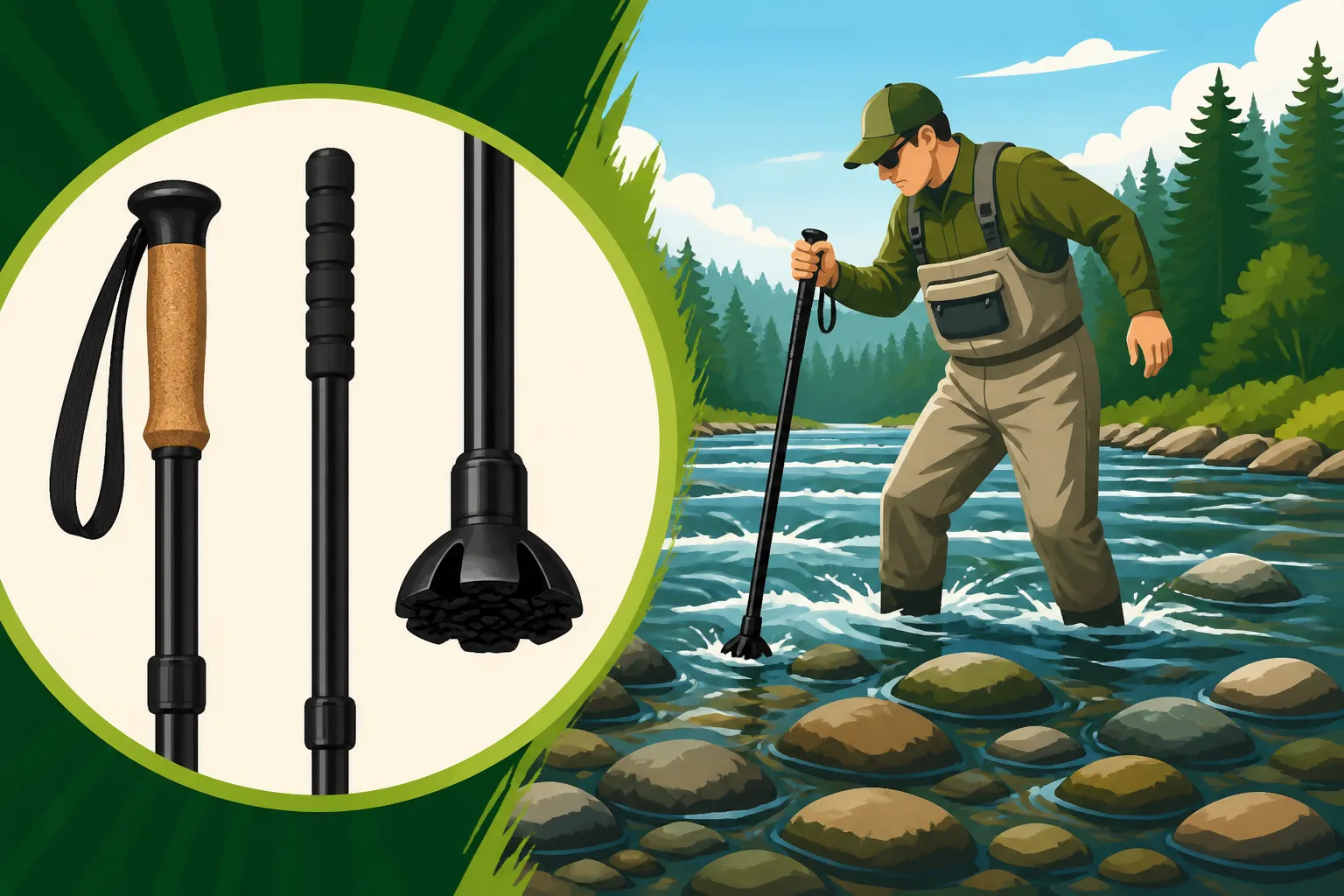
The grip is where your hand meets the staff, so it needs to be comfortable and secure, even when wet. Cork, foam, and rubber are common materials. Cork often provides a warm, natural feel, while foam and rubber offer excellent grip when slick with water or fish slime. Some grips are ergonomically shaped to fit the hand better, reducing fatigue during long days of wading.
Equally important is a reliable lanyard or retention system. This is what keeps your staff attached to you when you need both hands free for casting, landing a fish, or managing your gear. A strong, adjustable coiled lanyard that attaches to your wading belt or D-ring is ideal. You want it long enough to allow the staff to reach the riverbed without pulling uncomfortably, but short enough to keep the staff from floating away downriver if you let go. Some lanyards even have quick-release clips, which can be useful but ensure it's a secure one. Brands available at stores like Bass Pro Shops or online retailers like Amazon often feature various lanyard styles, so you can find one that suits your preference.
Reliable Deployment and Storage
For many anglers, especially those who hike to their fishing spots, a staff that can be easily deployed and collapsed is key.
- Folding staffs often use internal shock cords to snap together quickly, much like tent poles. They can be very compact for storage in a backpack or wading vest. The downside can be that the shock cord might wear out over time, or fine grit could get into the joints.
- Telescoping staffs adjust in length with twist or lever locks. These offer more adjustability in length but can sometimes be longer when collapsed. Ensure the locking mechanisms are robust and don't slip.
- Fixed-length staffs are the simplest and arguably the most durable, as there are no moving parts to fail. However, they are also the least portable, which means they are best suited for situations where you're already at the water's edge or using a boat.
Think about how you'll carry your staff when not in use. Many come with a small sheath or holster that clips to your wading belt or backpack, keeping it out of the way until needed. The easier it is to get out and put away, the more likely you are to actually use it.
Tip Material and Accessories
The business end of your wading staff – the tip – is critical for traction. The most common and effective material for wading staff tips on slippery rocks is carbide or hardened steel. These offer superior grip on algae-covered stones, wet gravel, and even submerged wood. Some staffs also come with a rubber boot or cover for the tip, which can be useful when walking on harder surfaces like pavement or boat docks, or when you want to protect your boat's floor.
Beyond the tip, some staffs offer additional features. A built-in measuring tape might be handy, or perhaps a reflective strip for low-light conditions. While these aren't deal-breakers, they can add to the overall utility of the staff.
| Feature | Aluminum Staffs | Carbon Fiber Staffs | Fixed Staffs |
|---|---|---|---|
| Durability | Very high, withstands impact well | High, but can be more brittle on direct impact | Extremely high, no moving parts |
| Weight | Moderate to heavy | Very light | Variable, depending on material |
| Portability | Folding/telescoping models are good | Excellent for folding/telescoping | Poor, always full length |
| Cost | Generally more affordable | Higher price point | Can be affordable, or custom-made and expensive |
| Grip on Rocks | Excellent with carbide tip | Excellent with carbide tip | Excellent with carbide tip |
| Ideal Use Case | General purpose, robust use, less concern for weight | Long hikes, minimalist setups, highly maneuverable | Bank access, boat use, dedicated wading areas |
Types of Wading Staffs and Their Ideal Uses
Not all wading staffs are created equal, and what works best for one angler might not be ideal for another. Understanding the different types can help you pinpoint the perfect companion for your Ontario adventures.
Folding Wading Staffs: The Compact Explorer
Folding wading staffs are probably the most popular choice for anglers who spend time hiking to their fishing spots. They typically consist of several short sections connected by an internal elastic cord, much like a tent pole. When you're ready to use it, you simply snap the sections together, and the cord pulls them taut, forming a rigid staff. When you're done, they collapse into a very compact package that can be tucked into a small pouch, clipped to your wading belt, or stashed inside a backpack.
This portability is a huge advantage. If you're tackling a longer portage route into a remote lake in Algonquin Park, or bushwhacking through dense forest to reach a hidden pool on a tributary, a folding staff won't get in your way. It's there when you need it for wading across a swift section or navigating slippery rocks, and then disappears when you're on dry land. The key is to ensure the shock cord is durable and the ferrules (the joints) fit snugly to prevent any wobbling. Many excellent models can be found from reputable brands at stores like Bass Pro Shops.
Telescoping Wading Staffs: Adjustable Versatility
Telescoping wading staffs offer a balance between portability and adjustability. Instead of folding, these staffs feature sections that slide into one another, locking into place with either twist-locks or lever-locks. The main benefit here is the ability to easily adjust the staff's length to suit different wading depths or personal preferences. If you're in a shallow riffle, you might shorten it; in a deeper crossing, you can extend it for maximum reach and stability.
While generally not as compact as folding staffs, telescoping models are still very manageable for transport. Their adjustable nature can be particularly useful if you're fishing a variety of water conditions, from broad, shallow rivers to narrow, deeper channels. The locking mechanisms are the crucial component here; you want them to be robust and reliable, holding the chosen length firmly without slipping, especially under pressure from current. Just be sure to rinse them thoroughly after use to prevent grit from seizing the locking mechanisms.
Fixed-Length Wading Staffs: Simple and Sturdy
Fixed-length wading staffs are the most straightforward option. They are a single, solid piece, meaning there are no folding joints or telescoping sections to worry about. This inherent simplicity makes them incredibly durable and reliable. There's virtually nothing to break or fail, which can be a huge comfort when you're leaning heavily on it in strong currents.
However, their main drawback is their lack of portability. They can be cumbersome to carry when not in use, often requiring external straps on a backpack or a designated spot in a boat. This makes them less ideal for long hikes or situations where you're frequently transitioning between wading and walking on land. Fixed staffs are best suited for anglers who primarily fish from a boat and use the staff for short wading excursions, or those who access their fishing spots directly from a vehicle and only need it while in the water. For someone fishing the expansive flats of Lake Erie or short, easy-access stretches of the Grand River, a sturdy fixed staff could be a fantastic, no-nonsense choice.
Choosing and Using Your Wading Staff Effectively
Selecting the right wading staff is just the first step; knowing how to use it properly is what truly makes a difference in your safety and confidence on the water. A good technique will make your staff an extension of your body, rather than just another piece of gear to juggle.
How to Choose the Right Length
The ideal length of your wading staff is usually determined by your height and the typical depth of the water you fish. A good rule of thumb is that the staff should reach at least to your sternum (breastbone) when standing upright. This allows for comfortable gripping while providing enough length to probe deeper water and maintain leverage. Some anglers prefer a staff that reaches their chin or even nose, especially if they frequently wade in deeper or faster currents.
If you opt for a telescoping or folding staff, ensure that its extended length meets this criterion. Remember, you'll rarely hold the staff perfectly upright; it will be angled slightly downstream to brace against the current, so a little extra length is better than not enough. Consider trying out different lengths if possible, perhaps borrowing a friend's or testing models at an outdoor store before making a purchase. The goal is a staff that feels like a natural support, not an awkward impediment.
Mastering Wading Techniques with a Staff
Using a wading staff isn't just about poking it in the water. There are specific techniques that maximize its effectiveness and your safety.
- Three-Point Contact: This is the golden rule of safe wading. Always maintain three points of contact with the riverbed at all times – either two feet and the staff, or two staff points and one foot. Before moving a foot, plant your staff firmly. Before moving the staff, plant both feet securely. This continuous triangulation provides maximum stability.
- Probe Before You Step: Use your staff to feel out the bottom ahead of you. Probe for unseen holes, slippery rocks, or loose gravel. A solid, audible "thunk" indicates good footing; a soft feel or a scraping noise means caution is needed.
- Brace Against the Current: When crossing a current, position the staff slightly upstream and downstream of your body. This creates a stable "tripod" against the force of the water. Angle the staff so the current pushes against it, helping to brace you.
- Shuffle, Don't Stride: When moving, take small, shuffling steps, keeping your feet close to the bottom. Avoid lifting your feet high, as this reduces stability and exposes your wading boot to the full force of the current.
- Side-Stepping: For particularly strong currents or difficult terrain, side-stepping while maintaining your three points of contact can be safer than attempting to walk forward.
- Lanyard Use: Always keep your staff attached to you with its lanyard. This prevents it from floating away if you lose your grip or need both hands free suddenly, such as when you hook a fish. For more detailed guidance on safe wading, check out articles like How to wade an Ontario trout stream safely or Wading Techniques for Ontario Trout Streams.
Maintaining Your Wading Staff for Longevity
Like any piece of essential gear, your wading staff will last longer and perform better with a little care. Ontario's waters, especially those with silt, sand, or minerals, can be tough on equipment, so a simple maintenance routine is important.
Cleaning and Drying Your Staff
After every outing, especially if you've been in silty or sandy rivers, take a few minutes to clean your wading staff.
- Rinse thoroughly: Use fresh water to rinse off any mud, sand, or algae from the entire staff. Pay special attention to the joints of folding or telescoping models. Fine grit can get into these mechanisms and cause them to seize up or wear out prematurely.
- Inspect joints: For folding staffs, gently flex the joints to ensure no debris is trapped. For telescoping staffs, extend all sections and wipe them clean, then retract them.
- Dry completely: Hang your staff in a well-ventilated area to air dry. If it's a folding staff, leave it partially assembled or extended to allow air circulation through the sections. This prevents mildew and corrosion, especially if your staff has metal components. Don't store it wet in its sheath or a confined space.
A quick rinse and dry can prevent minor issues from becoming major problems, ensuring your staff is ready for your next adventure.
Inspecting and Replacing the Tip
The carbide or steel tip of your wading staff is designed for maximum grip, but it will eventually wear down, especially with frequent use on abrasive riverbeds. Regularly inspect the tip for signs of excessive wear. If it looks dull, chipped, or rounded, it's time for a replacement.
Many wading staffs have replaceable tips, which is a significant advantage. Check the manufacturer's instructions for how to remove and install a new one. This usually involves twisting or unscrewing the old tip and screwing on a new one. Having a sharp, aggressive tip ensures you maintain optimal traction, which is paramount on Ontario's notoriously slippery terrain. You can often find replacement tips from the manufacturer or through outdoor retailers like Bass Pro Shops or on Amazon.
Storage and Transport Tips
Proper storage helps maintain your staff's condition.
- Storage position: When not in use, store your staff in a cool, dry place, ideally hanging vertically or lying flat. Avoid leaning it against a wall where it could warp or fall.
- Sheath/Holster: Use the provided sheath or holster for transport. This protects the staff from damage and prevents it from damaging other gear or yourself. Ensure the sheath is clean and dry before inserting the staff.
- Avoid extreme temperatures: Don't leave your staff in direct sunlight in a hot car for extended periods, or in freezing conditions where moisture might freeze in the joints. While well-made staffs are durable, extreme temperatures can shorten their lifespan.
By following these simple maintenance steps, your wading staff will remain a trusted, indispensable tool on all your Ontario fishing excursions. Pair it with good wading boots like those discussed in Best Wading Boots for Rocky Streams and quality waders (see Best Waders for Ontario Trout Streams), and you'll be as surefooted as a mountain goat on any riverbed.
Disclaimer
This article is for general informational purposes only and does not constitute professional advice. Laws, prices and regulations vary by location and change over time. Consult a qualified professional for guidance on your specific situation.