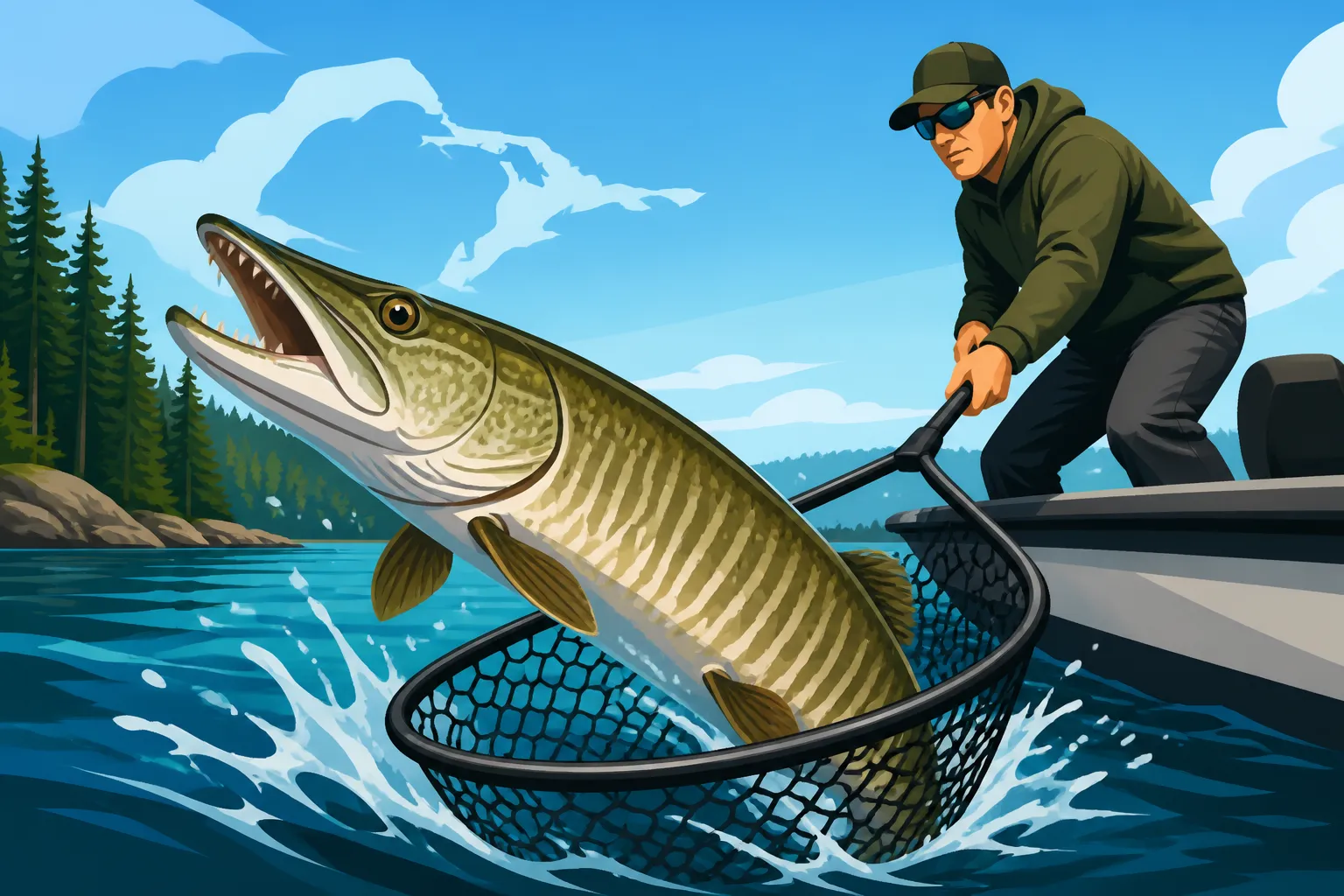
Best net for landing a big muskie from a boat
There's nothing quite like the heart-stopping moment when a massive muskie boils up behind your lure, follows it all the way to the boat, and then commits to the strike right at your feet. It's exhilarating, it's terrifying, and it's what keeps us coming back for more. But that incredible high can turn into a gut-wrenching low in a split second if you’re not prepared for the final act – landing that beast. Many anglers, myself included, have felt the sting of losing a trophy muskie boat-side because their net wasn't up to the task. This guide is all about helping you avoid that agony by choosing the absolute best net for landing a big muskie from your boat, ensuring those memorable encounters end with a successful, healthy release.
Why a Specialized Muskie Net Isn't Just "Nice to Have" – It's Essential
Let's be real, muskie fishing isn't for the faint of heart or the casually equipped. We spend hours, sometimes days, casting monstrous lures, battling the elements, and pushing our limits. To then have that monumental effort undone by an inadequate piece of gear at the most critical moment? It’s soul-crushing. A specialized muskie net isn't just a convenience; it's a non-negotiable part of your arsenal when you're targeting these apex predators in Ontario's waters.
The Heartbreak of a Lost Trophy
Think about it: you've made countless casts, twitched every jerkbait just so, and finally, after what feels like an eternity, that colossal shadow emerges from the depths. Your heart hammers against your ribs as the muskie engulfs your bait, and the fight is on. You skillfully play the fish, avoiding snags and keeping tension, bringing it boat-side after a grueling battle. Then, as you reach for your trusty bass net, you realize it's far too small. The muskie, sensing its freedom, surges, wraps itself around the puny hoop, and with a violent thrash, spits the hook, leaving you with nothing but a lingering image and the crushing weight of a lost opportunity.
This scenario plays out more often than anglers care to admit. Muskies are not just big; they are incredibly powerful, notoriously acrobatic, and possess an almost supernatural ability to throw a hook at the last second. Their sheer size, combined with the weight of the lure and the boat-side energy surge, means a standard net simply isn't robust enough to contain them safely and securely. The pain of losing a fish this way is profound, especially when you consider the time and dedication involved in chasing Muskellunge Fishing in Ontario.
Protecting Both Angler and Fish
Beyond the personal anguish of a lost fish, there are crucial safety implications for both you and the muskie. Landing a muskie is a chaotic event, even with the right gear. These fish are essentially living torpedoes with mouths full of razor-sharp teeth and hooks from your lure dangling precariously. Trying to wrestle a thrashing, uncontained muskie into an undersized net can lead to serious injuries – a treble hook in your hand, a gill plate slicing your arm, or even a violent headshake sending a lure flying back at your face.
Furthermore, our responsibility as anglers extends to the fish itself, especially with a species like muskie that takes many years to reach trophy size. Improper netting can cause severe harm. Small, abrasive mesh can strip off their protective slime coat, leaving them vulnerable to infection. Struggling against a tangled, inadequate net can lead to fin damage, scale loss, or even internal injuries. A properly designed muskie net, with its specific materials and dimensions, minimizes this stress and damage, ensuring that if you choose to release your catch, it swims away strong and healthy, ready to fight another day. We want to maximize the chances of Muskie Catch and Release Survival Tips for these magnificent creatures.
Size, Strength, and Netting Material Matters
A muskie net is fundamentally different from nets designed for bass or walleye, and for good reason. You wouldn't bring a butter knife to a sword fight, and you shouldn't bring a panfish net to a muskie encounter. The frame, handle, and netting material must be exceptionally strong to handle the weight and power of these fish.
Firstly, the sheer size of a muskie demands a net with an incredibly large hoop. We're talking about fish that can easily exceed 40, 50, or even 60 inches in length, and sometimes tip the scales at truly impressive weights. A hoop that’s too small will either miss the fish entirely or allow it to get tangled and escape. Secondly, the construction needs to be bombproof. Imagine a 30-pound fish slamming against a weak aluminum frame – it will bend, break, or simply give way. You need thick-walled, heavy-duty aluminum or composite materials that can withstand immense pressure. Finally, the netting material is paramount. Traditional knotted nylon mesh is a death trap for muskies, tearing their fins, removing their slime, and getting hopelessly tangled with those massive treble hooks. Knotless, rubberized mesh is the gold standard for its fish-friendly properties and hook resistance.
Key Features to Look for in a Top-Tier Muskie Net
When you're ready to invest in a net that can handle the biggest fish Muskellunge Growth Rate to Trophy Size Ontario has to offer, there are specific features you absolutely need to prioritize. This isn't just about grabbing the biggest net you see; it's about intelligent design and robust construction that stands up to the rigors of muskie fishing.
Hoops and Handles Built for Battle
The size and strength of the net's hoop and handle are your first line of defense. For a serious muskie angler, the hoop needs to be expansive – think at least 30-36 inches wide, and preferably even larger. This generous opening provides a wide target and reduces the chance of the fish escaping as you attempt to scoop it. Look for hoops constructed from heavy-gauge aluminum or a high-strength composite. Flimsy, thin-walled frames will buckle under the weight and force of a big muskie.
The handle is equally critical. It needs to be long enough to reach the fish comfortably from your boat, but also robust enough to withstand the leverage and thrashing. Many top-tier muskie nets feature telescoping or extendable handles, allowing you to adjust the length for different situations or boat layouts. A handle that extends from, say, 4 to 8 feet can be incredibly versatile, enabling a single angler to reach or providing extra leverage for a two-person netting effort. Ergonomic grips are a bonus, offering better control when things get wet and slippery. You'll find excellent options that fit these criteria at major retailers like Bass Pro Shops or through online platforms like Amazon, offering a variety of handle lengths and hoop sizes.
Netting Material: Rubberized and Knotless is King
This is perhaps the single most important feature for both fish safety and angler convenience. If you're serious about catch and release, or simply want to avoid spending 20 minutes untangling hooks, you need a net with knotless, rubberized (or rubber-coated) mesh.
Here's why:
- Fish Protection: The smooth, soft surface of rubberized mesh is gentle on a muskie's delicate slime coat, which is their primary defense against disease and infection. Traditional knotted nylon, with its abrasive texture, can easily scrape off this protective layer, severely compromising the fish's health after release. It also helps prevent fin and scale damage.
- Hook Resistance: Those large treble hooks on muskie lures are notorious for snagging in traditional mesh, turning a quick release into a frustrating and potentially harmful ordeal. Rubberized mesh drastically reduces tangles, allowing hooks to be removed quickly and easily, minimizing the fish's time out of the water. This is especially vital when you're using heavy muskie baits like those recommended in Best Lures for Muskie Fishing in Ontario.
- Durability: Rubberized mesh is inherently more durable and resistant to tears and snags than conventional netting, meaning your investment will last longer, even after countless encounters with toothy critters.
- Ease of Cleaning: Blood, slime, and debris don't stick to rubberized mesh as easily, making cleanup much quicker and simpler after a successful catch.
Depth and Design: Keeping the Fish Secure
A shallow net, no matter how wide the hoop, is an invitation for disaster. A muskie's powerful tail can propel it out of a net with surprising ease if there isn't enough depth to contain it. Look for nets with a generous bag depth, often 36 inches or more. This depth allows the entire fish to be cradled securely within the net, preventing it from thrashing out over the sides.
The overall design should also consider how the net will be used. Some nets feature a flat bottom or a "cradle" design, which allows the fish to lie more naturally and reduces stress. The junction where the hoop meets the handle should be reinforced, as this is a high-stress point when lifting a heavy, struggling fish. Consider the balance and weight of the net when extended; you want something manageable that won't strain your back as you lean over the gunwale for the scoop.
Choosing the Right Size and Style for Your Boat and Fishing Style
Just like you wouldn't use the same rod for finesse walleye fishing as you would for heavy muskie trolling, the ideal net isn't a one-size-fits-all proposition. Your boat type, whether you fish solo or with a crew, and how you prefer to store your gear all play a role in selecting the perfect muskie net.
Boat Type and Space Considerations
The kind of boat you fish from significantly impacts your net choice. If you're running a smaller aluminum tiller boat, deck space is at a premium. A net with a long, fixed handle might be cumbersome to store and deploy quickly. In this case, a net with a collapsible or telescoping handle becomes invaluable, allowing you to compact it for storage under a seat or along a gunwale when not in use.
For larger boats, like a fiberglass bass boat or a deep-V multispecies rig, you might have more room. Even then, an extendable handle is often preferred for versatility, letting you reach fish further from the transom or bow. Consider how the net will fit into your rod lockers or how it can be secured to avoid becoming a projectile in rough water. Some anglers even rig quick-release mounting brackets for their nets, ensuring it's always accessible and out of the way until needed. Imagine trying to land a fish in the tight quarters of a smaller boat, like the kind often used on the Kawartha Lakes Fishing Guide, versus a spacious craft on Lake Nipissing Fishing Guide. The ergonomics and storage solutions will be vastly different.
Solo Angler vs. Team Effort
Your fishing style, specifically whether you fish alone or with a partner, should also guide your net selection.
- Solo Angler: If you're a lone wolf chasing muskies, you need a net designed for single-handed operation. This typically means a lighter net with a handle that's long enough to reach, but not so long or heavy that it becomes unmanageable. Many solo anglers opt for nets with a relatively quick-deploying telescoping handle, allowing them to extend it with one hand while keeping the rod in the other. Practice is key here; you need to be able to deploy, scoop, and secure the fish efficiently on your own.
- Team Effort: When fishing with a buddy, the dynamics change. One person typically handles the rod, leading the fish to the net, while the other is on netting duty. In this scenario, a longer handle is a huge advantage, as the netter can stand further forward in the boat, providing a better angle and more leverage. A heavier, more robust net is also perfectly acceptable, as two sets of hands can manage it. Communication between the angler and the netter becomes paramount – who will lead the fish, when to scoop, and how to safely bring it into the boat. This teamwork is critical for successfully landing these big fish, a skill often honed while targeting trophy fish in waters like Georgian Bay Muskie Fishing.
Deployment and Storage: Ready When You Need It
The best net in the world is useless if you can't deploy it quickly when that muskie surfaces. Speed is of the essence. Many nets feature a sliding yoke that locks the handle in place, and you want one that can be released and extended with minimal fuss. Think about the precious seconds when a muskie is making its final run at the boat – you don't have time to fumble with complicated latches or sticky mechanisms.
Storage, while secondary to deployment, is still important. After a long day on the water, you want a net that can be easily stowed without taking up half the boat. Telescoping handles are great for this, as they shrink down to a more manageable size. Some nets even have folding hoops, though these can sometimes compromise the overall rigidity if not designed well. Evaluate the available space in your boat – rod lockers, deck storage, or even bow compartments – and choose a net that fits neatly, yet remains easily accessible. For those moments when the muskie of a lifetime follows your figure-eight, being able to quickly grab and extend your net can make all the difference, as discussed in How to Figure Eight a Muskie Boatside.
Tips for Netting That Trophy Muskie Successfully
Having the right net is a massive step, but knowing how to use it effectively is just as important. Landing a muskie isn't like netting a panfish; it requires strategy, patience, and often, quick reflexes.
Teamwork Makes the Dream Work (If Applicable)
If you're fortunate enough to have a partner in the boat, establish clear roles before you even make your first cast. The angler's job is to lead the fish to the netter. This means keeping the rod tip low, applying steady pressure, and guiding the fish past the boat. The netter's job is to be ready, net deployed, and positioned correctly.
Netter's Role:
- Be Prepared: Net out, handle extended, positioned near the water, but not in the water (it spooks fish).
- Stay Calm: The angler is fighting the fish; your job is to stay cool and wait for the signal.
- Scoop, Don't Chase: Wait for the muskie to be guided towards the net, then make one decisive, smooth scoop, leading with the fish's head. Don't lunge or try to chase the fish; let the angler bring it to you.
- Lift and Control: Once the fish is in the net, lift it quickly but carefully into the boat. Secure the net, making sure the muskie is contained and can't flop out.
Timing is Everything
This is perhaps the biggest mistake new muskie anglers make when netting. You don't want to net a "hot" fish that still has a lot of fight left. A green fish in the net will thrash violently, potentially injuring itself, damaging your net, or causing hooks to fly.
The ideal time to net a muskie is when it's tired and has made its last few runs. The angler should work to "lead" the fish, meaning guiding it towards the net in a controlled manner, often turning its head towards the net opening. Wait for the fish to be on its side, or just about to give up that final surge. This moment of exhaustion is your window. Make that decisive scoop, ensuring the muskie slides headfirst into the net. This reduces the chance of it seeing the net and making another run, and ensures its fins are folded back, minimizing damage.
Ethical Handling After the Catch
Once that muskie is safely in the net, the work isn't over. Your actions in the next few moments are crucial for the fish's survival, especially if you plan on releasing it, which many of us do with trophy fish.
- Keep it in the water: If possible, try to keep the net with the fish mostly submerged while you get your tools ready. This minimizes its time out of its natural environment.
- Tools Ready: Have your hook cutters (long-nosed pliers or bolt cutters for stubborn trebles), release tools, and measuring board easily accessible. You don't want to be rummaging through your tackle box while the muskie is out of the water.
- Minimize Handling: Touch the fish as little as possible. If you need to handle it, do so gently, supporting its body. Avoid holding it vertically by the head or tail, as this can damage its internal organs.
- Quick Photo (Optional): If you must take a photo, do it quickly and ensure the fish is supported horizontally. Then get it back in the water for release. You might find some excellent specific tools for this at retailers like Bass Pro Shops or on Amazon. Remember that ethical angling is paramount when pursuing Muskellunge Fishing in Ontario.
Here's a quick comparison of some general muskie net features:
| Feature | Standard Muskie Net | Heavy-Duty/Trophy Muskie Net |
|---|---|---|
| Hoop Size (Width) | 24-30 inches | 30-36+ inches |
| Handle Length | 4-6 feet (fixed or telescoping) | 6-10+ feet (telescoping, reinforced) |
| Netting Material | Rubber-coated mesh, knotless | Heavy-gauge rubberized mesh, knotless |
| Net Depth | 30-36 inches | 36-40+ inches |
| Frame Material | Durable Aluminum | Heavy-gauge Aluminum or Reinforced Composite |
| Ideal For | General muskie fishing, smaller boats, solo anglers | Trophy hunting, larger boats, two-person netting |
| Storage | Collapsible/Telescoping for easy stowage | May be larger, sometimes fixed handle for maximum strength |
Choosing the right net for landing a big muskie from your boat is an investment in your success and in the well-being of these incredible fish. It’s a piece of gear that you’ll be incredibly thankful for when that fish of a lifetime finally comes boat-side. Happy fishing, and may your net always be big enough!
Disclaimer
This article is for general informational purposes only and does not constitute professional advice. Laws, prices and regulations vary by location and change over time. Consult a qualified professional for guidance on your specific situation.