Muskie catch and release survival tips
There's nothing quite like the thrill of hooking into a massive muskie, a true freshwater apex predator. But the excitement often comes with a dose of anxiety, especially when it's time for the release. Many anglers struggle with knowing the best practices to ensure these magnificent fish survive, leading to frustration and sometimes, unfortunately, avoidable fatalities. This guide is here to walk you through the essential steps and insights for successful muskie catch and release, helping you protect Ontario's trophy fishery for generations to come.
Understanding Why Muskie Need Special Care
Muskies, often called the "fish of 10,000 casts," are not just another fish. They are apex predators that play a vital role in their ecosystems, and their populations are often naturally limited. Their sheer size, powerful fighting ability, and unique physiology make them particularly vulnerable during the catch and release process. Understanding these factors is the first step toward becoming a truly responsible muskie angler.
The Physiology of a Muskie's Fight
When a muskie hits your lure, it's an explosion of power. These fish are built for short, intense bursts of speed and aggression, not prolonged struggles. During a fight, a muskie's body rapidly produces lactic acid, similar to a human athlete performing an intense sprint. While a quick fight might seem exhausting, a prolonged battle can lead to a dangerous buildup of this lactic acid, causing severe physiological stress that can be fatal even hours after the fish is released. This stress impacts their gill function, metabolism, and overall ability to recover, making the time spent fighting crucial to their survival.
Beyond lactic acid, the physical exertion of a long fight can cause internal damage. Their massive bodies, powerful tails, and sharp gill plates are all part of their hunting arsenal, but they can become liabilities when fighting on a line. The intense struggle puts strain on their internal organs, spinal column, and jaw structure. It's a delicate balance; you need to fight hard to land them quickly, but you must also be acutely aware of the toll that fight takes on the fish. Every minute counts when you're battling a muskie, and the goal isn't just to get it to the boat, but to get it there in the best possible condition for a successful release.
The Importance of Conservation for a Trophy Species
Muskies are a truly special fish in Ontario, and indeed across their range. They are incredibly slow-growing, taking many years to reach trophy sizes. A 50-inch muskie, for example, could be anywhere from 15 to over 25 years old. They also mature late in life and don't reproduce in large numbers compared to other species. These biological factors mean that muskie populations are inherently fragile and cannot withstand significant mortality rates. Every single trophy-sized muskie that is successfully released back into the water represents years, sometimes decades, of growth and potential future spawning.
For these reasons, catch and release is not just a suggestion for muskie fishing; it's practically a requirement for sustaining healthy fisheries. Many of Ontario's prime Muskellunge Fishing in Ontario waters have strict regulations, often mandating catch and release or very restrictive slot limits, specifically to protect these valuable breeders. By committing to proper catch and release, anglers become stewards of this resource, ensuring that the next generation of anglers (and muskie!) can experience the same incredible thrill. Your actions at the boat can directly influence the health and future of a muskie population.
Essential Gear for Responsible Muskie Release
Being prepared with the right tools is paramount for ensuring a muskie's survival. Trying to wrangle a large, powerful, toothy fish without the proper equipment is not only dangerous for the angler but almost certainly lethal for the fish. Think of it like a surgeon preparing for a delicate operation – you wouldn't want them to go in without their instruments!
The Right Tools for the Job
First and foremost, a large, rubberized landing net is non-negotiable. Forget those small, knotty nets you use for walleye or bass. A muskie net needs to be wide, deep, and feature a sturdy, rubber-coated mesh. The rubberized mesh is crucial because it protects the fish's slime coat – their first line of defense against disease and infection. Traditional nylon nets can abrade this protective layer, leading to post-release mortality. A net with a hoop opening of at least 36 inches is a good starting point, with many serious muskie anglers opting for even larger nets. You can find excellent options on platforms like Amazon that specialize in heavy-duty fishing gear.
Next, you need a collection of hook removal tools. This includes long-nosed pliers, which are essential for reaching deep-set hooks and providing leverage. Even better are dedicated long-handled hook removers or forceps, which offer even greater reach and control. For those times when hooks are truly buried or ganged treble hooks make removal impossible, a pair of bolt cutters (yes, bolt cutters!) is a lifesaver. These allow you to quickly snip the hooks and remove the lure, often leaving the hook points embedded if removal would cause more damage. A sturdy pair of jaw spreaders can also be invaluable for safely accessing the mouth without risking fingers or gills, especially if a muskie has clamped down. Finally, heavy-duty fishing gloves offer protection for your hands from those razor-sharp teeth, allowing you to handle the fish more confidently and safely for both you and the muskie.
Preparing Your Boat and Yourself
Before you even make your first cast in a prime muskie spot, get your boat organized. Clutter in the boat can turn a quick, clean release into a frantic, dangerous ordeal. Designate a "release zone" in your boat – often near the net – where your essential tools are easily accessible. Your net should be deployed and ready. Your long-nosed pliers, bolt cutters, jaw spreaders, and gloves should be laid out, untangled, and within arm's reach. You don't want to be fumbling around for tools while a 50-inch muskie is thrashing in the net. Consider having your camera ready too, but prioritize the fish's health over the photo.
Mentally prepare yourself as well. Understand that the process will be fast and intense. When the fish is netted, the clock starts ticking. Have a plan for how you will approach the hook removal and revival. It’s also a good practice to wet your hands or gloves before touching the fish. This helps preserve the protective slime coat. If you plan to measure the fish, have a measuring board or tape ready and wet. Many anglers prefer cradle-style measuring boards that keep the fish in the water, further minimizing stress. Check out various options on Amazon to see what fits your boat and style best.
The Catch and Release Process, Step-by-Step
Once you've hooked into a muskie, the next few minutes are critical. Your actions from the strike to the final release will determine the fish's chances of survival. It's a swift, coordinated dance between angler and fish, focused entirely on minimizing stress and maximizing a healthy return to the water.
Minimize the Fight Time
This might sound counterintuitive, especially if you're used to playing out fish, but with muskie, a quick, powerful fight is crucial. The longer a muskie fights, the more lactic acid builds up in its muscles, making recovery much harder. This is why using appropriate heavy tackle is so important. You need a stout rod, a strong reel, and heavy line designed for these powerful fish. A medium-heavy or heavy action rod, matched with a reel spooled with at least 80-pound braided line and a strong fluorocarbon or wire leader, allows you to apply maximum pressure without fear of breaking off. Don't go light, thinking you'll "enjoy the fight" more; for a muskie, a prolonged fight can be a death sentence.
When a muskie strikes, set the hook hard and immediately start cranking. The goal is to gain control of the fish and bring it boatside as quickly and efficiently as possible. Keep your rod tip up and maintain constant pressure. Try to keep the muskie's head up as you reel, which helps to steer it towards the net and prevents it from making deep, lunging runs that extend the fight. A quick, decisive battle, even if it feels less "sporting" in the traditional sense, is the most humane approach for a muskie. Your efforts to get it to the net quickly will pay off in a much higher chance of survival. Remember to review How to Catch Muskie in Ontario for more on appropriate tackle and techniques.
Landing and Handling with Care
Once the muskie is boatside, the net operator (or yourself, if solo) should be ready. Netting the muskie safely means leading the fish headfirst into the waiting net. Once its head and shoulders are over the net, scoop quickly and decisively, engulfing the entire fish. Do not let the muskie thrash wildly at the surface outside the net, as this can cause further injury. The moment it's in the net, keep the net and the fish in the water as much as possible. Dragging a large muskie into the boat immediately puts immense pressure on its internal organs and strips its protective slime coat. Keeping it submerged allows it to breathe and reduces physical stress.
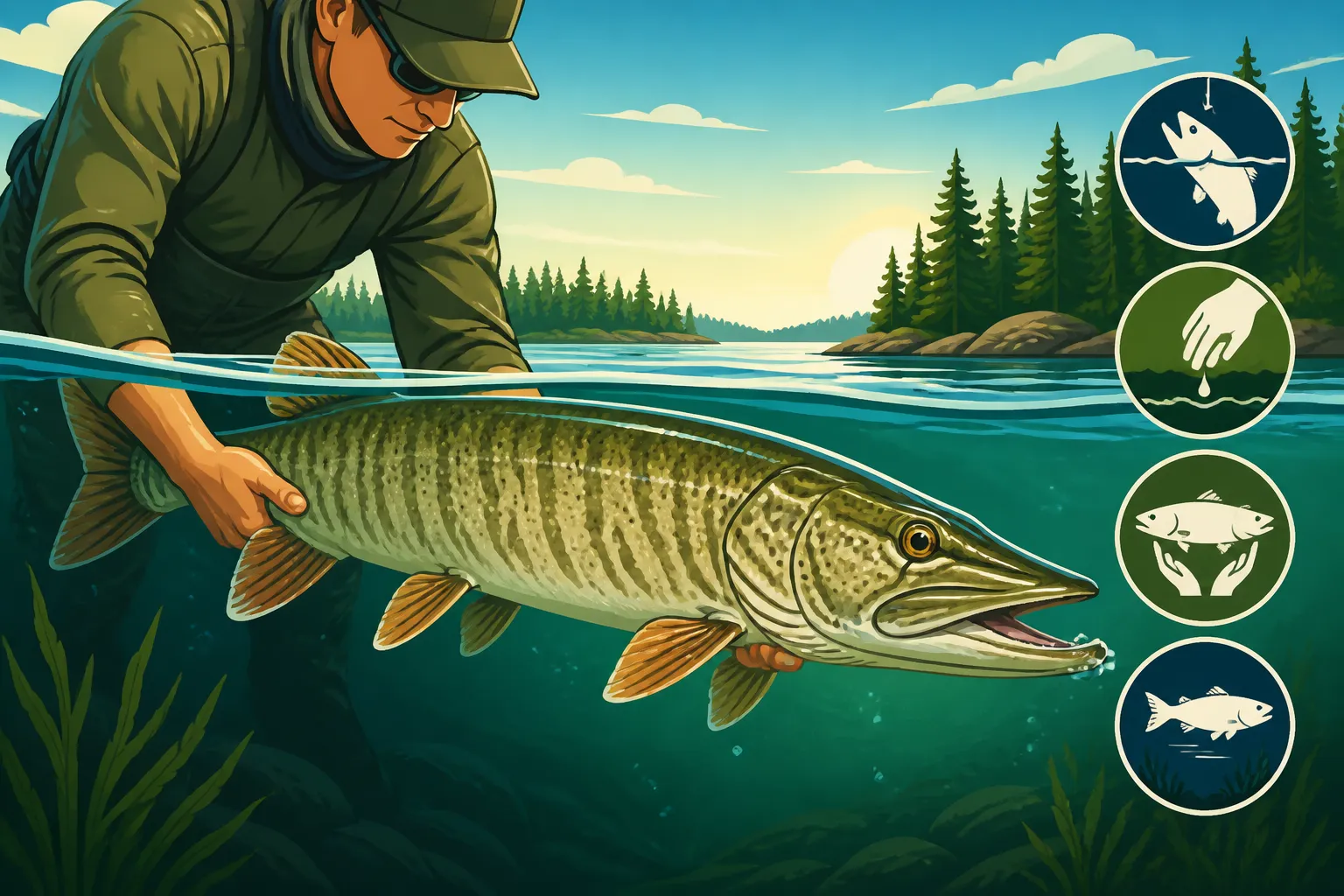
With the muskie secured in the water within the net, it's time for quick hook removal. Wearing your heavy-duty gloves, use your long-nosed pliers or hook removers to carefully extract the hooks. If a hook is deeply embedded or the fish is particularly feisty, don't hesitate to use those bolt cutters to snip the hooks. It's far better to leave a small piece of hook in the fish than to tear its mouth or gills trying to wrench it out. Be methodical, but efficient. If you plan for photography, do it very quickly. Cradle the fish horizontally, supporting its entire body, especially its head and tail. Hold it out of the water for no more than 5-10 seconds, snap a few quick photos, and immediately return it to the net and the water. Avoid holding it vertically by the jaw or tail, as this puts immense stress on its spine and internal organs.
The Critical Revival Process
This is arguably the most important stage of muskie catch and release. Many muskie deaths occur after release because the fish wasn't properly revived. With the muskie still in the net and in the water, hold it gently but firmly. The goal is to manually move water over its gills, essentially giving it artificial respiration. Position the fish upright, supporting its belly and tail, and allow the current or boat's slow forward motion to flow over its gills. If you're in a still bay, gently move the boat forward at idle speed, allowing water to flow through the net and over the fish. If on shore or in a canoe, gently rock the fish back and forth in the water.
Look for key signs of recovery. The muskie will start to regain its colour, its gills will be moving rhythmically, and it might even start to gently move its tail or jaw. You'll feel it trying to orient itself and eventually, it will push against your hands with surprising strength. Don't rush this part; take as long as it needs, even if it's 5-10 minutes or more. When you feel strong, sustained resistance, and the fish is actively trying to swim away, that's your cue. Release it gently, allowing it to swim away under its own power. Never simply toss a muskie back into the water without revival, as it will likely just sink and perish. This careful process is paramount for Muskellunge Growth Rate to Trophy Size and ensuring a sustainable fishery.
Common Mistakes to Avoid When Releasing Muskie
Even experienced anglers can sometimes make mistakes when the adrenaline is pumping after landing a big muskie. Being aware of these common pitfalls can significantly improve the survival rate of these magnificent fish. A successful release often comes down to avoiding these critical errors.
Excessive Air Exposure and Rough Handling
This is perhaps the most common and damaging mistake. Muskies are built for water, and keeping them out of their natural element for extended periods is extremely detrimental. Excessive air exposure can cause irreversible damage to their delicate gills, which collapse and stick together when not supported by water. Imagine holding your breath for several minutes after an intense workout – that's what a muskie experiences when held out of water too long. Even a minute or two can be too much for a stressed fish. As mentioned before, prioritize hook removal and revival, and keep photography brief, ideally with the fish partly submerged.
Equally damaging is rough handling. This includes dropping the fish on the boat floor, squeezing it too tightly, or holding it vertically by its head or tail. A muskie's skeletal structure is not designed to support its massive weight out of water, especially when held vertically. This puts immense strain on its spine and internal organs, leading to internal injuries that may not be immediately apparent but can be fatal later. Always cradle a muskie horizontally, supporting its entire body, especially if you must lift it for a quick photo. Treat these fish with the respect they deserve as fragile, wild creatures.
Inadequate Gear and Rushing the Release
Trying to land and release a muskie without the proper tools is a recipe for disaster. Using a net that's too small or has knotted mesh, or trying to remove hooks with small pliers or no gloves, will inevitably lead to more stress on the fish and a longer, more dangerous handling process. This is where investing in the right gear, available from retailers like Amazon, truly pays off. A proper large, rubberized net, long-nosed pliers, and bolt cutters aren't just conveniences; they are essential survival tools for the muskie. Without them, you're almost guaranteed to prolong the process, increase the fish's injuries, and decrease its chances of survival.
Another common mistake is rushing the release, particularly the revival stage. After the excitement of the catch and the effort of hook removal, it's natural to want to get the fish back in the water and move on. However, if you skip or shorten the revival process, the muskie might swim away weakly, only to succumb to stress and exhaustion moments later. A fish that looks like it's swimming away but is actually disoriented or barely moving is not a successfully released fish. Be patient, observe the signs of strong recovery, and only release when the muskie is actively struggling to get out of your hands. Your diligence in this final step is paramount to the fish's survival. Remember, the goal is not just to catch a muskie, but to ensure it swims away to fight another day.
Here's a quick summary of essential muskie release gear:
| Item | Purpose | Key Features | Why It's Crucial |
|---|---|---|---|
| Large Rubberized Net | Landing and containing the muskie | 36"+ hoop, deep, knotless rubber mesh, sturdy handle | Protects slime coat, prevents injury, keeps fish submerged |
| Long-Nosed Pliers | Reaching and removing hooks | 10-12 inches long, strong jaws | Safely removes hooks without deep reach into mouth |
| Bolt Cutters | Cutting hooks quickly | Strong, sharp jaws, able to cut heavy wire hooks | Essential for deeply swallowed or ganged hooks, minimizes damage and time |
| Jaw Spreaders | Safely holding the mouth open (optional) | Sturdy, non-damaging tips | Provides clear access to hooks, protects angler's hands, minimizes fish stress |
| Heavy-Duty Gloves | Protecting hands from teeth and gill plates | Puncture-resistant, good grip | Prevents injury to angler, allows for confident handling |
| Measuring Board/Tape | Accurately measuring length (if desired) | Wet, cradle-style preferred, clearly marked | Records trophy size, minimizes air exposure |
This article is for general informational purposes only and does not constitute professional advice. Laws, prices and regulations vary by location and change over time. Consult a qualified professional for guidance on your specific situation.