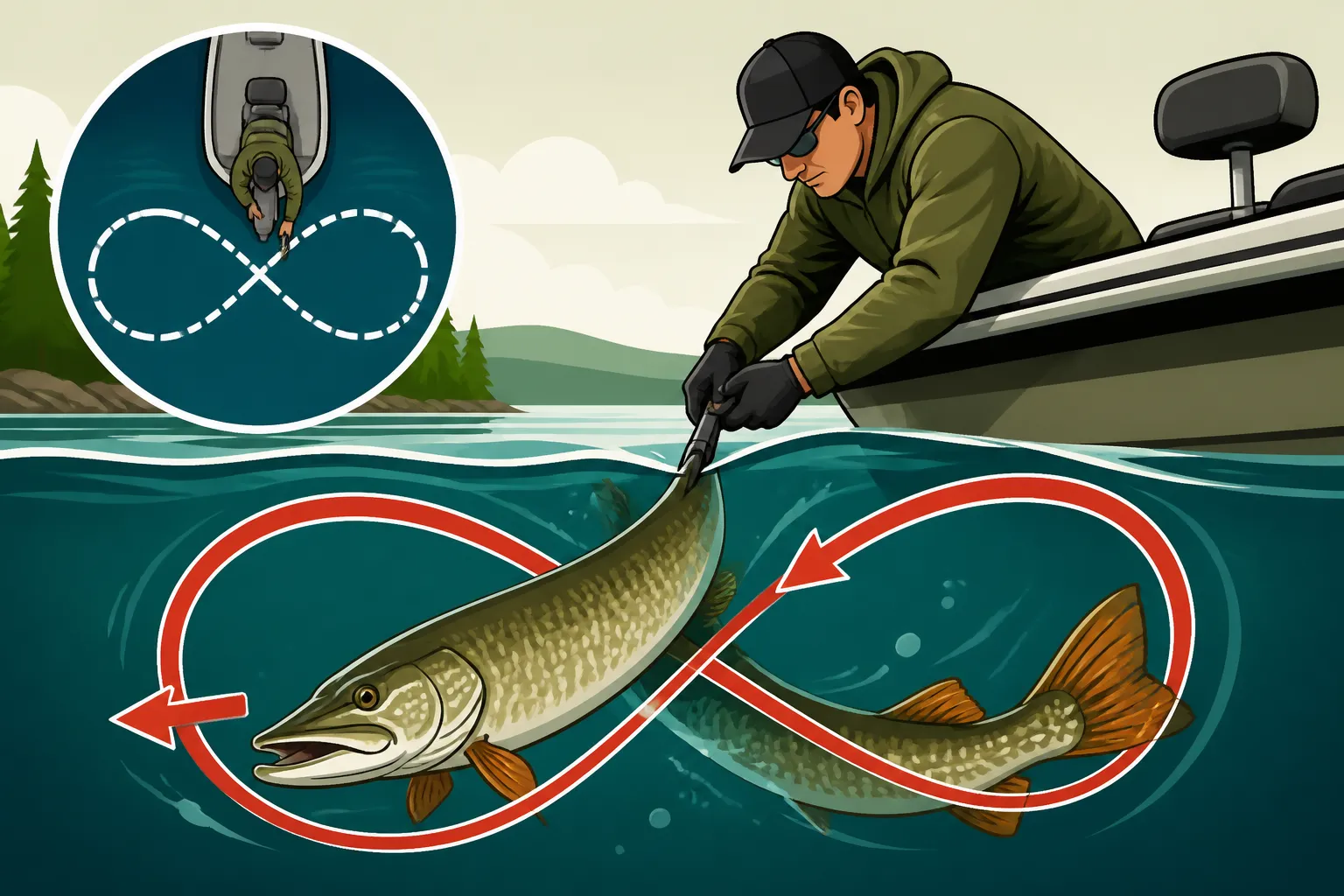
How to figure eight a muskie boatside
That heart-stopping moment when a massive muskie appears out of nowhere, following your lure right to the boat, can be exhilarating – and incredibly frustrating if it just turns away at the last second. We've all been there, adrenaline pumping, only to watch that giant shadow vanish back into the depths. This guide is all about mastering the "figure eight" technique, a critical skill that turns those frustrating follows into thrilling, boat-side strikes.
Understanding the Muskie Follow and Why the Figure Eight Works
There's nothing quite like the sight of a muskie, sometimes a true giant, gliding silently behind your lure. It's a testament to their predatory nature and keen interest. But why do they follow without striking, leaving us with that gut-wrenching feeling of a missed opportunity? More importantly, how do we flip that script?
The Frustration of the "Follow-Through"
Muskies are incredibly curious fish, but they're also apex predators, meaning they're not often in a rush. When a muskie follows your lure, it's often engaged in a complex assessment. It might be checking out the size, speed, and action of your presentation, trying to determine if it's a real meal or just some flashing plastic. Water conditions, light levels, boat noise, and even its own mood can all play a role in this hesitation. Sometimes, the fish might just be plain spooked by the boat, even if it’s still interested enough to follow. They’re masters of deception and stealth, and they expect their prey to react a certain way. If your lure’s action becomes predictable or ceases altogether at the boat, it loses its allure.
Think about it from the muskie's perspective: it's been tracking this "prey" for a while, maybe from a distance. As it gets closer to your boat, the entire environment changes. There's the shadow of the boat, perhaps the subtle hum of a trolling motor, or even your own scent. All of these factors can make a muskie wary. It's doing a final safety check, evaluating whether committing to a strike is worth the risk. Many anglers, myself included, have pulled their lure out of the water too quickly, inadvertently telling the muskie, "Yep, this wasn't real after all!" Muskellunge Habits in Georgian Bay provides great insight into their typical behaviors.
The Predator's Instinct: Triggering the Strike
The figure eight technique works by tapping into the muskie's deepest predatory instincts: the flight response of prey and the competitive advantage. When a muskie is following, it's often just looking for that final trigger. By executing a wide, fluid figure eight, you're essentially making your lure "disappear" and then "reappear" in an unexpected way, simulating a panicked baitfish trying to escape. This sudden, erratic movement within a confined space often pushes the muskie over the edge, turning its curiosity into an aggressive strike. It's like giving them a second, even more enticing, chance.
This rapid change in direction and speed, especially as the lure swings out of the muskie's immediate sightline and then quickly back, mimics what a wounded or disoriented baitfish would do. The muskie, a creature of opportunity, sees this as a prime chance to ambush. It's the moment of truth where hesitation turns into commitment. The figure eight effectively extends your "strike zone" from the end of your cast all the way to the boat, giving you control over that critical final few feet. It's a proactive move, not a desperate one, and understanding How to Catch Muskie in Ontario involves mastering this crucial skill.
The Anatomy of a Perfect Figure Eight
Executing a flawless figure eight takes practice, but the core principles are straightforward. It’s about maintaining control, fluidity, and never breaking eye contact with that following fish.
Rod Position and Lure Depth: Crucial First Steps
The moment you see a muskie follow, the game changes. Keep your rod tip absolutely buried in the water, a foot or two down if possible. This isn't just for depth; it's also about leverage and keeping the line angle low. A high rod tip makes for a shallow, ineffective figure eight and can also make it harder to react to a sudden strike. You need to maintain the lure's depth and action from your retrieve. If your lure typically runs 2-3 feet deep, keep it there throughout the figure eight. This consistency is key – don't let the lure rise to the surface prematurely.
I've seen so many anglers, myself included in my early days, instinctively lift the rod tip when they see a follow. It’s a natural reaction of excitement and anticipation. But doing so often brings the lure too high, making the figure eight shallow and less enticing. The muskie is looking for something that's trying to escape below the surface, not jump out of the water. Keeping that rod tip down also gives you a better angle to control the lure through the turns and to set the hook powerfully if the fish does strike.
The Classic "Eight" Motion
Once your rod tip is submerged and you're maintaining depth, it's time to draw the "eight." Start by sweeping your rod in a wide, smooth arc, parallel to the boat, drawing the first loop of your figure eight. The key here is wide – don't make small, jerky movements. Imagine you're drawing a large, lazy '8' in the water with your lure. As you complete the first half-circle, smoothly transition into the second, reversing direction and drawing the other loop. The goal is to keep the lure moving at a consistent, or even slightly accelerating, speed, never pausing.
The size of your figure eight should be proportional to the size of the muskie and the lure. A truly massive muskie, or a bigger lure, might require a wider sweep. The corners of your "eight" are critical; these are the points where the lure makes its most abrupt turns, often triggering the strike. Don't be afraid to extend those turns a good few feet away from the boat, giving the muskie room to chase and commit. The idea is to keep that fish engaged, making it think its meal is constantly trying to get away.
Varying Your Technique: Speed, Depth, and Shape
Not all muskie follows are created equal, and neither should all your figure eights be. Sometimes, a slow, methodical, deep eight is what it takes, especially in colder water or for a sluggish fish. Other times, a fast, aggressive, erratic figure eight, mimicking a panicked baitfish, will get the job done. Don't be afraid to experiment with the speed of your sweeps, the depth of your turns, and even the shape of your eight. You might find a wide, flat "S" curve works better than a traditional "8" on certain days.
For instance, if a muskie is just lazily tracking, try a sudden burst of speed through one of the turns, followed by a slight pause (but keep the lure moving!). If the fish seems to be losing interest, increase the aggression. If it's hot on the tail, maintain a consistent, enticing speed. You can also vary the depth slightly – sometimes bringing the lure up a foot on one sweep and then driving it deeper on the next can trigger a reaction strike. The adaptability of your figure eight is what truly makes it a deadly technique. This ties in nicely with understanding Best Techniques for Fall Muskie Fishing, where fish can be either aggressive or lethargic depending on conditions.
Common Mistakes and How to Avoid Them
Even seasoned muskie anglers can make mistakes during the adrenaline-fueled moments of a figure eight. Recognizing and correcting these common errors can significantly increase your success rate.
The "Too Small" or "Too Fast" Eight
One of the most common pitfalls is making your figure eight too small or too fast. In the heat of the moment, it's easy to panic and try to cram a tiny "8" right next to the boat. This doesn't give the muskie enough room to maneuver and commit to the strike. They need space to accelerate and ambush. Similarly, pulling the lure through too quickly, while sometimes effective, can also be a turn-off, making it seem unnatural or giving the fish no time to react. You’re trying to trigger a predatory response, not outrun the fish entirely.
Remember, a muskie is a big fish, and they need room to turn their body and open their mouth. A tiny figure eight might not even register as a viable target. Aim for sweeps that extend at least the length of your rod, if not more, away from the boat. As for speed, think of it as a controlled, urgent escape, not a frantic dash. It's a balance: fast enough to suggest escape, but slow enough for the muskie to connect. If you're using larger lures, like those big bucktails or glide baits, you absolutely need to give them ample space to complete their action in the water. Looking for good lures? Check out the selection on Amazon for a wide range of options.
Lifting the Lure Out of the Water
This mistake is often linked to the "too small" or "too fast" error. Anglers, either out of excitement or trying to make a tighter turn, inadvertently lift the lure out of the water at the apex of a turn. This immediately breaks the illusion of a struggling baitfish. The muskie is looking for prey in the water, not flying through the air. Once that lure breaks the surface, it's game over; the muskie almost always turns away. It's a classic rookie mistake, but one even experienced anglers can make when under pressure.
To combat this, keep your rod tip submerged as much as possible throughout the entire maneuver. If your rod can't reach deep enough, lean over the side of the boat (safely, of course!). Focus on maintaining that constant contact with the water. Practicing this motion boat-side, even without a fish, can help build muscle memory. Think of the lure as a submarine, constantly moving through its underwater world, never surfacing until you decide to pull it in.
Losing Sight of the Fish
This is perhaps the biggest mistake of all. As you're focused on executing the perfect figure eight, it's easy to lose track of the muskie's position. You need to keep your eyes glued to that fish. Is it directly behind the lure? Is it falling back? Is it gaining speed? Knowing where the muskie is at all times dictates how you adjust your figure eight. Losing sight for even a second can mean missing the strike or not being able to react effectively. This is where quality polarized sunglasses, which you can find a wide selection of on Amazon, become an essential piece of muskie gear.
The muskie's body language will tell you everything you need to know. If it's hot on the lure's tail, getting aggressive, you might need to accelerate your turns. If it's starting to drop back, slow down slightly or make your turns wider to give it more time to catch up. A slight change in its fin movement or body posture can signal an imminent strike. Staying focused and observing the fish will allow you to adapt your figure eight in real time, dramatically increasing your chances.
Gear Considerations for Effective Figure Eights
While the figure eight is primarily a technique, having the right gear can make a significant difference in its execution and your overall success rate. The right tools truly enhance your ability to make those critical movements fluidly. Best Muskie Gear for Ontario Waters covers a lot of the essentials.
The Right Rod Length and Action
For effective figure eights, a longer, stout muskie rod is often preferred. Rods in the 8 to 9-foot range, with a heavy power and fast action, provide the necessary leverage and reach to make wide, deep sweeps without straining yourself. The extra length allows you to extend the figure eight further away from the boat, giving the muskie more room to commit. The heavy power ensures you can control large lures through the water, and the fast action provides the sensitivity and backbone needed for a solid hookset.
Think about the physics: a longer rod means a wider arc for the same hand movement. This translates directly to a bigger, more enticing figure eight. If you’re using a shorter rod, say 7 feet, you’ll have to lean over the boat much further and work harder to achieve the same sweep, which can be tiring and compromise your balance. Many anglers swear by specific models, and a quick search on Amazon will show you countless options to compare for your next muskie rod upgrade.
Line and Leader Choices
Your fishing line needs to be incredibly strong and abrasion-resistant. Braided line, typically 80 to 100-pound test, is the standard for muskie fishing. Its lack of stretch provides excellent feel and powerful hooksets. Coupled with this, a heavy-duty fluorocarbon or wire leader is absolutely essential. Muskies have razor-sharp teeth that will easily shred monofilament or lighter fluorocarbon. A good leader should be at least 100-150 pound test and long enough to protect your main line during the figure eight and the fight.
The leader is your last line of defense, especially when that muskie has the lure deep in its mouth. I always recommend checking your leader after every fish, or even after a lot of casts, for any nicks or fraying. A small imperfection can lead to a heartbreaking break-off. For wire leaders, consider multi-strand stainless steel, which offers flexibility and supreme strength. For fluorocarbon, ensure it’s specifically designed for big game. Best Line Weight for Muskie Fishing goes into more detail on this critical component.
Lure Type and Presentation
While you can technically figure eight with almost any muskie lure, some are better suited than others. Bucktails, glide baits, and large crankbaits are excellent choices because they maintain their action and profile well during the sweeping motions. Topwater lures can be tricky to figure eight effectively while keeping them in the water, but it's not impossible with practice. The key is to choose a lure that you can control and keep submerged during the maneuver.
Consider the lure's weight and buoyancy. A heavy lure will stay down more easily, while a highly buoyant lure might want to pop up. When choosing your lure, think about the muskie's mood. If it's just following, a more erratic, "fleeing" presentation might be key, which some bucktails and crankbaits excel at. If you’re looking to stock up on new muskie lures, Amazon has an incredible array of options, often with helpful reviews from other anglers.
Here’s a quick overview of how different muskie behaviors might influence your figure eight strategy:
| Muskie Behavior | Recommended Figure Eight Variation | Key Considerations |
|---|---|---|
| Lazy Follow (Slow & Steady) | Wide, Deep, Consistent Speed | Give the fish time to assess; minimal sudden changes. Maintain continuous movement. |
| Hot on Tail (Aggressive & Close) | Faster, Erratic, Varying Speed and Depth | Mimic a panicked escape; sudden direction changes. Keep the rod tip deep. |
| Falling Back (Losing Interest) | Wider Sweeps, Slight Acceleration through Turns | Try to re-engage by presenting a more challenging chase. Extend the "escape route." |
| "Nosing" the Lure (Hesitant Contact) | Subtle Twitching within the Sweeps, Slight Pause | Add micro-movements to trigger; a brief, almost imperceptible pause can work wonders. |
| Turns Away at Boat (Spooked) | Extremely Wide Loops, Move Away from Boat | Give the fish more space; try to draw it back out from under the boat's shadow. |
Remember, every muskie is different, and conditions vary wildly on the water. The most effective anglers are those who can adapt their approach in the moment. Keeping an eye on that fish and responding to its cues is paramount. After you've successfully landed your muskie with this technique, don't forget the importance of proper handling and release. Muskie catch and release survival tips offers great advice to ensure the fish can fight another day.
The figure eight is more than just a technique; it's a display of determination and an understanding of the muskie's predatory nature. It's the final, decisive move in the chess game between angler and fish. Don't be discouraged if it doesn't work every time – practice, patience, and persistence will make you a master. Next time that giant shadow appears, you'll be ready to turn that follow into an unforgettable boat-side strike on the waters of Ontario!
Disclaimer
This article is for general informational purposes only and does not constitute professional advice. Laws, prices and regulations vary by location and change over time. Consult a qualified professional for guidance on your specific situation.