Best Techniques for Fall Muskie Fishing
The leaves are turning, the air is crisp, and you can almost feel the anticipation buzzing in the air. For many dedicated anglers, the arrival of fall isn't just about pumpkin spice lattes and cozy sweaters; it signals the absolute peak of muskie fishing in Ontario. It's a challenging, often frustrating pursuit, but when those colder waters invigorate these apex predators, the rewards can be truly spectacular. This comprehensive guide will walk you through the essential techniques, prime locations, and crucial gear you'll need to successfully target Ontario's elusive fall muskie.
Why Fall is the Ultimate Season for Ontario Muskie
Let's be real, chasing muskie any time of year can test your patience. But there's a reason so many of us mark our calendars for autumn. This isn't just another season; it's the season. The metabolic drive shifts, and these toothy giants enter a feeding frenzy that makes them more vulnerable to your presentations. If you've ever felt like you're casting to ghosts in the summer, fall offers a glimmer of hope, a tangible increase in your odds for that fish of a lifetime.
The Metabolic Surge: Why Muskies Feed Aggressively
As the water temperatures begin to drop, muskie, like many other cold-blooded predators, get a surge of energy. They know winter is coming, and that means one thing: feed, feed, feed. Their metabolism ramps up in preparation for the leaner months, and they become far more active and willing to chase down larger meals. This isn't a subtle shift; it's a profound change in their behavior. They're no longer conserving energy in the warm, oxygen-depleted waters of mid-summer; they're actively hunting.
This increased activity translates directly to more aggressive strikes and longer follows. You might find a muskie that ignored your perfectly presented bait in August suddenly crushing it with abandon in October. They're not just looking for a snack; they're looking for a substantial meal to pack on calories. This is why you often hear tales of anglers catching their personal bests in the autumn – the fish are fatter, healthier, and significantly more inclined to smash your offerings. Understanding this fundamental biological drive is the first step in unlocking successful fall muskie fishing.
Declining Water Temperatures and Baitfish Movement
The gradual cooling of the water is the primary trigger for this entire fall phenomenon. As surface temperatures drop, baitfish—the muskie's primary food source—begin to congregate and move to deeper, more stable water. This migration isn't haphazard; it follows predictable patterns. Large schools of cisco, whitefish, suckers, and perch will push into main lake basins, off deeper points, and along pronounced breaklines. And where the bait goes, the muskie follow.
This convergence of baitfish creates feeding opportunities that simply don't exist in the same concentrated way during other seasons. Muskie don't have to expend as much energy hunting scattered prey; they can ambush large schools. This is particularly noticeable in large bodies of water like Georgian Bay or Lake St. Clair, where immense schools of forage provide a buffet for hungry muskie. Keeping an eye on water temperatures and understanding the typical movements of baitfish in your chosen body of water is paramount to putting your bait in the right strike zone. For a deeper dive into how this affects various species throughout the year, check out our guide on Ontario Fishing Seasons by Zone and Month.
Locating Fall Muskies: Decoding Their Deepwater Hangouts
Finding muskie in the fall isn't about aimlessly casting shorelines anymore. They've moved. They've gone deep, following their food and seeking out specific structures that offer ambush points and comfortable holding areas in the cooling water column. If you're still working shallow weed beds exclusively, you're likely missing out on the majority of the action. This is where your electronics, your knowledge of underwater topography, and a bit of detective work really come into play.
Key Structures and Depths in Autumn
As the season progresses, muskie will increasingly relate to deeper structures. Think main lake points that drop off sharply into basins, deep rock humps, submerged islands, and the edges of expansive offshore flats. These aren't just random spots; they're strategic locations that offer quick access to deep water for thermal stability, but also proximity to passing schools of bait. You'll often find them holding on the deeper sides of these structures, facing towards the open water, waiting for their next meal.
For example, on lakes like Nipissing or Lake of the Woods, you might find muskie staging on the deep edges of historical walleye reefs, especially those with steep transitions from 20 to 50 feet. In clearer, deeper lakes, they might be suspended over open water basins, but always close to a prominent structure. The key is to look for structure that provides both depth and an ambush point. Don't be afraid to experiment with different depths, but generally, expect to find them deeper than you would in summer, often from 15 to 40 feet, sometimes even deeper in late fall.
Following the Bait: Tracking Forage Fish
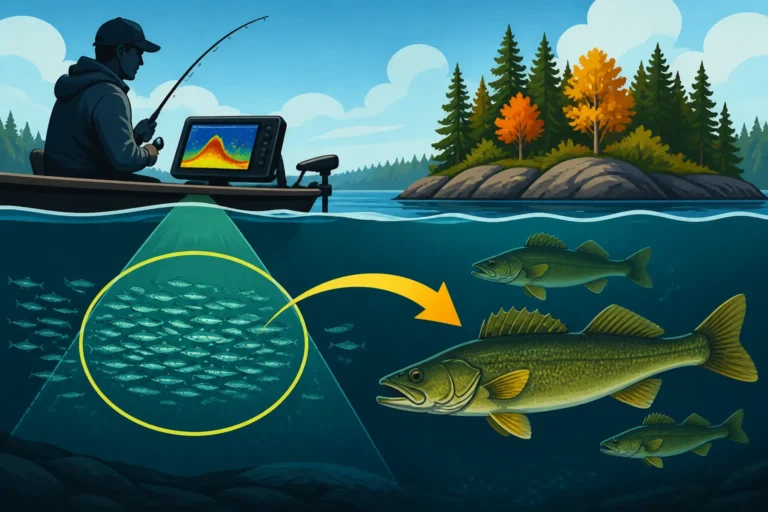
The old adage "find the bait, find the fish" is never truer than during fall muskie season. Muskie are entirely driven by their prey during this time. If you're marking huge schools of baitfish on your sonar, you can bet muskie are not far behind. These schools often appear as dense clouds or arches on your fish finder, typically in deeper water. Once you locate these baitfish schools, start systematically working the areas immediately around them.
Muskie won't necessarily be in the densest part of the bait school, but rather on the fringes, beneath them, or along nearby structures where they can stage for an attack. Look for larger, distinct arches or lines appearing near or under the bait. That's likely your target. Pay close attention to current seams, wind-blown points, or any other natural funnel where baitfish might be concentrated. Sometimes, even finding one or two isolated baitfish on your screen can signal a prime muskie hunting ground. Mastering your electronics to identify and track forage is an invaluable skill for finding Where to Find Walleye in Ontario, and it's equally crucial for muskie.
Essential Lures and Presentations for Fall Muskie
When it comes to fall muskie fishing, it's all about making a statement. These fish are looking for a substantial meal, and your lures need to reflect that. This isn't the time for finesse; it's the time for big, bold presentations that trigger their aggressive feeding instincts. You'll want a diverse arsenal, as conditions and fish moods can change rapidly, but there are definitely some go-to categories that consistently produce results.
Big Baits for Big Fish: Crankbaits and Jerkbaits
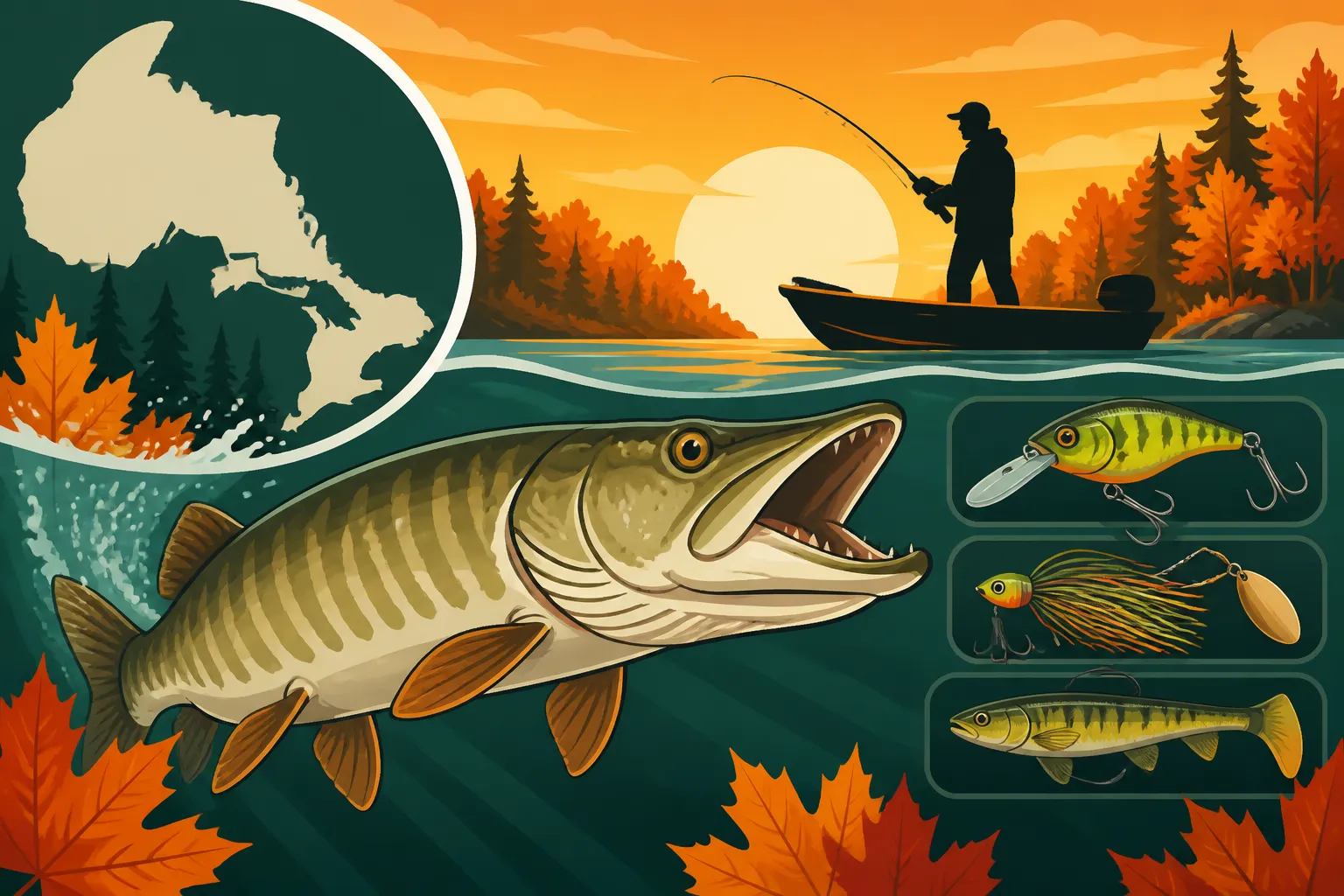
Fall is the prime time to throw big crankbaits and jerkbaits. These lures imitate large baitfish and can be worked at various depths, making them incredibly versatile. Think about baits from companies like Rapala, Livingston Lures, or even some of the custom crankbait builders. For fall, you're often looking for lures in the 8-inch to 14-inch range, sometimes even larger. Color patterns that mimic cisco, perch, or suckers are usually top choices.
Deep-diving crankbaits are fantastic for trolling over offshore humps and through deep basins, reaching depths of 20, 30, or even 40 feet. Adjust your speed and line length to precisely tick the tops of submerged structures. For casting, large twitch baits or glide baits can be incredibly effective when worked over deep breaklines or alongside rock piles. A slow, deliberate retrieve with pauses that allow the bait to hang and tantalize can often trigger a follow or a strike. Remember, muskie might be aggressive, but they still appreciate a chance to ambush a struggling meal. Many anglers swear by the effectiveness of custom, hand-painted lures, which you can often find from artisans, or even mass-produced versions from brands like Musky Innovations, readily available on Amazon.
Spinnerbaits and Glide Baits: Versatility in Action
While crankbaits get a lot of glory, large spinnerbaits and glide baits are equally potent, especially when you're casting. Bucktail spinnerbaits, with their pulsating skirts and flashing blades, create an irresistible visual and vibrational presence in the water. In the fall, larger blades (like #10 or #12) and heavier weights are preferred to get them down to cruising depths quickly. Work them with a steady retrieve, varying your speed, and don't hesitate to "rip" them now and then to create a reactive strike.
Glide baits, on the other hand, offer a totally different action. These lures typically have a flat side and, when twitched, "glide" from side to side, mimicking a wounded baitfish. They excel when muskie are a bit more finicky, or when you want to impart a more erratic action. Brands like Salmo and Musky Mania offer excellent glide baits. They're particularly deadly over deep weed edges or around submerged timber where you want a lure that stays in the strike zone longer. Both spinnerbaits and glide baits are fantastic for covering water when you're searching for active fish.
Soft Plastics and Live Bait Considerations
Don't underestimate the power of large soft plastic baits for fall muskie. These can be incredibly effective, especially when vertically jigged over deep structure or slowly retrieved along contours. Soft plastics like oversized swimbait paddletails (8-12 inches) or large creature baits, often weighted with heavy jig heads, offer a more subtle, natural presentation. The key is to impart action with your rod tip, making the bait "swim" or "hop" along the bottom, mimicking a distressed baitfish. This can be especially good on high-pressure days or when muskie are holding tight to structure and aren't keen on chasing faster presentations.
While live bait for muskie is less common in Ontario due to regulations and conservation ethics, it is sometimes used in specific scenarios (always check local regulations!). Large suckers, for instance, can be effective when fished on quick-strike rigs. However, the focus for most ethical muskie anglers in Ontario is on artificial lures due to the highly effective catch-and-release practices associated with them. The goal is to hook the fish quickly and cleanly, ensuring its survival. For more on ensuring a healthy future for these fish, consider our article on Muskie catch and release survival tips.
Here's a quick comparison of popular fall muskie lure categories:
| Lure Type | Best Application | Pros | Cons |
|---|---|---|---|
| Deep Crankbaits | Trolling deep contours, open water | Cover vast areas, reach extreme depths, trigger aggressive strikes | Can be expensive, prone to snagging in rocky areas |
| Jerkbaits/Glide Baits | Casting over structure, twitching for reaction | Erratic action, effective for finicky fish, mimic wounded bait | Requires specific retrieve cadence, can be harder to cast accurately |
| Bucktail Spinnerbaits | Casting over shallower structure, covering water | Excellent vibration and flash, attract from a distance, versatile | Can be tiring to retrieve, may not reach extreme depths |
| Soft Plastics | Vertical jigging, slow retrieves over structure | Natural presentation, good for pressured fish, subtle action | Slower presentation, can be less exciting than hard baits |
Mastering Trolling Techniques for Ontario Fall Muskie
Trolling is arguably one of the most effective methods for fall muskie fishing, especially on large bodies of water. It allows you to cover vast areas efficiently, present multiple baits at once, and precisely control the depth and speed of your lures. If you're looking to locate active fish in expansive basins or along long breaklines, trolling is your friend. It's a game of patience, precision, and understanding the subtle nuances of your boat and gear.
Speed, Depth, and Patterning: The Trolling Equation
The magic of fall muskie trolling lies in finding the right combination of speed, depth, and pattern. Typically, slower trolling speeds (2.5 to 4.5 mph) are effective in colder fall waters, allowing muskie more time to react to the bait. However, don't be afraid to experiment; sometimes a sudden burst of speed or a slow-down can trigger a strike. GPS and trolling motors with speed control are invaluable for maintaining consistent speeds.
Achieving the correct depth is absolutely critical. You want your lures running just above the structure where muskie are holding, or right in the middle of a suspended bait ball. This often means using lead-core line, braided line with heavy weights, or downriggers for precise depth control. Different lures dive to different depths, so understanding your lure's capabilities at various speeds is essential. Many anglers use a dive curve chart to predict a lure's depth. As for patterning, pay attention to where you get bites. Is it at a specific depth? Over a particular type of structure? On an inside or outside turn? Note everything, as this helps you replicate success. Our guide to Trolling Techniques for Ontario Lake Trout offers some transferable principles for depth management.
Gear Setup for Effective Fall Trolling
Your trolling setup needs to be robust enough to handle powerful muskie and the heavy baits you'll be deploying. This means sturdy rods (often 8-10 feet in length, medium-heavy to heavy power), high-quality baitcasting reels with a strong drag system, and heavy braided line (80-100 lb test) for abrasion resistance and direct hooksets. When it comes to leaders, a strong fluorocarbon or wire leader (150-200 lb test) is non-negotiable to prevent bite-offs from those razor-sharp teeth. Don't skimp here; a cheap leader is the quickest way to lose a trophy fish and an expensive lure.
Rod holders are also essential for keeping your rods secure and properly spread out. Many anglers run multiple rods, often utilizing planer boards to spread baits out wide and cover a broader swath of water. Remember to have a good pair of line cutters on hand, and invest in a quality boat hook or gaff (used only by experienced anglers and for specific situations for safety of fish and angler, otherwise a large net is preferred) and a massive landing net – a Best Landing Net for Muskie is crucial for landing these giants safely. All these specialized items are readily available on Amazon or at dedicated fishing tackle shops.
Precision Casting for Structure-Oriented Fall Muskie
While trolling covers water, casting allows for precision. It's about dissecting specific pieces of structure, making multiple presentations to known muskie holding areas, and triggering strikes with intricate lure movements. This is often the preferred method for targeting humps, rocky shoals, steep breaklines, and specific points where muskie are known to stage. It's more active than trolling, demanding a keen eye and precise bait placement.
Targeting Key Spots with Controlled Casts
When casting for fall muskie, your focus shifts to pinpoint accuracy. Instead of covering miles, you're picking apart football-field-sized areas. Look for those deep points, rocky shelves, and submerged islands you identified on your electronics. Make long, accurate casts that land your lure just beyond the suspected strike zone, allowing you to retrieve it through the most productive area. Pay attention to how the lure interacts with structure – a slight bump against a rock can often be the trigger.
Vary your retrieve speeds and patterns. Sometimes a slow, steady crank is all it takes. Other times, a series of sharp jerks, followed by a long pause, will get a muskie to commit. Think about what a baitfish would do: dart, pause, try to escape. Mimic that. You might have to make dozens, even hundreds of casts to a single spot before getting a reaction. This is where patience and persistence truly pay off. This precise approach is also fundamental to How to Catch Smallmouth Bass in Ontario around similar structures.
The Importance of the Figure-Eight
The figure-eight maneuver is an absolutely non-negotiable technique when muskie fishing, especially in the fall. Many muskie will follow a lure all the way to the boat, inspecting it before deciding whether to strike. This is often when you'll see a massive shadow emerge from the depths, sending your heart into your throat. If you simply pull your lure out of the water, that's a missed opportunity.
Instead, as your lure approaches the boat, smoothly sweep your rod tip into a figure-eight pattern, keeping the lure in the water and creating continuous movement. Make the loops as wide as your boat allows. Maintain eye contact with the muskie, and watch for any signs of aggression. Often, a follow that seemed uninterested will suddenly explode into a strike during the figure-eight. It's a high-adrenaline moment that can turn a "no fish" day into a "fish of a lifetime" memory. Practice this until it's second nature; it will save you countless heartbreaks. Learning How to Catch Muskie in Ontario effectively means mastering this one technique above almost all others.
Crucial Gear and Safe Handling for Autumn Giants
Fall muskie fishing isn't just about lures and techniques; it's also about preparedness. The weather can change rapidly in Ontario, going from mild to truly frigid in a matter of hours. Beyond that, the sheer power and size of these fish demand specific gear and a commitment to safe handling to ensure both your safety and the muskie's. Don't let a moment of excitement overshadow the responsibility you have to these incredible creatures.
Cold Weather Apparel and Boating Safety
Being comfortable and safe on the water in fall is paramount. Hypothermia is a real danger, and conditions can turn nasty quickly. Invest in quality layering systems: thermal base layers, insulating mid-layers (fleece or down), and a waterproof, windproof outer shell. A warm hat, gloves, and waterproof boots are absolute must-haves. Bring more layers than you think you'll need; you can always take them off. For an extensive selection of reliable fishing outerwear, checking options on Amazon is a good starting point.
Beyond personal comfort, boating safety becomes even more critical in colder weather. Always wear a PFD (Personal Flotation Device), even if you're a strong swimmer; cold water shock can incapacitate you almost instantly. Ensure your boat's safety equipment is up to date and easily accessible, including flares, a whistle, a bailing device, and a fully charged cell phone in a waterproof bag. Let someone know your float plan – where you're going and when you expect to be back. And remember, rough water in October hits differently than in July; exercise extreme caution. For a complete overview of requirements, consult Ontario Boating Laws for Anglers.
Muskie Release Best Practices: Ensuring Survival
Muskie are a precious resource in Ontario, and most anglers practice catch and release to preserve these magnificent fish. Proper handling is absolutely critical to their survival, especially for large, stressed fish caught in cooler water. Firstly, keep the fish in the water as much as possible. Minimize air exposure, especially if the fish has been fought for a long time. Have a large, rubber-coated landing net ready, which protects their slime coat.
Once in the net, use long-nosed pliers or jaw spreaders to quickly and carefully remove the hooks. If the fish is deeply hooked, cut the line as close to the hook as possible rather than tearing tissue. Never boat-flip a muskie. Support its body horizontally with two hands for a quick photo, then immediately get it back in the water. Cradle the fish in the water, supporting its belly, and allow it to recover, facing it into any current until it swims away under its own power. Sometimes, this can take several minutes. Your diligence here ensures that another angler can experience the thrill of catching that same fish someday. Equip yourself with the right tools, like those found in a well-organized Best Tackle Box Setup for Ontario Anglers, including release tools.
Disclaimer
Fishing inherently carries risks, and regulations can change. Always consult the most current Ontario Fishing Regulations Summary and adhere to all local laws before heading out on the water. This guide provides general information and recommendations; personal safety and adherence to regulations are the angler's responsibility.