Best swivel type for muskie leaders
If you've spent any time chasing muskie in Ontario, you know it's a game of big baits, powerful fish, and a whole lot of stress on your gear. One of the most overlooked, yet absolutely critical, components of your leader setup is the swivel. Picking the wrong one can lead to frustrating line twists, lost lures, and worse yet, lost fish. This guide will dive deep into the world of muskie swivels, helping you understand the types available and how to choose the best one to keep your lines clean and your lures connected to those toothy giants.
Why Swivels Are Non-Negotiable in Muskie Leaders
Let's face it, muskie fishing is not for the faint of heart, and your tackle needs to be just as tough as the fish you're targeting. Many anglers focus heavily on the rod, reel, and the lure itself, sometimes forgetting the smaller, yet equally vital, components that tie everything together. Swivels are one of those unassuming pieces of hardware that play an absolutely crucial role, especially when you're casting or trolling those big, drag-inducing muskie baits.
Preventing Line Twist from Heavy Lures and Fish Fights
The primary job of a good swivel in muskie fishing is to eliminate line twist. Think about the mechanics: you're casting large bucktails, big crankbaits, or heavy jerkbaits that often have a significant amount of wobble, rotation, or erratic action in the water. Every retrieve, every sweep of the rod, and certainly every violent head shake from a hooked muskie, introduces twist into your line. If you don't have a component that allows your lure to spin freely without transferring that rotation to your main line, you're in for a world of hurt. Twisted line leads to weakened spots, terrible casting performance, and can even cause your reel to spool improperly, creating frustrating tangles and wind knots. A quality swivel acts as a rotational buffer, letting your lure do its thing while keeping your main line straight and strong.
Moreover, muskie are notorious for their thrashing, rolling, and powerful runs once hooked. They'll spin, dive, and try every trick in the book to throw your lure. This violent fight puts immense pressure on your line, and if your swivel isn't up to the task of freely rotating, that twisting energy translates directly to your mainline. This dramatically increases the chances of a break-off, especially if you're using braided line, which can "dig in" on itself when twisted. Investing in the right swivel is truly an investment in keeping that trophy fish attached through the entire ordeal.
Enhancing Lure Action and Presentation
Beyond preventing line twist, the right swivel can actually enhance how your lure performs in the water. Imagine a large crankbait or a thumping bucktail. These lures are designed to move and vibrate in specific ways to attract predatory fish. If your line is twisted or if your swivel isn't allowing the lure its full range of motion, you're hindering its natural action. A high-quality, free-spinning swivel ensures that your lure can swim, dive, and wobble exactly as the manufacturer intended. This means a more enticing presentation, which can make all the difference when trying to fool a wary muskie.
Furthermore, some muskie techniques involve very specific lure presentations. For instance, in How to Catch Muskie in Ontario, you'll learn that figure-eighting at the boat is a crucial maneuver. During this aggressive boat-side dance, a free-moving lure attached by a smooth swivel is much less likely to foul or snag, allowing you to maintain that critical presentation right to the last second, often triggering a strike when the fish thinks it's about to escape. A sticky or poorly performing swivel can quickly ruin this precise technique, leading to missed opportunities.
Understanding Different Swivel Types for Muskie Leaders
When you walk into a fishing tackle shop or browse online at places like Bass Pro Shops or Amazon, you'll see a dizzying array of swivels. For muskie fishing, however, we're really narrowing it down to a few key players that can withstand the abuse. Not all swivels are created equal, and for muskie, strength, smooth rotation, and durability are paramount.
Barrel Swivels: The Workhorse for Many Anglers
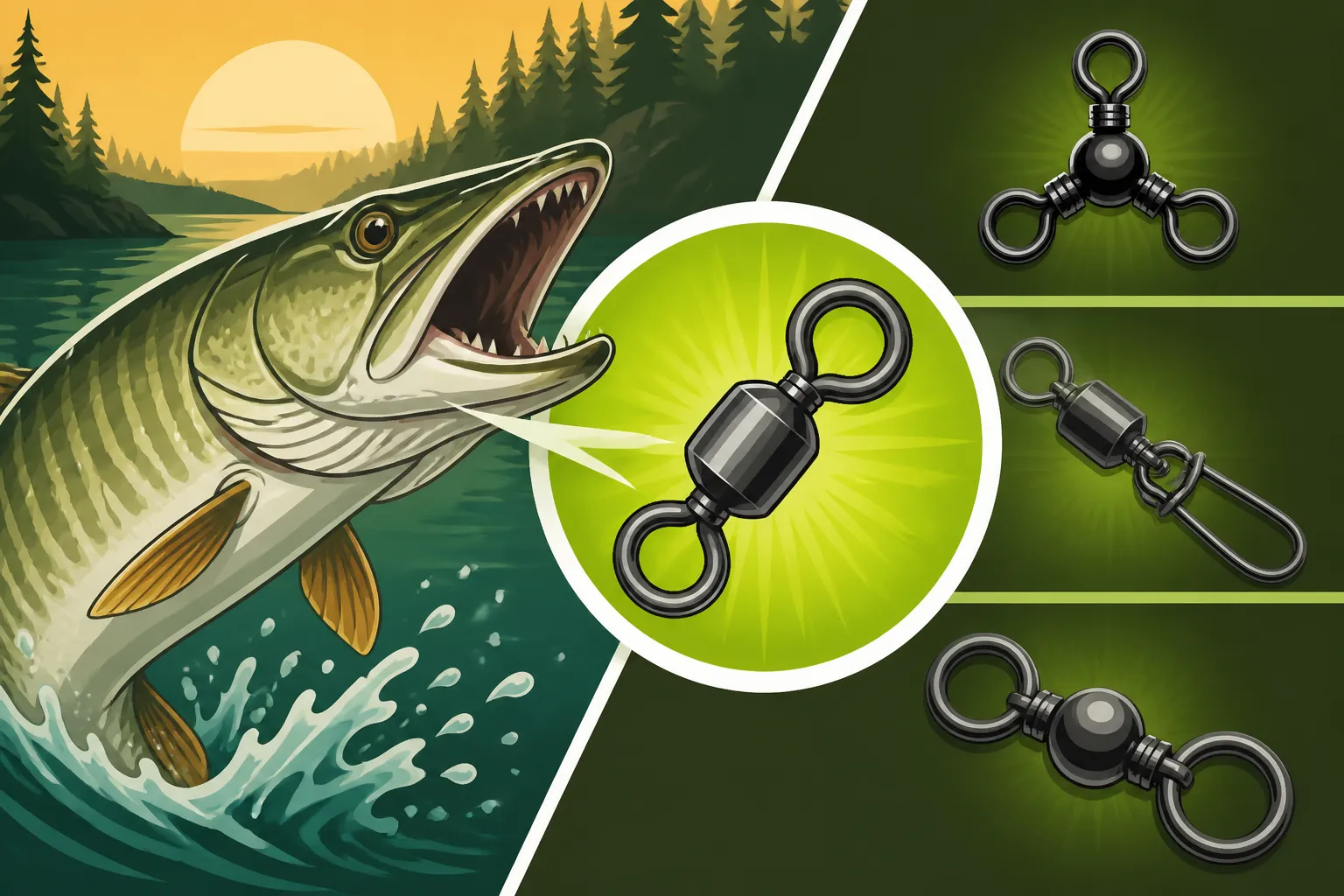
Barrel swivels are probably the most common and recognizable type of swivel. They consist of two eyes connected by a short, cylindrical barrel that allows each eye to rotate independently. They are relatively inexpensive and widely available, making them a popular choice for many types of fishing. For muskie, you'll need to look for heavy-duty barrel swivels, often rated for much higher pound tests than what you might use for bass or walleye.
While they are strong, the primary drawback of a standard barrel swivel for muskie is its anti-twist performance. They do a decent job for general fishing, but when you're dealing with huge, continuously rotating bucktails or the violent death rolls of a muskie, they can sometimes struggle to keep up. The friction within the barrel mechanism can sometimes impede their ability to spin freely under heavy load. This isn't to say they don't have their place; for situations where line twist is less critical or where cost is a major factor, a very large, high-quality barrel swivel can still be adequate, especially if you're frequently checking and addressing line twist manually. However, for maximum twist prevention, other options might be superior.
Ball Bearing Swivels: The Gold Standard for Muskie
If there's a "must-have" swivel for serious muskie anglers, it's the ball bearing swivel. These swivels feature small stainless steel ball bearings encased within the barrel, which allows for incredibly smooth, friction-free rotation. This design means they can spin almost effortlessly, even under extreme tension, making them exceptionally effective at preventing line twist. When you're constantly casting and retrieving big, heavy, and often rotational muskie lures, the smooth action of a ball bearing swivel is absolutely invaluable.
The superior anti-twist performance of ball bearing swivels means less time untangling your line and more time fishing effectively. They also tend to be incredibly strong for their size, capable of handling the brutal forces exerted by trophy muskie. The trade-off, however, is that they are generally more expensive than barrel swivels. But for the peace of mind they offer in protecting your line and preventing the loss of an expensive muskie lure or a once-in-a-lifetime fish, most muskie anglers consider them a worthwhile investment. You'll find these high-quality options prominently displayed at specialty retailers. Consider how important a reliable connection is when reviewing Best Muskie Gear for Ontario Waters.
Crane Swivels: A Stronger Alternative to Barrel Swivels
Crane swivels are an interesting middle ground between standard barrel swivels and the high-performance ball bearing varieties. They typically have a more robust, "crane-like" shape to their body, which can often house a slightly larger or more refined pin mechanism than a basic barrel swivel. This design often allows for smoother rotation than a traditional barrel swivel, though not quite to the frictionless standard of a ball bearing model. They are generally stronger and more durable than equivalent-sized barrel swivels, making them a better choice for heavy-duty applications.
For muskie fishing, a high-quality crane swivel can be a viable option if you're looking for something more robust than a barrel swivel but want to avoid the higher cost of a ball bearing swivel. They offer a good balance of strength, decent anti-twist properties, and affordability. However, just like barrel swivels, it's crucial to select them in appropriate sizes and strength ratings for muskie. Don't compromise on quality or pound test, as a failed swivel means a lost fish. Many anglers find crane swivels perfectly suitable for certain applications, especially if their lures don't create excessive rotational drag.
Snap Swivels: Convenience vs. Reliability
Snap swivels combine a swivel (either barrel, crane, or sometimes ball bearing) with a snap clip on one end. The snap allows for quick and easy changing of lures, which is a huge convenience when you're trying to cover water and experiment with different baits. For muskie fishing, the convenience of a snap swivel is undeniable – you can swap out a bucktail for a jerkbait in seconds. However, this convenience introduces a potential weak point: the snap itself.
For muskie, any snap used must be incredibly strong and reliable. Cheap or flimsy snaps can bend, open, or break under the strain of a heavy muskie and a violent fight. If you opt for snap swivels, always choose heavy-duty, high-quality snaps, such as Duo Lock or similar robust designs, made from strong stainless steel. A good quality snap swivel will integrate a ball bearing swivel for optimal performance. While they offer speed in lure changes, some purist muskie anglers prefer to tie directly to a robust ball bearing swivel or use a solid ring with a heavy-duty split ring for lure attachment, believing it offers the absolute strongest connection and minimizes hardware failure.
Key Considerations When Choosing a Muskie Swivel
Selecting the right swivel for your muskie leader isn't just about picking a type; it's about matching the swivel to your specific fishing style, the lures you're using, and the sheer power of the fish you're targeting. There are several crucial factors that all muskie anglers need to consider to ensure their swivels are up to the task.
Strength and Pound Test Rating
This is arguably the most critical factor. Muskie are big, powerful fish, and they hit hard. Your swivel needs to withstand not just the weight of your lure, but the sudden, violent impact of a strike and the sustained, thrashing fight that follows. Always choose swivels with a pound test rating that significantly exceeds your main line's strength. If you're fishing with 80-pound braid, don't use a 50-pound test swivel. It's simply not worth the risk. Many muskie anglers will opt for swivels rated for 150 lbs, 200 lbs, or even higher, especially for heavy trolling applications or when targeting true giants.
Remember, the weakest link in your entire setup is where failure will occur. A high-quality wire leader for muskie might be rated for 100+ lbs, but if you attach it to an 80 lb swivel, that swivel becomes your breaking point. It's always better to over-engineer this component slightly. Reputable brands that specialize in heavy-duty tackle will clearly label their swivels with their breaking strength, making it easier to select the appropriate size for your needs.
Smoothness of Rotation and Anti-Twist Performance
As we've discussed, line twist is the enemy of efficiency and strength in muskie fishing. The smoother and more freely a swivel rotates, the better it will be at preventing twist. This is where ball bearing swivels truly shine. Their internal design drastically reduces friction, allowing them to spin with minimal resistance, even when a large, rotating lure is putting constant pressure on one side. This smooth performance not only protects your main line but also ensures your lure can exhibit its intended action without being hindered by line torque.
When evaluating swivels, you can often test their rotation by simply holding one eye and spinning the other with your finger. A good ball bearing swivel should spin almost endlessly with very little effort. A barrel or crane swivel will have more resistance. While this isn't a perfect real-world test, it gives you a general idea of its quality. For high-rotation lures like bucktails, especially those with multiple blades, prioritizing a swivel with exceptional anti-twist performance is a non-negotiable.
Size and Profile
While strength and rotation are paramount, the physical size and profile of the swivel also matter. You don't want a swivel that's so bulky it interferes with the lure's action or creates excessive drag. Conversely, you don't want one so tiny that its strength is compromised or it's difficult to handle with cold or gloved hands. The goal is to find the smallest, strongest swivel that provides optimal rotation.
Generally, for muskie leaders, you'll be looking at swivels that are larger than what you'd use for most other freshwater species. The size should be proportional to your leader material, whether you're using a heavy fluorocarbon leader or a robust Best Wire Leader for Muskie Fishing. A good rule of thumb is to choose a swivel that doesn't overwhelm the lure but is clearly substantial enough to handle the fight. Some anglers prefer black swivels, believing they are less visible to fish, though for muskie, the "flash" of a silver swivel often isn't a deterrent given their aggressive nature.
Corrosion Resistance and Durability
Muskie fishing often takes place in demanding conditions, from hot summer days to freezing ice-out periods. Swivels, especially those made from lesser quality metals, can be susceptible to corrosion, particularly if you're fishing brackish waters or simply not rinsing your gear after each outing. Corrosion can weaken the metal, leading to catastrophic failure, and it can also gum up the internal mechanism, impeding the swivel's ability to rotate freely.
Look for swivels made from high-grade stainless steel. Many reputable brands use corrosion-resistant coatings or materials to ensure their swivels stand up to the elements. Even with high-quality swivels, it's always a good practice to rinse your tackle with fresh water after fishing, especially if it's been exposed to damp conditions for extended periods. Regularly inspect your swivels for any signs of rust, pitting, or deformation; if you see any, it's time to replace them. It's a small cost to replace a swivel compared to the heartbreak of losing a monster muskie due to equipment failure.
Here's a quick comparison of common swivel types for muskie:
| Swivel Type | Primary Benefit | Anti-Twist Performance | Strength for Muskie | Cost Range | Common Application for Muskie |
|---|---|---|---|---|---|
| Barrel Swivel | Affordable, readily available | Fair | Moderate (large sizes) | Low | Lures with minimal rotation, budget setups |
| Crane Swivel | Good strength, better rotation than barrel | Good | High (large sizes) | Medium | General-purpose, heavier lures, a step up from barrel |
| Ball Bearing Swivel | Superior anti-twist, incredibly smooth rotation | Excellent | Very High | High | High-rotation bucktails, heavy crankbaits, all-around top choice |
| Snap Swivel | Quick lure changes (snap included) | Varies by swivel type | Varies by snap quality | Medium to High | Anglers who frequently change lures, requires heavy-duty snap |
Maintenance and Longevity of Your Muskie Swivels
Alright, so you’ve invested in some top-notch, heavy-duty swivels for your muskie leaders. That’s a fantastic start! But like any piece of high-performance gear, they need a little love and attention to ensure they perform flawlessly trip after trip. Just slapping them on and forgetting about them until you lose a fish is a recipe for disappointment. A little proactive maintenance goes a long way in ensuring these small but mighty components live a long and reliable life.
Regular Inspection for Wear and Tear
Before and after every muskie outing, make it a habit to inspect your swivels meticulously. Take a close look at the eyes for any signs of wear, such as thinning metal or sharp edges that could abrade your line. Check the barrel or casing for dents, cracks, or corrosion, which might indicate structural weakness. Most importantly, test the rotation. Hold one end of the swivel and give the other end a good spin. Does it rotate smoothly and freely, or does it feel gritty, sticky, or uneven? Any resistance or grinding sensation means the internal mechanism might be compromised, and its anti-twist capabilities are diminished.
If you notice any of these issues – a sticky rotation, visible corrosion, or any deformation – it’s time to retire that swivel. Don't try to "get one more trip" out of it. The cost of replacing a swivel is minimal compared to the regret of losing a trophy muskie because you ignored a failing piece of tackle. You're putting a lot of time, effort, and money into chasing these fish, don't let a faulty swivel be the weak link. This kind of attention to detail is part of the overall strategy for Muskellunge Fishing in Ontario.
Cleaning and Storage Practices
After a long day on the water, especially if you’ve been out in rain, mist, or even just high humidity, your swivels can start to accumulate grime, salt, or mineral deposits. These can interfere with the smooth operation of the ball bearings or the barrel mechanism. A simple rinse with fresh, clean water is often all it takes. Make sure to dry them thoroughly, either by air drying or gently wiping them down. Avoid harsh chemicals or abrasive cleaners, as these can strip protective coatings or damage the metal.
When storing your leaders, ensure your swivels are kept in a dry environment. Tackle boxes with individual compartments are great for keeping them organized and preventing them from knocking against other hardware, which can cause nicks or damage. Some anglers even go so far as to store their leaders with swivels in small, airtight containers with a desiccant packet, especially if they live in very humid climates. Proper storage, much like how you would care for your Best Line Weight for Muskie Fishing, will prevent premature corrosion and ensure your swivels are ready to go for your next big adventure.
When to Replace Your Swivels
Knowing when to replace a swivel is crucial. It’s not just about obvious damage. If a swivel has been involved in a particularly intense fight with a large muskie, even if it appears fine, the internal components might have been stressed. The force exerted by a powerful fish can cause microscopic wear or fatigue that isn't immediately visible but could lead to failure on the next strike. Consider it a wear-and-tear item, much like your Best Lures for Muskie Fishing in Ontario.
A good rule of thumb for muskie swivels is to replace them periodically, even if they seem okay. Some anglers replace them after a certain number of trips, especially if they've been used with high-rotation baits. Others might replace them after landing a particularly large fish. If you're using snap swivels, pay extra attention to the snap itself. Over time, constant opening and closing can weaken the metal, or it can be bent out of shape by a fish. If the snap doesn't close perfectly or shows any signs of stress, replace the entire snap swivel immediately. Investing a few dollars in new swivels is a cheap insurance policy against losing the fish of a lifetime. This proactive approach applies to all your gear, from your Best Baitcasting Reels for Muskie Fishing down to the smallest terminal tackle.
Disclaimer
This article is for general informational purposes only and does not constitute professional advice. Laws, prices and regulations vary by location and change over time. Consult a qualified professional for guidance on your specific situation.