Best drop shot weight for lake current
There's nothing quite as frustrating as trying to fish a drop shot rig in a moving current, feeling like your bait isn't reaching the fish, or worse, not being able to tell if you're getting a bite at all. That relentless pull of the water can make your light line bow and your carefully chosen weight feel like it's dragging uncontrollably, leaving you guessing. This guide is here to help you navigate those tricky waters, offering practical advice on selecting the best drop shot weight to maintain control, feel those subtle strikes, and ultimately, put more fish in your boat or on the shore in Ontario's diverse waterways.
Understanding Lake Current and Its Impact on Drop Shot Presentation
Before we even talk about weights, it's crucial to really understand what "current" means in the context of lake fishing, and how it completely changes the game for drop shotting. Many anglers think of rivers when they hear current, but lakes, especially large ones like Lake Erie or even certain areas of Lake Simcoe, can have significant currents that are often underestimated. This isn't just about the main flow; it's about localized currents, wind-driven currents, and even thermocline currents that can all mess with your drop shot.
How Current Affects Your Line and Lure
Imagine dropping a feather in a gentle breeze – it drifts easily, right? Now imagine that same feather in a strong gust. That's essentially what happens to your fishing line and lure in current. Water moving past your line creates drag, pushing it downstream and forming a bow. The stronger the current, the bigger the bow, and the more challenging it becomes to keep your bait vertically beneath you or even feel what's happening at the business end of your rig. This bow in the line effectively creates slack, making it incredibly difficult to detect those light bites that smallmouth bass or walleye are so famous for delivering.
Beyond the line, current also dictates how your lure behaves. A drop shot is designed to present a bait neutrally, hovering just above the bottom, often with subtle quiver and shake. But introduce current, and suddenly that bait might be swinging wildly, tumbling along the bottom, or not sitting still at all. This might not be what the fish want to see, especially if they're hunkered down and not actively chasing. Your goal is to minimize the current's negative effects while still achieving that natural, enticing presentation. It's a delicate balance, and it starts with the right weight.
Identifying Different Types of Lake Current
You might think "lake current" is a single, straightforward phenomenon, but it's much more nuanced. Recognizing the different types of current you might encounter on Ontario's lakes is the first step to conquering them with your drop shot rig. For example, wind is a huge factor. A strong southwesterly wind on Lake Erie can create significant surface currents, but it can also push warmer surface water, creating sub-surface currents as different water masses move against each other. Similarly, in large, deep lakes, you'll often have thermal currents, where different temperature layers move independently.
Then there are what I call "bottleneck currents." Think of areas where a large body of water narrows, like channels connecting two lakes, or even bridge abutments and points that constrict flow. The St. Lawrence River, which behaves like a massive lake in many sections, is a prime example where currents can be incredibly strong and varied. Even in smaller lakes, feeder creeks or river inlets can create localized current zones that funnel baitfish and attract predators. Understanding these dynamics helps you anticipate where you'll need more weight, or a different weight shape, to maintain control. Ignoring current means you’re essentially fishing blind, hoping for a bite you might never feel.
Choosing the Right Drop Shot Weight Material and Shape for Current
So, you've identified the current. Now, how do you choose the right weight? This isn't just about how heavy it is; the material and shape of your drop shot weight play an enormous role in how it behaves in current, and crucially, how well you can feel the bottom and those subtle bites. Anglers in Ontario often face tough conditions, and having the right weight can make all the difference, particularly when targeting finicky fish like smallmouth bass.
Lead vs. Tungsten: Density Matters
This is perhaps the biggest debate in drop shot weights, and for good reason. Lead has been the old standby for decades – it's cheap, it's readily available, and it gets your bait down. However, when you're battling current, lead has some serious drawbacks. It's less dense than tungsten, meaning a lead weight of the same poundage will be physically larger. This larger profile creates more surface area for the current to push against, increasing drag and making it harder to maintain a vertical presentation. Plus, the feel through the line can be somewhat muted.
Tungsten, on the other hand, is a game-changer for current. It's significantly denser than lead, typically about 1.7 times denser. This means a tungsten weight of the same poundage is much smaller and more compact. Less surface area translates directly to less drag in the current. But the real benefit, in my opinion, is the increased sensitivity. Tungsten transmits vibrations much more efficiently up your line, letting you feel every subtle tap on the bottom, every rock, every twig, and most importantly, every single bite, even in strong currents. While tungsten weights are certainly a bigger investment upfront, the benefits in terms of control and sensitivity, especially when fishing challenging conditions, are undeniable. You can often use a lighter tungsten weight than you would a lead weight to achieve the same or better bottom contact. Many anglers, myself included, will gravitate towards tungsten in moving water, and you'll find a good selection at places like Bass Pro Shops.
Weight Shapes: Round, Cylinder, and Teardrop
The shape of your drop shot weight is almost as important as its material, particularly when you're dealing with current. Each shape has its own advantages and disadvantages, and knowing when to use which can drastically improve your success.
-
Round Weights: These are common and versatile for many situations. In light current or still water, they perform well, offering good snag resistance because they tend to roll over obstacles. However, in moderate to strong current, their round profile can become a liability. They tend to roll too easily, making it difficult to keep your bait stationary or precisely positioned. If the current is pushing your round weight, your bait is likely moving, too, which isn't always ideal for a drop shot presentation. They also tend to "wash out" more easily, meaning the current can lift them off the bottom more readily than other shapes, reducing your crucial bottom contact.
-
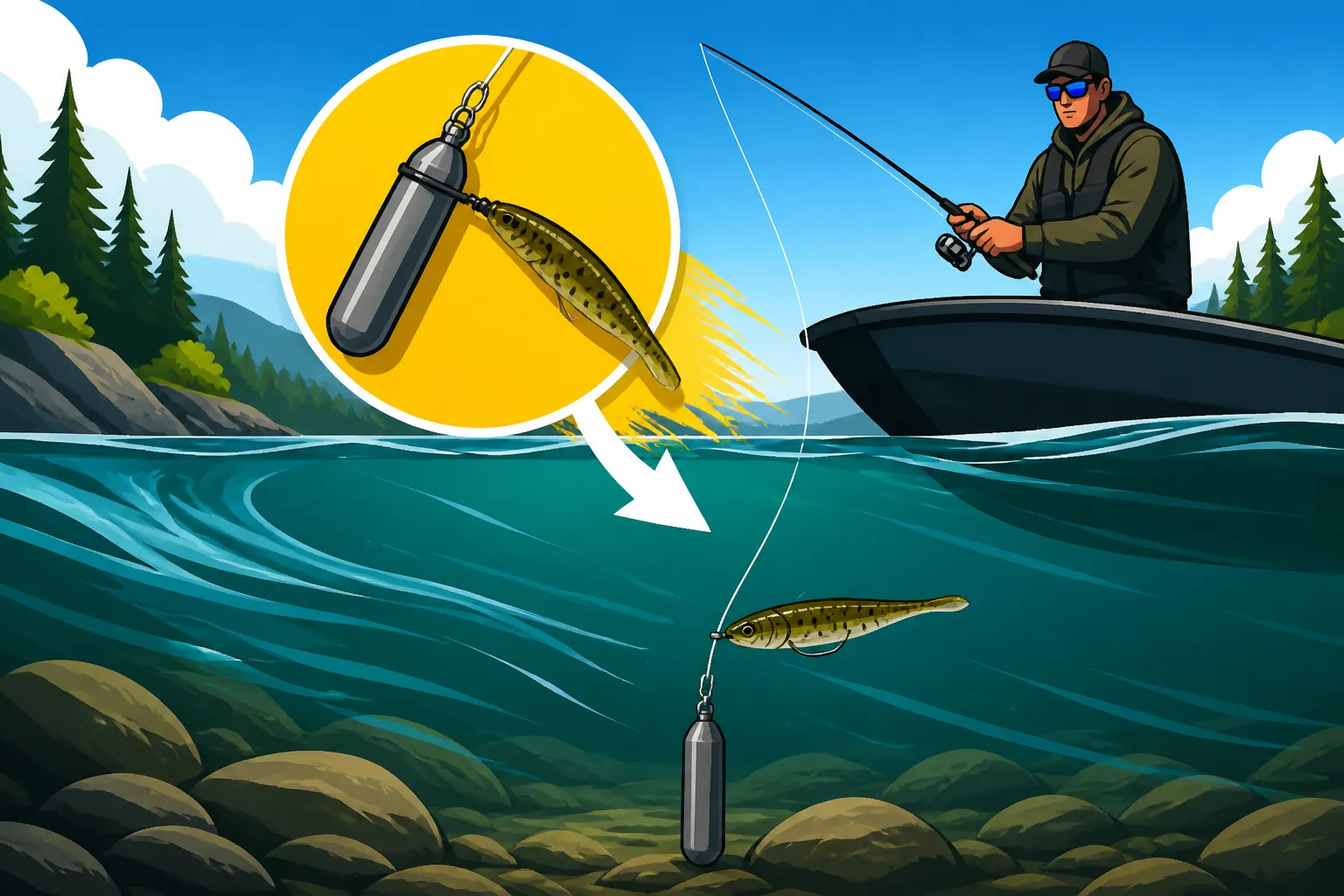
Cylinder Weights: Ah, the workhorse for current. Cylinder weights, sometimes called pencil weights, are long and slender. This streamlined profile offers minimal resistance to the current, allowing them to cut through the water more efficiently and maintain better bottom contact. They are less likely to roll than round weights, which helps keep your bait in the strike zone longer. Even better, they tend to get wedged between rocks or into crevices less often than round or teardrop weights because of their narrow profile, sliding out easily. For consistent bottom contact and excellent feel in current, a tungsten cylinder weight is often the top choice. When fishing rivers or river-like sections of lakes, this is often my go-to.
-
Teardrop Weights: These weights offer a hybrid approach, combining some of the snag resistance of round weights with a bit more stability than a pure round shape. Their broader base helps them sit on the bottom without rolling as much as a round weight, while the tapered top reduces some drag. They can be a good choice for moderate currents or areas with a mix of current and bottom structure where you might want a bit more "stick" to the bottom than a cylinder provides, but less tendency to roll than a round weight. However, they can still be prone to getting wedged in rocky bottoms more so than cylinders, which can be a real pain if you're trying to fish productive current seams.
Ultimately, for current, the cylinder shape, especially in tungsten, reigns supreme. It's designed to minimize drag and maximize your ability to feel the bottom and detect bites. I've found a substantial difference when switching to cylinder weights in windy conditions on the Bay of Quinte or in the faster flows of the Niagara River.
| Weight Material | Shape Type | Pros in Current | Cons in Current | Best Use Case |
|---|---|---|---|---|
| Lead | Round | Affordable | Low density, high drag, rolls easily, poor sensitivity | Very light current, still water |
| Lead | Teardrop | Affordable, some stability | Low density, moderate drag, can snag | Light to moderate current, mixed bottom |
| Lead | Cylinder | Affordable, decent cut through water | Low density, still higher drag than tungsten, less sensitive | Moderate current, sandy/muddy bottom |
| Tungsten | Round | High sensitivity | Still prone to rolling, higher drag than tungsten cylinder | Light current, maximum snag resistance |
| Tungsten | Teardrop | High sensitivity, good stability | Can snag in rocky current | Moderate current, mixed bottom, good feel |
| Tungsten | Cylinder | Highest sensitivity, lowest drag, best bottom contact, minimizes snags | Higher cost | Strong current, rocky bottom, deep water, subtle bites |
Matching Weight to Current Strength and Depth
Alright, we've talked about materials and shapes, but how much weight do you actually need? This isn't a "one size fits all" answer, unfortunately. The "best" drop shot weight is highly dependent on the specific conditions you're fishing – namely, the strength of the current and the depth of the water. Too light, and you'll be constantly swept away. Too heavy, and you'll lose that crucial finesse feel that makes drop shotting so effective.
Gauging Current Strength and Adjusting Weight
Learning to "read" the current is a skill that comes with practice, but there are some tell-tale signs. On a lake, observe your boat's drift if you're in one, or how your line behaves if you're shore fishing. Is your line bowing significantly downstream even with a reasonably heavy weight? Is your boat drifting faster than you'd like without the trolling motor? These are indicators of stronger current. You can also use your electronics to see if your jig is falling truly vertical, or being swept away. The more your line gets pushed, the more weight you'll need.
Start with a weight you think might be a bit too light, and then progressively move up until you achieve good bottom contact and a near-vertical line presentation. For example, if you typically use a 1/4 oz tungsten weight in still water, you might start with 3/8 oz or even 1/2 oz in a noticeable current. The goal is to use the minimum amount of weight necessary to maintain control. This is where high-quality line, like a sensitive braided main line with a fluorocarbon leader, really helps you feel what's going on down there. Best fluorocarbon leader for clear water walleye would be a good read for more on that.
In a situation like the St. Lawrence River near Gananoque, where currents can be surprisingly swift, I might start with a 1/2 oz or even 3/4 oz tungsten cylinder weight in 20-30 feet of water. If I feel my line bowing too much, or I can't distinguish between bottom contact and current drag, I'll go heavier. If I'm fishing a calmer pocket just out of the main flow, I might drop down to 3/8 oz or even 1/4 oz to enhance sensitivity. It's a constant adjustment game, and having a variety of weights on hand is absolutely key.
The Role of Depth in Weight Selection
Depth works hand-in-hand with current to determine your ideal weight. The deeper you're fishing, the more line you have out, and the more surface area that line presents to the current. This means more drag and a greater tendency for your line to bow. Therefore, in deeper water with current, you'll almost always need to go heavier on your drop shot weight than you would in shallow water with the same current strength.
Consider a scenario where you're fishing for smallmouth bass on a deep shoal in Georgian Bay, say 40 feet down, and there's a good push of water moving over it. A 1/4 oz tungsten might be fine in 15 feet, but at 40 feet, it'll likely be swept away. You might need to jump up to a 1/2 oz, 5/8 oz, or even a 3/4 oz tungsten weight to keep that bait down and feel what's happening. The longer the column of water your line is passing through, the more it will be affected by any movement in that water.
It's not just about the weight, either; your line choice plays a part. Using thinner diameter line, like a 10-15 lb braided mainline with a fluorocarbon leader, helps cut through the water better than thicker mono or fluoro lines, reducing drag and making your weights more effective. Best fluorocarbon line for clear lake water dives deeper into line choices. Always carry a range of weights, from 1/4 oz all the way up to 3/4 oz or even 1 oz, especially if you're exploring new areas or fishing in varying conditions on larger bodies of water. Amazon is a great place to stock up on a variety of weights without breaking the bank.
Tips and Techniques for Effective Drop Shotting in Current
Choosing the right weight is just one piece of the puzzle. How you actually present your rig, manage your line, and interpret what you're feeling are equally critical for success when drop shotting in current. It's about combining the right gear with smart angling techniques.
Line Management and Presentation
One of the biggest challenges in current is line management. That big bow in your line not only kills sensitivity but also makes it hard to keep your bait where you want it. Here are a few tips:
- Cast Upstream: This might sound counterintuitive, but by casting slightly upstream and letting your rig drift back to your target area, you give the current a chance to straighten your line. As the weight settles, you can slowly reel in slack to maintain a vertical presentation as it moves downstream. This technique is especially effective when targeting walleye in river channels or current seams on lakes.
- Keep Your Rod Tip Low and Pointed at the Line: By keeping your rod tip closer to the water's surface, you reduce the amount of line exposed to the wind and surface current, minimizing bow. Pointing your rod directly at your line's entry point into the water also creates a more direct path to your weight, enhancing feel.
- Use Your Trolling Motor or Anchor: If you're in a boat, a good trolling motor is your best friend. Use it to "hover" over your spot, battling the current just enough to keep your bait vertical. This allows you to use lighter weights and achieve a more natural presentation. If anchoring, try to anchor upstream of your target and let your rig drift back into the strike zone.
- Minimal Movement: With a drop shot, less is often more, especially in current. The current itself will impart some action to your bait. Focus on keeping your weight on the bottom and imparting very subtle shakes or lifts of your rod tip. Let the current do some of the work, making your bait look like a struggling minnow or crayfish.
Remember, the goal is to feel the bottom. If you stop feeling it, you either need more weight, or you need to reel in slack and re-establish contact. When you're fishing for active smallmouth, which often hold in current, this consistent bottom contact is crucial. For more on catching these tenacious fighters, check out How to Catch Smallmouth Bass in Ontario.
Detecting Bites and Setting the Hook
Detecting a bite in current can be tricky because the constant pull often feels like a fish. This is where tungsten weights really shine, offering unparalleled sensitivity. However, even with the best gear, you need to train yourself to distinguish between current and a fish.
- Watch Your Line: Beyond feeling, visually inspecting your line where it enters the water is critical. Any unnatural twitch, sideways movement, or sudden slack could indicate a bite. Sometimes, the only indication you get is a slight "tick" or a feeling of added weight, rather than a definitive "thump."
- Focus on the "Different": Don't expect a hard thud every time. Often, a bite in current will feel like something different than the usual current tug or bottom contact. It might feel like a spongy resistance, a slight cessation of the current's pull, or a faint tap. Your mind will play tricks on you, so practice and repetition are key.
- The "Sweep" Set: When you suspect a bite, don't rear back and yank hard like you would with a jig. Instead, make a firm, sweeping motion with your rod tip, moving it horizontally or slightly upward, reeling simultaneously. This takes up any slack and sets the hook effectively without ripping the bait out of the fish's mouth. Since fish in current often grab and hold, a firm sweep is usually all it takes.
Don't be afraid to experiment with your retrieval speed and presentation. Sometimes, letting the current push your bait for a few seconds before a subtle lift is all it takes to trigger a strike. It's a constant dance with the water, and learning to adapt is part of the fun of fishing Ontario's diverse waters.
Choosing Your Drop Shot Rod and Reel
While this article focuses on weights, the rod and reel you use are inseparable from the weight's performance, especially in current. You need a rod that can transmit those subtle tungsten vibrations up to your hand, and a reel that allows for precise line control.
- Rod Choice: For drop shotting in current, a medium-light to medium power spinning rod, typically 6'6" to 7'3" in length, with a fast or extra-fast action is ideal. The sensitive tip will help you feel those light bites and bottom changes, while the backbone allows for solid hooksets. The longer rod length helps with line control and casting distance, which can be advantageous when trying to cast upstream or manage a longer line. A good quality graphite rod is a must for sensitivity. You can often find great drop shot specific rods in places like Bass Pro Shops or on Amazon.
- Reel Choice: A smooth spinning reel in the 2000-3000 size range, with a good drag system, is perfect. Look for a reel with excellent line lay and a retrieve ratio that allows for both slow, controlled retrieves and quick slack take-up. The smooth drag is crucial when fighting larger fish in current, preventing line breaks.
- Line Choice (Again): As mentioned, a thin, low-stretch braided mainline (8-15 lb test) is paramount for sensitivity and cutting through current. Pair this with a fluorocarbon leader (6-10 lb test), which is nearly invisible underwater and has good abrasion resistance. The knot connecting your braid to your leader (like an FG or Albright knot) needs to be strong and streamlined. Remember, your line is your direct connection to the weight and the fish, so invest wisely. For more on this, consider reading Best Spinning Rods for Walleye as many of the principles apply to smallmouth and other species you target with a drop shot.
By combining the right tungsten cylinder weights with a sensitive rod, precise reel, and diligent line management, you'll be well-equipped to tackle whatever currents Ontario's incredible fishing waters throw at you.
Disclaimer
This article is for general informational purposes only and does not constitute professional advice. Laws, prices and regulations vary by location and change over time. Consult a qualified professional for guidance on your specific situation.