Non-Resident Annual Fishing License Cost in Ontario
Figuring out the exact cost of an annual fishing license in Ontario as a non-resident can feel like navigating a maze blindfolded. You're ready to plan that dream trip to the Kawarthas or a remote Northern Ontario lodge, but the last thing you want is a surprise bill or, worse, to be caught without the right paperwork. This comprehensive guide is here to untangle all the complexities, providing a clear, detailed breakdown of exactly what you’ll pay for a non-resident annual fishing license in Ontario, along with all the crucial details you need to know to fish legally and confidently.
Understanding Non-Resident Fishing Status in Ontario
Before we dive into the numbers, it's absolutely vital to understand what officially makes you a "non-resident" in the eyes of Ontario's fishing regulations. This classification isn't just a label; it directly impacts the type of license you need and how much you'll pay. Misunderstanding this can lead to purchasing the wrong license, which is something no one wants when they're excited to hit the water.
Who Qualifies as a Non-Resident Angler?
In Ontario, a "non-resident" for fishing license purposes is generally defined as any person who is not a resident of Ontario. This might sound straightforward, but it has important nuances. If you primarily live outside of Ontario, whether in another Canadian province or territory, or in another country entirely (like the United States or overseas), you are considered a non-resident angler. This distinction is paramount because the licensing structure, fees, and even some regulations can differ significantly from those for Ontario residents.
For instance, someone living in Manitoba or Quebec, while still a Canadian citizen, is treated as a non-resident by Ontario’s fishing license system. They won't qualify for the same pricing or exemptions that a long-term Ontario resident would. This is often a point of confusion, especially for those who travel between provinces frequently for recreation. Always remember, it’s about your primary place of residence relative to Ontario, not your national citizenship.
The reason for this clear separation largely boils down to how fisheries management is funded and managed within the province. Ontario residents contribute through their provincial taxes, which help support the Ministry of Natural Resources and Forestry (MNRF) programs that manage fish stocks, enforce regulations, and maintain access points. Non-residents, while welcome and highly valued contributors to the provincial tourism economy, are expected to contribute directly to these efforts through their license fees.
The Outdoors Card Requirement for Non-Residents
Here's where many non-residents first encounter a bit of a hurdle: the Outdoors Card. It's not just a fishing license; it's a mandatory identification card that you must possess before you can purchase any fishing or hunting license in Ontario, regardless of your residency status. Think of it as your unique angler ID within the province's system. For non-residents, this card is just as essential as the fishing license itself. You can't have one without the other, at least not for annual licenses.
The Outdoors Card is not a fishing license in and of itself, but rather a prerequisite. It confirms your identity and provides a unique customer number that links all your licenses and permits within the provincial system. When you purchase your first fishing license as a non-resident, you'll need to purchase an Outdoors Card concurrently. This card remains valid for a three-year period, meaning you only need to renew it every three years, not annually. This is a crucial detail, as it impacts your initial outlay versus subsequent years.
Once you have your Outdoors Card, it acts as your permanent customer profile. When you return for future fishing trips within that three-year validity period, you only need to purchase the appropriate fishing license (annual, 1-day, etc.) and not another Outdoors Card. This streamlines the process considerably for returning visitors. You can find more in-depth information about this essential document in our guide, "Ontario Outdoors Card, Explained".
Different License Options: Sport vs. Conservation
Now that we've covered the Outdoors Card, let's talk about the actual fishing licenses. Non-residents in Ontario have two main choices for their annual fishing license: a Sport Fishing License or a Conservation Fishing License. This choice isn't just about price; it's about how much fish you can keep and your overall approach to angling in the province. Understanding the distinction is key to fishing responsibly and avoiding unintentional violations.
The Sport Fishing License is the option that allows for higher possession and catch limits. It's designed for anglers who enjoy keeping a portion of their catch, within legal limits, to take home or enjoy at the lodge. If your goal is to have the maximum legal opportunity to harvest fish, then the Sport Fishing License is likely the one for you. However, it's important to remember that "higher limits" doesn't mean unlimited. All species still have strict daily and possession limits that must be adhered to.
On the other hand, the Conservation Fishing License is designed for anglers who prefer to catch and release most of their fish, or only keep a very small amount for a fresh meal. This license type comes with reduced catch and possession limits—often half of what a Sport Fishing License allows, or sometimes even catch-and-release only for certain species or in specific zones. The idea here is to promote greater conservation of fish stocks, putting less pressure on the resource. It’s a great option for those who primarily fish for the sport and experience, rather than for the freezer. This distinction is so important that we have a dedicated article, "Ontario Sport vs Conservation Fishing License", that delves even deeper into the nuances of each.
Detailed Breakdown of Annual Non-Resident Fishing License Costs
Alright, let's get down to the nitty-gritty: the actual dollar amounts you can expect to pay. It’s important to remember that these figures are current at the time of writing and are subject to change, so always double-check the official Ontario government website before your trip. However, this breakdown will give you a very accurate picture of what you’ll be budgeting for.
Non-Resident Annual Sport Fishing License
The Non-Resident Annual Sport Fishing License provides the most generous catch and possession limits for anglers visiting Ontario from outside the province. It's the go-to choice for many who plan an extended stay or multiple trips throughout the year and wish to bring home some of their hard-earned catch.
As of early 2024, the cost for a Non-Resident Annual Sport Fishing License is approximately $61.18 CAD. This price, like all license fees in Ontario, is subject to applicable taxes (HST) which will be added at the time of purchase. So, while $61.18 is the base fee, expect the final total to be slightly higher once taxes are applied. This license is valid for a full calendar year, from January 1st to December 31st, regardless of when you purchase it. So, if you buy it in July, it will still expire on December 31st of that same year.
Anglers choosing this license should be fully aware of the specific regulations for the waters they are fishing. While it offers higher limits, you still need to consult the current Ontario Fishing Regulations Summary to understand species-specific rules, size restrictions, and sanctuary areas. The Sport license allows you to participate in most recreational fishing opportunities across Ontario, from targeting trophy walleye on Lake Nipissing to casting for smallmouth bass on Georgian Bay, all with the privilege of higher harvest potential than the conservation option.
Non-Resident Annual Conservation Fishing License
For those who prioritize the thrill of the catch and are less focused on filling a cooler, the Non-Resident Annual Conservation Fishing License is an excellent, more economical option. This license reflects a commitment to sustainable angling practices by imposing reduced catch and possession limits, often half of what the Sport license allows.
Currently, the Non-Resident Annual Conservation Fishing License costs approximately $37.91 CAD. Again, this amount is the base fee, and Harmonized Sales Tax (HST) will be added at the point of sale. This makes it a significantly more affordable choice than the Sport license, appealing to anglers on a tighter budget or those who simply prefer to practice catch and release. Like its Sport counterpart, this license is valid from January 1st to December 31st of the year it's purchased.
Choosing a Conservation license means you're still getting the full Ontario fishing experience, just with more stringent limits on what you can retain. For some popular species, certain lakes or zones might even be catch-and-release only regardless of your license type, but the Conservation license generally defaults to more restrictive harvesting opportunities. It's perfect for the fly angler pursuing brook trout in Crown land lakes, or the muskie enthusiast who plans to photograph their catch before releasing it to fight another day. It also means you’re contributing to the long-term health of Ontario’s fisheries in a very tangible way.
The Mandatory Non-Resident Outdoors Card Cost
As we discussed earlier, the Outdoors Card is a separate, foundational component of your licensing. You cannot purchase an annual fishing license without first having a valid Outdoors Card. This is a critical point that often catches first-time non-resident visitors off guard, as it represents an additional, distinct cost.
The cost for a Non-Resident Outdoors Card is approximately $8.57 CAD. This fee also has HST applied at the time of purchase. Remember, this card is valid for three full years from its date of issue. So, while it adds to your initial cost, you won't need to purchase it again for your next two annual fishing trips, assuming they fall within that three-year window. This multi-year validity is a key benefit, spreading the cost out over time.
When calculating your total expense for your first annual non-resident fishing trip to Ontario, you must factor in the Outdoors Card. It's not an optional extra; it's a fundamental part of the system. In subsequent years, if your Outdoors Card is still valid, you simply purchase your desired Sport or Conservation fishing license, saving you that $8.57 (plus tax). It’s a bit like a fishing passport for Ontario, allowing the provincial government to track your licensing history and ensure compliance.
Here's a quick summary table of the approximate base costs (before HST) for non-resident annual fishing in Ontario:
| Item | Description | Approximate Cost (CAD, before HST) | Validity Period |
|---|---|---|---|
| Outdoors Card | Mandatory ID card for all licenses | $8.57 | 3 years |
| Annual Sport Fishing License | Higher catch & possession limits | $61.18 | January 1 – December 31 |
| Annual Conservation Fishing License | Reduced catch & possession limits | $37.91 | January 1 – December 31 |
Note: All prices are subject to change and Harmonized Sales Tax (HST) will be added at the time of purchase.
Factors Influencing Your Total Non-Resident Fishing Expense
Understanding the individual costs is one thing, but planning your budget means considering how these components combine and what other variables might come into play. It's not always as simple as adding two numbers together, especially when you think about trip duration and other potential charges.
Combining the Outdoors Card with Your License
When you make your very first annual fishing license purchase as a non-resident, you'll always buy the Outdoors Card and your chosen fishing license together. This is a single transaction, though the system clearly itemizes both components. For example, if you opt for a Non-Resident Annual Sport Fishing License, your initial outlay will be the Outdoors Card fee plus the Sport Fishing License fee, plus HST on both.
Let's do a quick calculation with the approximate base fees (before HST) to illustrate:
- Outdoors Card: $8.57
- Annual Sport Fishing License: $61.18
- Total for first-time non-resident annual Sport license: $69.75 (plus HST)
If you chose the Conservation option for your first year:
- Outdoors Card: $8.57
- Annual Conservation Fishing License: $37.91
- Total for first-time non-resident annual Conservation license: $46.48 (plus HST)
In subsequent years, as long as your Outdoors Card is still valid (i.e., within its three-year window), you would simply pay for the annual fishing license itself, significantly reducing your cost for those years. This is a common point of relief for returning anglers! This initial combined purchase is managed seamlessly whether you buy online or in person, ensuring that all necessary identification and licensing requirements are met from the get-go.
Short-Term vs. Annual License Considerations
While this guide focuses on annual licenses, it's really important for non-residents to consider if an annual license is truly the most economical option for their specific trip plans. Ontario offers shorter-term non-resident licenses, specifically 1-day, 3-day, and 8-day options. For many visitors, especially those coming for a single, brief fishing getaway, these shorter licenses can save a considerable amount of money.
Consider a non-resident who plans one single long weekend trip to Ontario per year. Buying an annual Sport Fishing License at $61.18 (plus Outdoors Card and HST) might seem reasonable, but an 8-day non-resident Sport Fishing License is often much less. For example, the approximate cost of an Ontario 1-Day Non-Resident Fishing License Cost is significantly lower, and the 8-day is also substantially cheaper than the full annual option. If you're only spending a few days fishing and won't return later in the year, a short-term license (which includes the Outdoors Card component within its price for that period) is almost always the smart financial choice.
However, if you anticipate making two or more trips to Ontario within a calendar year, or if your single trip extends beyond 8 days, then the annual license quickly becomes the more cost-effective choice. It truly pays to do a quick calculation based on your itinerary. Don't just default to the annual option; assess your needs to ensure you’re not overpaying. This flexibility in licensing options is designed to accommodate the diverse travel plans of non-resident anglers.
Potential Additional Fees or Charges
Beyond the base license and Outdoors Card fees, there are a few other financial considerations that might subtly increase your total expense, though usually not by much. The most consistent additional charge will be the Harmonized Sales Tax (HST). In Ontario, HST is 13% and is applied to all fishing licenses and the Outdoors Card at the point of purchase. This is standard for almost all goods and services in the province, so it shouldn't come as a surprise. When you see a price advertised, always assume HST will be added.
Sometimes, if purchasing through certain third-party vendors or online platforms not directly managed by the MNRF portal, there might be a small processing or convenience fee. While the official Ontario website aims for transparency, some independent retailers might add a nominal charge for their services. This is not common with the main online system or ServiceOntario locations, but it's something to be aware of if you're buying from a remote tackle shop, for example. Always confirm the final price before completing your transaction.
Lastly, while not a direct purchase fee, consider potential costs associated with replacements if you lose your physical license or Outdoors Card. While it's relatively easy to print a new one if you purchased online (we'll get to that soon!), requesting a physical replacement from a vendor might incur a small administrative fee. Ontario's policy on refunds for fishing licenses is quite strict, generally only allowed in very specific and rare circumstances, so assume your purchase is final.
Where and How Non-Residents Can Purchase Licenses
Once you've decided on the right license type, the next step is actually acquiring it. Thankfully, Ontario has made the process quite accessible for non-residents, with options both online and in person. Knowing these avenues beforehand will save you time and hassle, allowing you to get on the water faster.
Online Purchase Process for Non-Residents
For many non-resident anglers, the most convenient and straightforward way to purchase an annual fishing license is online. The Ontario government's Fish and Wildlife Licensing Service portal is robust and user-friendly. It allows you to complete the entire process from the comfort of your home, anytime, anywhere. This method is highly recommended for its efficiency and ease.
Here’s a general step-by-step guide for purchasing your non-resident annual fishing license online:
- Visit the Official Ontario Licensing Website: Navigate to the dedicated Fish and Wildlife Licensing Service portal.
- Create a Profile or Log In: If it's your first time, you'll need to create a customer profile. This is where you'll provide personal identification details, including your name, date of birth, and mailing address. This step will also initiate the creation of your Outdoors Card. If you already have an Outdoors Card, you'll simply log in using your Outdoors Card number or other credentials.
- Select Your License Type: From the available options, choose the "Non-Resident" category, and then select either the "Annual Sport Fishing License" or "Annual Conservation Fishing License." If your Outdoors Card is expired or you don't have one, the system will prompt you to add it to your cart automatically.
- Review and Confirm: Double-check all the details you've entered and ensure you've selected the correct license type and residency status. This is crucial to avoid any errors.
- Payment: Proceed to the secure payment portal. You'll need a valid credit card (Visa, MasterCard, American Express are typically accepted). Remember, HST will be applied at this stage.
- Print Your License: Once the transaction is complete, you'll receive a confirmation and usually a link to immediately print your temporary fishing license and Outdoors Card. It's highly advisable to print a physical copy and carry it with you, even if you plan to rely on a digital version. For a more detailed walkthrough, check out "How to Buy an Ontario Fishing License Online".
The online system is available 24/7, making it ideal for planning your trip at any hour. This flexibility means you can secure your license well in advance of crossing the border, eliminating any last-minute stress.
In-Person Purchase Options at ServiceOntario & Vendors
While online purchasing is increasingly popular, you still have the option to buy your non-resident annual fishing license in person. This can be particularly useful if you have questions, prefer a physical interaction, or find yourself without internet access before your trip.
You can purchase licenses at:
- ServiceOntario Centres: These are provincial government offices that handle a wide array of services, including fishing and hunting licenses. They are located in many towns and cities across Ontario. Staff can assist you with the application process and answer specific questions.
- Authorized License Issuers: This includes a vast network of tackle shops, sporting goods stores, bait shops, and some general stores throughout the province. Many of these vendors are avid anglers themselves and can offer valuable local fishing advice in addition to issuing your license. Just look for signage indicating "Fish and Wildlife Licensing Agent" or similar.
When purchasing in person, you'll need to bring valid photo identification (e.g., passport, driver's license) as proof of your non-resident status and for your Outdoors Card profile. The vendor will process your request, take payment, and issue you a physical Outdoors Card and fishing license. This tangible proof of purchase can be reassuring for some anglers. Finding a vendor can be as simple as searching online for "Ontario fishing license vendors near me" once you're in the province.
Understanding Digital vs. Physical Proof of License
In today's digital age, Ontario has adapted to allow for both digital and physical proof of your fishing license. This offers convenience but also requires a bit of foresight to ensure you're always compliant.
When you purchase online, you'll receive an email with your license details, which you can save to your smartphone or other mobile device. This digital copy, presented on your screen, is considered valid proof of your license. The convenience here is obvious – no paper to lose, and it’s always with you as long as your phone has battery. However, relying solely on a digital copy comes with its own risks. What if your phone battery dies? What if you drop it in the lake? What if you're in an area with no cell service and a conservation officer asks to see your license?
For these reasons, it is highly recommended to print a physical copy of your license and Outdoors Card. You can keep this paper copy laminated (if you're resourceful) or simply in a waterproof bag alongside your fishing gear. This serves as a reliable backup should your digital option fail. Many anglers choose to do both: have the digital copy readily available on their phone and a paper backup in their tackle box or wallet. It’s better to be overly prepared than underprepared, especially when a conservation officer asks to see your credentials. Our article "Printing or Carrying a Digital Fishing License in Ontario" provides even more practical tips on this.
Always remember that in addition to your license, you must carry a piece of government-issued identification that matches the information on your fishing license and Outdoors Card. This is usually a driver's license or passport. This helps confirm your identity and residency status to enforcement officials.
Common Questions and Misconceptions for Non-Residents
It's natural to have questions, especially when navigating a new set of regulations in a different jurisdiction. Non-residents often come with a unique set of queries, and clearing up common misconceptions can save a lot of confusion and potential issues on your trip.
Non-Resident Youth and Senior Exemptions
One of the most frequent areas of confusion for non-residents revolves around age-based exemptions. Many jurisdictions, including Ontario for its residents, offer free or reduced-cost licenses for youth and seniors. However, it's crucial to understand that these exemptions generally do not apply to non-residents.
- Non-Resident Youth: In Ontario, non-resident youth typically require a fishing license once they reach a certain age, often 18. While Ontario residents under 18 do not need a license (provided they fish with an adult who has one and stay within that adult's combined limits), non-resident youth usually do not benefit from this exemption. If your child is a non-resident and plans to fish, it's best to confirm the exact age requirement for a license to avoid any misunderstandings. Our guide on "Ontario Youth Fishing License Exemption Under 18" clarifies the rules for residents, which helps highlight the difference for non-residents.
- Non-Resident Seniors: Similarly, while Ontario residents aged 65 and older receive free fishing licenses, this significant benefit does not extend to non-resident seniors. If you are a non-resident senior planning to fish in Ontario, you will need to purchase the appropriate non-resident fishing license and Outdoors Card, just like any other adult non-resident. It's a common oversight, so please be aware of this difference. For comparison, you can read more about "Ontario Senior Fishing License Exemption at 65".
Always consult the most current Ontario Fishing Regulations Summary for precise age requirements for non-residents, as these can occasionally be updated. The general rule of thumb, though, is that if you're a non-resident, assume you'll need a license unless explicitly stated otherwise.
Boundary Water Reciprocity (e.g., Great Lakes, Quebec, Manitoba)
Another area of frequent inquiry for non-residents is fishing in "boundary waters" – bodies of water that straddle the line between Ontario and another province or country. The question often arises: "If I have a license from [other jurisdiction], do I still need an Ontario license?" The short answer, in almost all cases, is yes, you will need an Ontario fishing license to fish on the Ontario side of these waters.
For example, when fishing the Great Lakes, such as Lake Erie or Lake Superior, if you launch from or fish within Ontario waters, you are subject to Ontario's fishing regulations and licensing requirements, regardless of whether you hold a fishing license from a U.S. state bordering the lake. The same principle applies to shared rivers or lakes with neighbouring Canadian provinces like Quebec or Manitoba. While there might be limited reciprocal agreements for certain species or specific small boundary waters, these are exceptions, not the rule. It is rarely the case that a license from another jurisdiction fully covers you for fishing in Ontario.
Always operate under the assumption that an Ontario fishing license is required when you are fishing in Ontario’s waters. It is the safest and most compliant approach. Relying on assumed reciprocity can lead to significant fines and a ruined fishing trip. Be sure to understand "Ontario Fishing License Reciprocity on the Great Lakes with the United States" or with other provinces if you plan to fish near a border.
Consequences of Fishing Without a Valid Non-Resident License
This is perhaps the most serious misconception to clear up: fishing without a valid license in Ontario is a serious offense, and the consequences can be severe. It's not just a slap on the wrist; it can genuinely put a damper on your entire trip and potentially affect future visits.
If you are caught fishing without an Outdoors Card and a valid fishing license (Sport or Conservation, as appropriate for your activity), you can face substantial fines. These fines are designed to be a deterrent and can easily run into hundreds of dollars, sometimes even more depending on the nature of the violation. Beyond monetary penalties, conservation officers also have the authority to confiscate your fishing equipment (rods, reels, tackle) and potentially even your boat or vehicle if it was used in the commission of the offense. In serious or repeat cases, you could also face a fishing suspension, meaning you would be prohibited from fishing in Ontario for a specified period.
The Ontario Ministry of Natural Resources and Forestry (MNRF) conservation officers are highly trained and regularly patrol fishing areas, both popular and remote. They are diligent in checking licenses and compliance with regulations. It's simply not worth the risk to fish without the proper documentation. The minimal cost of a license pales in comparison to the potential legal and financial repercussions. For a detailed overview of what you could face, read "Fishing Without a License in Ontario: Penalties". Always ensure your license is current, valid for your residency status, and readily available for inspection.
Maximizing Value: Planning Your Ontario Fishing Trip as a Non-Resident
Now that you've got the lowdown on licensing costs and procedures, let's talk about how to make the most of your non-resident fishing adventure in Ontario. A well-planned trip isn't just about saving money on licenses; it's about having a seamless, enjoyable, and successful experience from start to finish.
Researching Ontario Fishing Regulations by Zone
Getting your license is just the first step; understanding the rules of the road (or, in this case, the water) is equally critical. Ontario's vast geography means that fishing regulations can vary significantly depending on where you cast your line. The province is divided into 20 Fisheries Management Zones (FMZs), and each zone can have different seasons, catch limits, and size restrictions for various species.
Before you even pack your first lure, thoroughly research the specific regulations for the Fisheries Management Zone you plan to visit. This includes knowing the season dates for your target species (e.g., when walleye or bass open), the daily and possession limits, and any special regulations for specific lakes or rivers within that zone. For instance, the walleye opener dates for FMZ 18 are likely different from those in FMZ 15, and failing to know this could lead to serious issues.
The official "Ontario Fishing Regulations Explained" summary is your best friend here. You can download it as a PDF or access it online. It's a comprehensive document, so take your time to digest the information relevant to your chosen destination and species. Understanding "Ontario Fisheries Management Zones, Explained" will provide crucial context for these variable rules. Many experienced non-resident anglers carry a printed copy of the relevant section of the regulations, or have it saved digitally, right alongside their license.
Essential Gear Considerations for Non-Residents
As a non-resident, you're likely traveling a distance, so packing smart is key. While we can't cover every piece of gear, here are a few considerations that are especially relevant for those venturing into Ontario's diverse fishing environments.
First off, consider the weather. Ontario's weather can be unpredictable, especially in spring and fall. Quality rain gear is non-negotiable. Look for waterproof and breathable jackets and pants to stay comfortable through unexpected showers. Brands like Simms or Columbia offer excellent options, and you can often find great deals on robust gear through online retailers like Amazon. Having proper layering clothes, including thermal wear, is also vital for early season or late fall trips, particularly in Northern Ontario.
Next, think about your tackle. Instead of bringing every lure you own, research the local baitfish and preferred techniques for your target species and location. If you’re chasing Walleye Fishing in Ontario, you might need specific jigs or crankbaits that mimic local forage. If you're heading to a remote lodge, consider bringing extra line, hooks, and basic repair kits, as access to tackle shops might be limited. A good tackle box setup for Ontario anglers should be versatile.
Finally, think about comfort and safety. Polarized sunglasses are essential for reducing glare and spotting fish. A quality first-aid kit is a must, especially if you're venturing into more remote areas. And don't forget bug spray – Ontario summers can be notorious for black flies and mosquitoes, particularly away from urban centers. Having the right gear not only enhances your enjoyment but also ensures your safety and preparedness for whatever Ontario's wilderness throws your way.
Boating Requirements for Non-Resident Anglers
If your Ontario fishing trip involves a boat, whether you're bringing your own or renting one locally, there are specific boating regulations you, as a non-resident, need to be aware of. These rules are designed for safety and compliance and are enforced by the same authorities who check fishing licenses.
The most important document for operating a powered recreational vessel in Canada is the Pleasure Craft Operator Card (PCOC). This card proves you have successfully completed an accredited boating safety course. If you plan to operate any motorized boat, regardless of engine size, you are legally required to have a PCOC or an equivalent recognized boating competency from your home jurisdiction. Many U.S. state boating licenses are recognized, but always carry proof of your competency. Our article "Ontario Boating Laws for Anglers" goes into great detail about this.
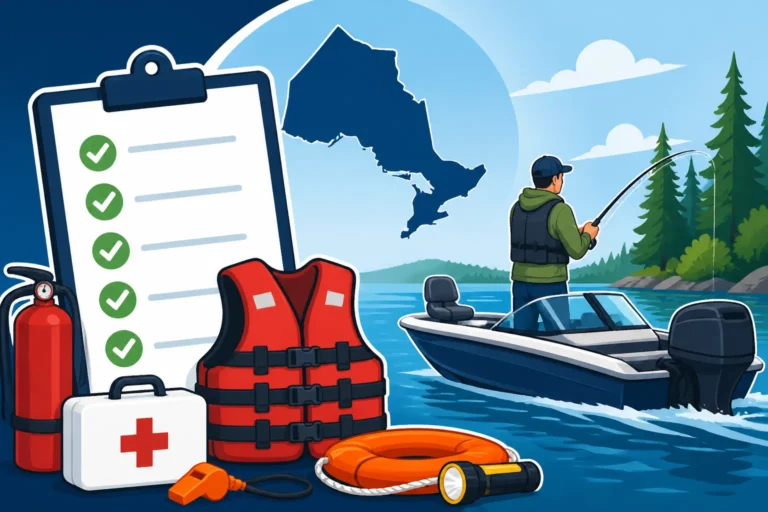
Beyond the PCOC, all boats must carry specific required safety equipment. This checklist includes items like life jackets for every person on board, a sound-signaling device, a bailer or pump, a throw bag, and navigation lights for night operation. The exact requirements vary slightly based on the size and type of vessel. This is not optional; failure to have the correct safety gear can result in fines and having your boat ordered to shore. Make sure to check "Life Jacket Requirements for Ontario Boaters" for detailed specifics.
Bringing your own boat from out of province or country also requires knowledge of potential import or registration rules, though typically for short recreational visits, displaying your home state/province registration numbers is sufficient. However, it's always wise to verify the latest regulations regarding out-of-province vessel operation in Ontario. Planning ahead for these boating requirements ensures your time on the water is safe, legal, and stress-free.
Disclaimer
This article is for general informational purposes only and does not constitute professional advice. Laws, prices and regulations vary by location and change over time. Consult a qualified professional for guidance on your specific situation.