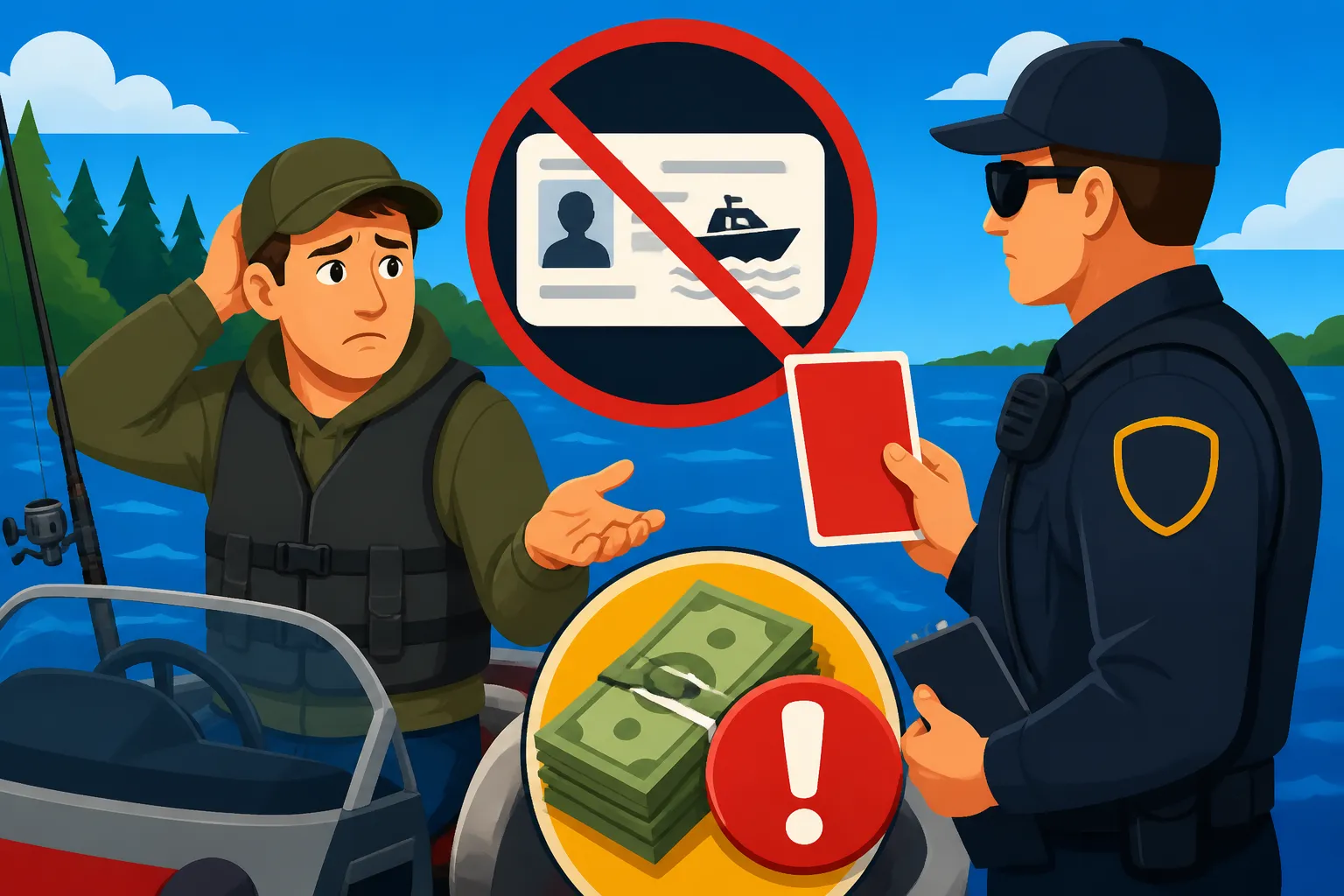
Ontario minimum fine for no Pleasure Craft Operator Card
There's nothing quite like the feeling of being out on an Ontario lake, the sun on your face, and the hum of your boat's engine as you head to your favourite fishing spot. However, that serene experience can quickly turn stressful if you're stopped by authorities and realize you don't have your Pleasure Craft Operator Card (PCOC). Many anglers find themselves caught off guard by the mandatory nature of this document and the penalties associated with not having one. This comprehensive guide will walk you through the minimum fine for operating without a PCOC in Ontario, along with all the critical details you need to stay compliant and enjoy the water worry-free.
Understanding the Pleasure Craft Operator Card (PCOC) in Ontario
The Pleasure Craft Operator Card (PCOC) is essentially your driver's license for the water when it comes to powered vessels in Canada. It's a federal requirement, meaning it applies across the country, including all the beautiful lakes and rivers of Ontario. The card signifies that you've passed a boating safety course and demonstrated basic knowledge of safe boating practices and regulations. It’s not just a piece of plastic; it’s a commitment to safety on our shared waterways.
What is the PCOC and Why is it Mandatory?
The PCOC was introduced to improve safety on Canadian waters. Before its implementation, many individuals operated boats with little to no formal training, leading to preventable accidents. The card ensures that anyone operating a boat with a motor – regardless of its size, horsepower, or whether it’s a personal watercraft (PWC) like a Jet Ski, a small fishing boat, or a large cruiser – has at least a foundational understanding of the rules of the road (or, in this case, the water). This includes everything from navigation rules and buoyage systems to basic safety equipment requirements and understanding the impact of operating under the influence. It’s about creating a safer environment for everyone, from competitive anglers to families enjoying a leisurely cruise.
Who Exactly Needs a PCOC in Ontario?
If you plan to operate any recreational boat fitted with a motor in Ontario, you need a PCOC. This applies to everyone, from residents to visitors. There are very few exemptions, and these are usually specific and temporary. For instance, non-residents who hold a valid equivalent competency certificate from their home country or state, or those operating a rented pleasure craft for a short period, might have certain allowances. However, for the vast majority of people living in or regularly fishing in Ontario, possessing a PCOC is a non-negotiable part of responsible boating. Even if you're just using a small electric trolling motor on your canoe or kayak, the PCOC requirement still applies. You can learn more about specific requirements in our detailed guide on the Ontario Pleasure Craft Operator Card Requirement.
The Financial Sting: Minimum Fine for Operating Without a PCOC
Getting caught without your PCOC isn't just an inconvenience; it comes with a direct financial penalty. Marine police, OPP, and other enforcement officers regularly patrol Ontario's waters, and they are empowered to stop vessels to check for compliance with federal and provincial regulations. One of the first things they'll ask for, after a friendly greeting, is your proof of competency.
The Minimum Fine for Operating Without a PCOC
If you are found operating a powered pleasure craft in Ontario without the required PCOC, or without proof of competency, you are subject to a minimum fine of $250. This isn't a suggestion; it's a firm penalty. This fine is set by Transport Canada, the federal body responsible for marine regulations, and it's uniformly applied across the country.
Imagine you've just trailered your boat down to Lake Simcoe for a day of perch fishing, or perhaps you're on the French River chasing walleye. You're feeling good, the weather's perfect, and then you see the flashing lights of a patrol boat. When they ask for your PCOC and you realize you left it at home, or worse, never got one, that $250 fine suddenly becomes a very real and unwelcome part of your day. It’s an immediate hit to your wallet, and it can certainly sour an otherwise fantastic fishing trip. This fine applies whether you outright don't have the card or if you simply failed to carry it onboard. It’s essential to have it with you, much like your Ontario Fishing License Guide for 2026.
Factors That Can Increase Your Fine
While $250 is the minimum fine for not having a PCOC, several other factors can escalate the total penalty. Enforcement officers are not just checking for your PCOC; they're also looking at overall safety compliance. If they find other infractions during their stop, those will be added on.
Here are a few common scenarios that can lead to higher total fines:
- Failure to produce the card: Even if you have a PCOC but can't produce it on demand, it can sometimes lead to a separate, though often similar, fine.
- Insufficient safety equipment: This is a big one. Life jackets, sound-signalling devices, bailers, fire extinguishers – if any mandatory safety equipment is missing or not in working order, you'll be ticketed for each deficiency. We have a detailed guide on the Ontario Required Boat Safety Equipment Checklist that can help you avoid these issues.
- Operating without proper registration/licensing: While the PCOC is for the operator, the boat itself might require licensing (for vessels with engines 10 horsepower or more). Failure to display the pleasure craft license numbers correctly or not having the appropriate documentation can add to the fine. See our article on Ontario Boat Registration and Licensing Rules for more information.
- Speeding or reckless operation: If the initial stop was due to observed unsafe boating, additional fines for those behaviors will definitely apply.
- Alcohol or drug impairment: This is a severe offense, carrying much steeper penalties than a simple PCOC infraction. Operating a boat while impaired is taken just as seriously as driving a car while impaired. You can read more about this in our guide on Ontario Boating Under the Influence Penalties.
To give you a clearer picture, here’s a quick overview of potential fines for various boating infractions:
| Infraction | Minimum Fine (Approximate) | Additional Consequences |
|---|---|---|
| Operating without PCOC / Proof of Competency | $250 | Can increase if other infractions are found. |
| Not carrying sufficient safety equipment | $200 per item | Potential impoundment, increased accident risk. |
| Not having enough life jackets onboard | $200 per missing jacket | Severe safety risk, especially for children. |
| Failure to display vessel license numbers | $250 | Can hinder identification in case of emergency. |
| Operating unlicenced vessel (over 10 HP) | $250 | Legal complications. |
| Operating at unsafe speed or recklessly | Varies, $250+ | Potential accidents, injury, higher insurance premiums. |
| Operating while impaired by alcohol or drugs | $1,000+ | Criminal charges, license suspension, jail time. |
As you can see, the $250 PCOC fine is just the starting point. Layering on other common violations can quickly turn a casual day on the water into a very expensive outing, easily costing you upwards of $1,000.
Beyond the Fine: Other Consequences and Risks
While the immediate financial penalty of a $250 fine is certainly a deterrent, the consequences of not having a PCOC stretch far beyond that. There are significant legal, safety, and even insurance implications that every boater should be aware of.
Legal Implications and Getting Stopped
Being stopped by marine law enforcement can be an uncomfortable experience, even if you're fully compliant. If you don't have your PCOC, it means the interaction will likely involve a fine. Repeated offenses could lead to more severe actions, though this is less common for a PCOC alone. More importantly, it demonstrates a lack of basic knowledge that could factor into other charges if you were involved in an accident. Officers are there to ensure safety, and an uncertified operator raises a red flag. Always remember to carry proof of your PCOC, much like you would carry your Printing or Carrying a Digital Fishing License in Ontario.
The True Cost of Neglecting Safety
The PCOC isn't just about avoiding a fine; it's about saving lives and preventing injuries. The course covers crucial topics like:
- Navigation Rules: Understanding port and starboard, right-of-way, and safe passing procedures. Without this, you're a hazard on crowded waters.
- Buoyage System: Knowing what different buoys mean (e.g., hazard markers, safe water markers) is vital for avoiding submerged rocks or navigating channels.
- Emergency Procedures: What to do in case of a fire, man overboard, or collision.
- Environmental Responsibility: Proper disposal of waste, preventing fuel spills, and understanding fishing regulations specific to Ontario Fisheries Management Zones, Explained.
Operating without this foundational knowledge puts you, your passengers, and other boaters at risk. A moment of inattention or a lack of understanding can lead to serious accidents, injuries, or even fatalities. The emotional and financial toll of an accident far outweighs the cost and effort of getting your PCOC. This is especially true if you are on popular fishing lakes like those covered in our Lake Simcoe Fishing Guide or Lake Erie Fishing Guide, where boat traffic can be significant.
Insurance Issues and Liability
This is a critical, often overlooked consequence. Your boat insurance policy, much like your car insurance, is a contract. Most policies will have clauses regarding operator competency. If you are involved in an accident and it's discovered that you were operating the vessel without a mandatory PCOC, your insurance company could deny your claim.
Imagine this scenario: you accidentally collide with another boat, causing significant damage to both vessels and maybe even injuring someone. If your insurance provider learns you didn't have your PCOC, they might refuse to cover the damages, leaving you personally liable for potentially hundreds of thousands of dollars in repair costs, medical bills, and legal fees. The small amount of time and money saved by not getting a PCOC suddenly looks minuscule compared to this massive financial risk. For this reason alone, ensuring you have your PCOC, and it's up-to-date, is non-negotiable for any responsible boater. This also extends to other safety gear, such as proper Life Jacket Requirements for Ontario Boaters, which can affect insurance claims.
How to Avoid the Fine: Getting Your PCOC
The good news is that avoiding the minimum $250 fine is incredibly straightforward. Getting your Pleasure Craft Operator Card is a simple, affordable, and lifelong investment in your safety and enjoyment on the water.
The Process of Obtaining a PCOC
Getting your PCOC typically involves three main steps:
- Enroll in an accredited course: There are several Transport Canada-approved course providers. Many offer online courses, which are incredibly convenient. You can study at your own pace, from the comfort of your home, using your computer, tablet, or even smartphone. This flexibility makes it easy to fit into any schedule.
- Complete the course material: The course covers all the essential topics mentioned earlier: navigation, safety equipment, emergency procedures, environmental concerns, and the rules of the road. It usually involves interactive modules, quizzes, and videos to help you understand the material.
- Pass the final exam: Once you feel confident with the material, you'll take a Transport Canada-approved final exam. This exam is usually done online, often with immediate results. If you pass, you'll receive your temporary PCOC right away, and a permanent card will be mailed to you. Don't stress too much about the exam; if you pay attention to the course material, you'll do great!
Some providers also offer in-person courses, which can be great for those who prefer a classroom setting or have specific questions for an instructor. However, the online option is by far the most popular due to its convenience.
Cost and Time Commitment
The cost of a PCOC course can vary slightly between providers but generally ranges from $40 to $70. Compared to the $250 minimum fine, it's a minimal investment. Some providers even offer a "Pass Guarantee," allowing you to retake the exam if needed.
As for time, most online courses can be completed in 3 to 5 hours of study time, followed by a 30-minute exam. You don't have to do it all at once; you can log in and out as much as you need to. This means you could spend an hour each evening for a few days, or dedicate a single Saturday afternoon. It's a quick and efficient way to ensure you're compliant and safe.
You can often find supplementary study guides or boating safety books on platforms like Amazon, which can further aid your learning if you prefer physical materials or additional resources. These can be particularly helpful if you're a visual learner or want to dive deeper into specific topics before taking the official course and exam.
Common Misconceptions About the PCOC
Despite the PCOC being a requirement for over a decade, many common myths and misunderstandings still circulate among recreational boaters. Clearing these up can help prevent you from inadvertently breaking the law and incurring a fine.
"It's Only for Big Boats or Fast Boats"
This is perhaps the most widespread misconception. Many people assume that if their boat is small, old, or has a low horsepower engine, they are exempt. This is absolutely incorrect. The PCOC requirement applies to any pleasure craft fitted with a motor, regardless of its size, horsepower, or type. This includes:
- Small aluminum fishing boats with a 9.9 HP outboard.
- Canoes or kayaks equipped with an electric trolling motor.
- Personal Watercraft (PWCs) like Sea-Doos or Jet Skis.
- Sailboats that have an auxiliary engine.
If there's a motor on it, and it's not a commercial vessel, you need a PCOC to operate it. This simple rule eliminates a lot of confusion. Even if you're just moving between your cottage and a nearby island in a tiny put-put boat, the requirement still stands. You can also explore Are Canoes Exempt from the Pleasure Craft Operator Card? for more specific details.
"My Driver's License or Boating Club Membership is Enough"
Another common misunderstanding is that a provincial driver's license or membership in a boating club somehow satisfies the PCOC requirement. This is not true. A PCOC is a separate, federal credential specifically for operating powered pleasure craft. Your G-class driver's license demonstrates your ability to operate a car on roads, not a boat on water. Similarly, while boating clubs often promote safety, membership does not grant you the legal right to operate a powered vessel without the official card. There is no equivalent substitute for the PCOC itself.
"I'm Just Visiting Ontario, So I Don't Need It"
While non-residents do have some specific exemptions, it's not a blanket pass. Non-residents operating their own pleasure craft in Canadian waters for less than 45 consecutive days can use a boating safety certificate from their home state or country, provided it's recognized as equivalent. However, if you're renting a boat, you must have a PCOC or complete a rental boat safety checklist and instruction provided by the rental company. It's always best to check the specific non-resident rules if you're visiting for an extended period or bringing your own vessel. For most Canadian residents, even those from other provinces, the PCOC is universally required in Ontario.
"The PCOC Expires After a Few Years"
Good news here! The Pleasure Craft Operator Card, once obtained, is valid for life. It does not expire. This means you only need to take the course and pass the exam once. However, it's still crucial to keep your knowledge up-to-date. Regulations can change, and refreshing your memory on safety practices is always a good idea. While the card itself doesn't expire, it's wise to double-check that you haven't lost or damaged it and ensure you keep proof on board. You can find more information about its validity in our article, Does a Pleasure Craft Operator Card Expire in Ontario?.
Protecting Yourself and Others on the Water
The ultimate goal of the PCOC, and all boating regulations, is to ensure everyone can enjoy Ontario's magnificent waterways safely. By understanding and adhering to the rules, you contribute to a positive experience for all.
Always Carry Your PCOC Onboard
This might seem obvious, but it's where many boaters get caught. You can have your PCOC at home in a drawer, but if you can't produce it when requested by an enforcement officer, you can still face the minimum fine. Treat your PCOC like your driver's license – it should always be with you when you're operating a powered vessel. Many anglers keep it laminated or in a waterproof pouch with their fishing license and boat registration. Consider keeping a digital copy on your phone as a backup, though a physical card is usually preferred.
Periodically Review Boating Safety Best Practices
Even though your PCOC doesn't expire, your knowledge might get a little rusty over time. Take some time each season, perhaps before your first big outing, to review key boating safety principles. There are many excellent resources available online, often from the same providers who offer the PCOC courses. A quick refresh on navigation rules, proper anchoring techniques, and emergency protocols can make a huge difference in an unexpected situation. This vigilance helps prevent accidents and ensures you're always prepared for the unexpected, whether you're navigating the busy waters of the Bay of Quinte or exploring remote northern lakes.
The Broader Purpose of Responsible Boating
Ultimately, the PCOC is just one component of being a responsible boater. It's about respecting the water, other users, and the natural environment. This includes:
- Practicing defensive boating: Always assume other operators might make mistakes.
- Maintaining your vessel: Ensure your boat and engine are in good working order to prevent breakdowns.
- Respecting wildlife: Give animals their space and avoid disrupting natural habitats.
- Being a good steward of the environment: Pack out what you pack in, avoid pollution, and follow catch and release guidelines where applicable.
- Understanding other regulations: Familiarize yourself with Ontario Boating Laws for Anglers, fishing season dates, and specific limits for species like walleye or lake trout in the zones you plan to fish.
By embracing these principles, you're not just avoiding fines; you're becoming a more skilled, safer, and more respected member of the Ontario boating community. Enjoy the unparalleled beauty and fantastic fishing opportunities our province offers, knowing you're doing your part to keep everyone safe.
Disclaimer
The information provided in this guide is for general informational purposes only and does not constitute legal advice. While we strive to provide accurate and up-to-date information, boating regulations can change. Always consult the official Transport Canada and Ontario Ministry of Natural Resources and Forestry websites or relevant authorities for the most current and specific regulations pertaining to your situation.