How to catch bass around submerged timber
Ah, the mighty bass! There's nothing quite like the thrill of feeling that thump, setting the hook, and battling a feisty smallmouth or largemouth. But if you've spent any time targeting them, you know they have a notorious love affair with submerged timber. We've all been there: a perfect cast, a promising bite, and then… thunk. Your line goes dead, hopelessly tangled in a sunken log, and your heart sinks along with your favorite lure. It's frustrating, I know, but those tangled depths are exactly where the biggest bass often lurk, waiting to ambush their prey. This guide is all about helping you understand why bass gravitate to these tricky spots and, more importantly, how to effectively fish them without constantly losing your tackle or, worse, those hard-fighting fish.
Why Bass Can't Resist Submerged Timber (and Why It Tests Our Patience)
Let's be honest, submerged timber, whether it's a massive fallen tree, a collection of old stumps, or a hidden brush pile, can be a real headache for anglers. Yet, time and time again, we find ourselves drawn to these areas, knowing the potential rewards. There's a good reason for this, and understanding it is the first step toward conquering the tangle.
Shelter and Ambush Points: Bass Heaven
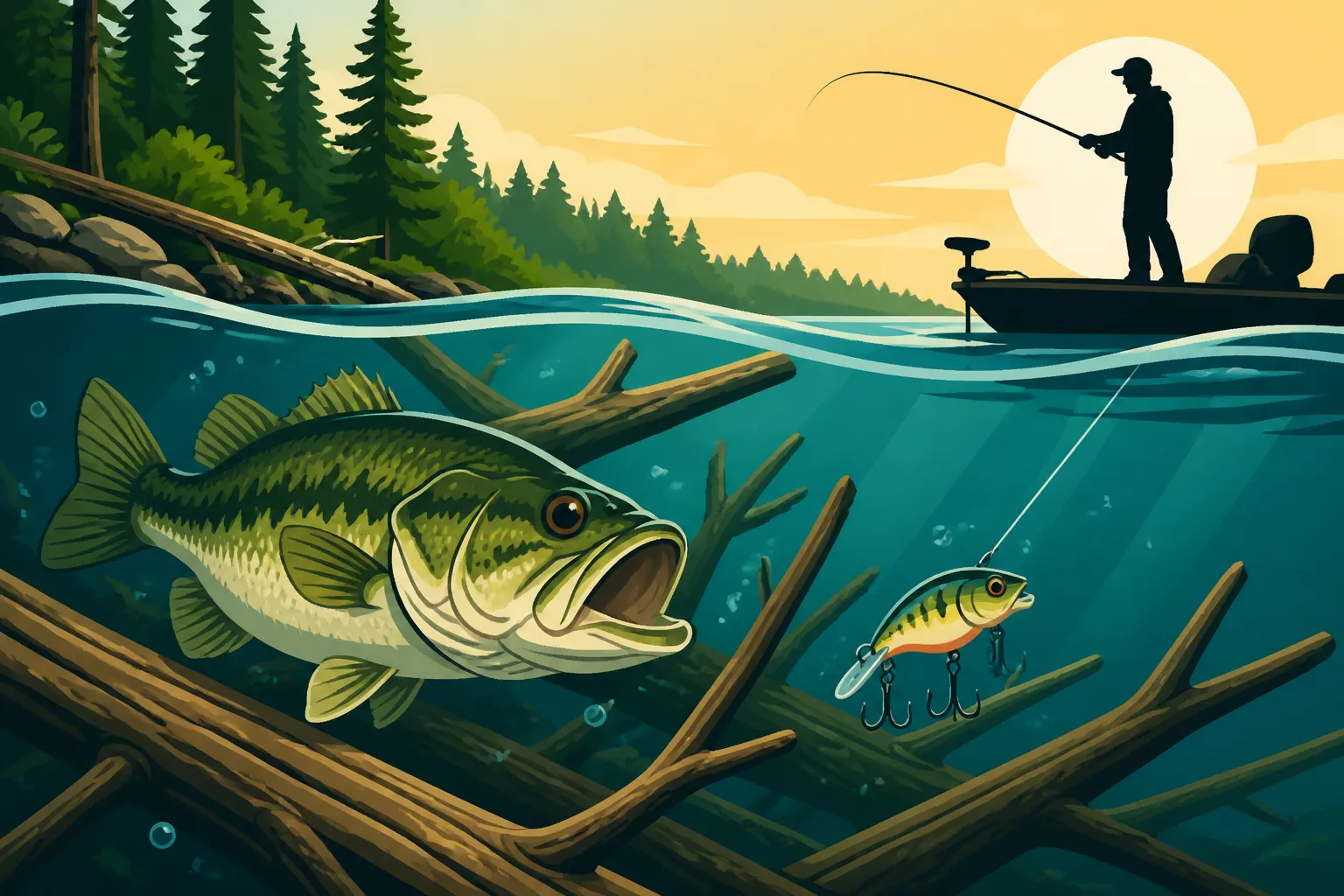
Think about it from a bass's perspective. Life out in the open water is risky business. There are eagles soaring above, bigger fish lurking below, and often, scorching sun beating down. Submerged timber offers immediate protection from all these threats. It's a natural fortress, providing shade from harsh sunlight, a break from strong currents, and a place to hide from predators. A big log lying on the bottom can be a fantastic overhead cover, making a bass feel secure.
But it's not just about safety; it's also about opportunity. Timber creates prime ambush points. Smaller baitfish, crawfish, and other forage species are naturally attracted to these structures for the same reasons bass are – shelter and food. A bass can tuck itself into a knot of branches, blend in with the shadows, and then dart out to snatch an unsuspecting meal as it swims by. Imagine a huge gnarled oak that fell into the lake years ago, its branches now a labyrinth of underwater limbs. Every pocket, every shadow, every intersection of branches could be home to a hungry bass just waiting for your lure. It's truly a bass's ideal hunting ground, making them more comfortable and often more aggressive when feeding.
The Inevitable Snagging Frustration: A Rite of Passage
Now, for the flip side of that coin – the sheer agony of a snag. We've all been there, right? You make a beautiful cast, your lure lands perfectly near that gnarly old stump, you feel a subtle tick, and then… nothing. Just dead weight, your line pulled taut against an immovable object. You try to twitch it, give it some slack, even snap your rod tip, but it's stuck. Hopelessly stuck. This scenario plays out constantly when fishing submerged timber.
Losing lures isn't just annoying; it's expensive. Those brand-new jigs, your favourite crankbait, or a perfectly rigged soft plastic can be gone in an instant. It can also break your focus, lead to frustration, and make you hesitant to cast into the very spots you know hold fish. This hesitation, my friend, is exactly what we need to overcome. The key isn't to avoid snags entirely – that's often impossible – but to minimize them, understand why they happen, and learn how to free your lure or at least manage the situation without ruining your day. It’s a delicate balance of aggression and finesse, knowing when to push the limits and when to back off.
Essential Gear for Conquering the Timber
Fishing submerged timber effectively requires a specific setup. You can't just go in with your everyday open-water spinning rod and expect to pull out lunker bass from the gnarly depths. This is where your gear really needs to be up to the task.
Rods, Reels, and Line: Power Up!
When you're wrestling a bass out of a submerged tree, you need power, sensitivity, and brute strength. Forget light action rods; we're talking heavy-duty here.
- Rods: Opt for a baitcasting rod with a heavy power rating and a fast to extra-fast action. This gives you the backbone to turn a big bass away from cover and the sensitivity to feel subtle bites even through the wood. A rod in the 7-foot to 7-foot, 6-inch range is often ideal, providing good casting distance for pitching and flipping, while still allowing you to leverage the fish. Brands like St. Croix or Fenwick offer excellent options that can stand up to the abuse. The length also helps with accurate presentations into tight spots without overshooting your target.
- Reels: Pair that rod with a sturdy baitcasting reel. Look for one with a strong drag system and a good retrieve ratio (around 7.1:1 or higher is popular for quick line pickup). A fast retrieve allows you to quickly get slack out of your line after a cast or a hookset, which is crucial for controlling a fish trying to bury itself in the branches. Look for reels known for their durability and smooth performance under pressure. While high-end models offer the most refinement, even mid-range reels can perform well if they have a robust internal construction.
- Line: This is perhaps the most critical component. Braided line is your best friend here. It has zero stretch, incredible strength for its diameter, and, most importantly, it's highly abrasion-resistant. When your line rubs against wood, braid is far less likely to fray and break than mono or fluorocarbon. Use a heavier test, perhaps 30 to 65-pound braid, depending on the cover's density and the size of bass you expect. The no-stretch property also transmits bites incredibly well, even if a bass just "mouths" your bait. This means you feel every little tap and can react instantly. For situations where bass might be line-shy, a short (12-18 inch) leader of 15-25 pound fluorocarbon can be tied to the end of your braid. Fluorocarbon is nearly invisible underwater and offers excellent abrasion resistance against the wood, though not as much as direct braid contact. You'll find a huge selection of these lines on Amazon.
| Line Type | Pros | Cons | Best Use in Timber |
|---|---|---|---|
| Braided | Extreme strength, no stretch, excellent abrasion resistance, thin | Visible, can dig into spool, needs knot strength | Main line for heavy cover, pitching, flipping, sensitivity |
| Fluorocarbon | Low visibility, good abrasion resistance, moderate stretch | Stiffer, more expensive, can be hard to tie smaller knots | Short leader material, some finesse techniques when visibility is key |
| Monofilament | Stretchy, inexpensive, easy to tie knots | Low abrasion resistance, high visibility, less sensitive | Generally not recommended for direct contact with heavy timber due to stretch and abrasion. |
Lures Designed for the Tangles: Go Weedless!
The right lure choice can make all the difference between bringing in a bass and leaving your tackle behind. The name of the game is "weedless," or at least "snag-resistant."
- Texas-Rigged Soft Plastics: This is the undisputed king of timber fishing. A soft plastic bait (worms, creatures, craws) threaded onto a worm hook with the hook point embedded back into the plastic makes it incredibly snag-proof. The hook point only exposes when a fish bites and compresses the plastic. Use an appropriate weight (1/4 oz to 1 oz) to help the bait penetrate cover and sink quickly. Experiment with colours like green pumpkin, junebug, or black and blue, which are consistently productive. You can find a wide range of soft plastics and hooks on Amazon.
- Jigs: Flipping and pitching jigs are fantastic for timber. They typically have a brush guard that protects the hook point, allowing them to slide over branches and through cover. Combine them with a craw or creature trailer for added bulk and action. Again, black and blue, green pumpkin, and browns are great colour choices. The weight of the jig helps it punch through thick canopy.
- Bladed Jigs (Chatterbaits): While not completely weedless, bladed jigs can be surprisingly effective around sparser timber or the edges of heavy cover. The blade helps deflect off wood, and their vibration draws strikes. Just be prepared for occasional snags in the densest areas.
- Swim Jigs: These are essentially a jig head with a skirt and a grub or paddle tail trailer. They can be very effective retrieved slowly through openings in timber, mimicking a baitfish or crawfish. Their streamlined profile helps them slip through cover more easily than, say, a squarebill crankbait.
The key with all these lures is their ability to navigate the submerged branches without constantly hanging up. Don't be afraid to experiment with different sizes and weights to find what works best for the particular timber you're fishing and the mood of the bass.
Techniques for Extracting Bass from the Wood
Now that you've got the right gear, it's time to talk about how to actually get your lure into those fish-holding areas and, more importantly, how to get the bass out.
Pitching and Flipping: Precision is Power
These two techniques are essential for fishing submerged timber. They allow you to present your lure precisely and stealthily into tight cover without spooking the fish.
- Pitching: This involves holding your lure in one hand, extending your rod tip, and using a pendulum-like motion to swing the lure forward. As it swings, you release the line and use your reel to guide it to your target. It's a quiet, accurate cast for targets a bit further away (10-30 feet). The goal is to make a soft, controlled entry, minimizing splash. Imagine a laydown tree with a small opening between two large branches. A pitch allows you to drop your Texas-rigged plastic right into that sweet spot. It's less about distance and more about pinpoint accuracy, letting you silently place your bait exactly where you want it.
- Flipping: This is for even closer, tighter cover (0-10 feet). You strip out some line, hold the lure in your hand, and use only your rod tip to swing the lure directly to your target. Your non-reeling hand controls the line, feeding it out or taking it in as needed. It's incredibly accurate and silent, ideal for dropping a jig into a small hole in a brush pile right next to the boat. Both techniques require practice, but mastering them will significantly increase your success rate in timber. They allow you to keep your boat further away from the prime target, reducing the chance of disturbing the fish.
Working Your Lure Through Cover: The Finesse of Feel
Once your lure is in the timber, it's not a simple retrieve. This is where the feel and patience come in.
- Slow and Deliberate: Work your lure slowly. Bass in timber are often waiting in ambush, and a fast-moving bait might pass them by too quickly. Let your Texas-rigged plastic or jig sink, feeling for any resistance or "ticks" as it falls. As it hits branches, pause. A lot of strikes happen right after the lure hits something, as it often mimics a crawfish scurrying away.
- Feeling the Timber: With braided line and a sensitive rod, you'll feel every branch, every log, every piece of structure. When you feel your lure touch wood, don't automatically pull it free. Sometimes, a slight slack in the line or a gentle shake of the rod tip is all it takes to walk it over the obstruction. If it feels truly stuck, try to give it a little slack and then snap your rod tip quickly, trying to make the lure jump free. Often, the lure will pop over the branch. This is where a quality fluorocarbon leader can offer just enough stretch to help prevent a complete hang-up, while still being durable enough.
- Pop and Drop: A fantastic tactic is the "pop and drop." Cast your bait past a piece of timber, reel it until it touches the wood, then quickly "pop" your rod tip to jump the bait over the obstruction, letting it fall freely on the other side. This mimics a baitfish or crawfish trying to escape, often triggering an immediate strike. Remember, if you get completely hung up and can't free it, try to back your boat up and pull from a different angle. Sometimes, that's all it takes.
The Art of the Hookset and Retrieve: No Time to Dawdle!
You've successfully presented your lure, navigated the cover, and felt that satisfying thud. Now what? This is the moment of truth where many fish are lost.
- The Immediate, Powerful Hookset: When you feel a strike in timber, you cannot hesitate. Bass will try to bury themselves deeper into the cover the moment they feel resistance. A strong, immediate hookset is paramount. Take up any slack, then give a solid, upward sweep with your heavy-powered rod. Don't be afraid to put some muscle into it. Your braided line and strong hook will do the rest. This firm set is necessary to drive the hook through the plastic and into the bass's jaw, pulling it away from the snags before it can react.
- Crank, Don't Pump: Once the hook is set, keep your rod loaded and crank the fish out. Many anglers try to "pump" the rod, lifting and reeling. While this works in open water, in timber, it creates slack line, giving the bass an opportunity to dive back into the branches. Keep constant, heavy pressure on the fish, reeling steadily until it's out of the heaviest cover. Your heavy rod and reel are designed for this kind of power play. If the fish surges, let your drag do its job, but try to gain line whenever possible. Maintaining pressure is key; any hesitation allows the bass to wrap your line around a branch, and then it's usually game over. Keep that rod tip up and pointed towards the fish, creating a direct pull.
Reading the Water and Targeting Productive Timber
Not all submerged timber is created equal. Some spots will consistently produce, while others will be barren. Learning to identify the most promising areas is a skill that comes with experience, but there are some general rules of thumb.
Identifying Key Timber Types: What to Look For
Different kinds of submerged timber attract bass differently, and knowing the difference can help you focus your efforts.
- Fallen Trees (Laydowns): These are fantastic. A tree that has fallen into the water provides a massive amount of varied cover, from the thick trunk to the network of branches. Look for where the main trunk enters the water and the deepest part of the crown. Bass will often hold along the trunk, under the thicker limbs, or right in the deepest brush. The thicker the branches, the more secure the bass feel. How to catch bass around submerged timber is all about dissecting these complex structures.
- Stumps: Solitary stumps, or fields of stumps, are classic bass magnets. Bass will often position themselves on the leeward side of a stump (away from the current) or right up against it, using it as an ambush point. If you find a cluster of stumps, you've hit the jackpot. These are usually easier to fish than full laydowns, as they present fewer snag points, but still offer excellent cover.
- Brush Piles: Sometimes man-made, sometimes natural accumulations of branches, brush piles are dense bass apartments. They offer incredible protection and are often packed with baitfish. These can be the most challenging to fish without snagging, requiring precise casts and a very weedless presentation. They are particularly productive in lakes with otherwise sparse cover.
- Standing Timber: In lakes where trees were flooded, you might find entire forests of standing, drowned timber. Bass will relate to these vertical structures, often holding near the base or suspended among the branches. These require careful boat control and accurate vertical presentations or slow, methodical retrieves. The depth where the fish are holding can vary significantly here, so a good fish finder is invaluable.
The best spots often combine timber with other features like a depth change, rock piles, or a weed line. Bass love transitions, and timber at a transition point is often prime real estate.
Seasonal and Depth Considerations: Where the Fish Are Hiding
Bass don't stay in the same timber all year round. Their depth and location preferences shift with water temperature and spawning cycles.
- Spring: As water temperatures rise, bass move shallower, often seeking timber in bays, coves, and shallower flats that warm up first. They'll use these timber areas for pre-spawn staging and post-spawn recovery. Look for timber in 2-8 feet of water, especially near spawning flats. A slow presentation right on the timber can be deadly.
- Summer: When the water gets hot, bass will often move deeper to find cooler, more oxygenated water. They'll relate to deeper timber, perhaps fallen trees on a sharp break line or standing timber in 10-25 feet of water. They might also be found in shallower timber if it offers dense shade, particularly during low light conditions or if there's an immediate depth drop nearby. Early morning or late evening, they might move back into shallower timber to feed.
- Fall: As temperatures cool again, bass begin to feed heavily, preparing for winter. They might spread out, relating to timber at various depths. They'll often follow baitfish schools, which also utilize timber for cover. Look for timber near primary points or channel swings where baitfish are congregating. Fall timber fishing can be incredible for catching big, aggressive bass.
- Winter: In many parts of Ontario, bass fishing shuts down or becomes extremely challenging in winter. However, if you're targeting smallmouth bass in open water during a mild winter (where legal and safe), they might suspend around deeper timber or hold tight to the bottom in deep timber fields. Ice fishing generally focuses on other species, but some lakes might offer opportunities for smallmouth if conditions are right, though timber can be a nightmare to navigate with ice fishing gear.
Understanding these seasonal movements allows you to narrow down your search and focus on the most productive timber for the current conditions. For more general information on bass behavior, check out Smallmouth Bass Fishing in Ontario or Largemouth Bass Fishing in Ontario. And for specialized gear to tackle specific situations, don't forget to look at resources like Best Rods for Ontario Lakes or Best Kayaks for Ontario Fishing if you're planning a stealthy approach to these timber-laden waters.
Disclaimer
This article is for general informational purposes only and does not constitute professional advice. Laws, prices and regulations vary by location and change over time. Consult a qualified professional for guidance on your specific situation.