How deep to troll for lake trout in summer
There’s nothing quite like the thrill of chasing lake trout, but let's be honest, trying to pinpoint their location in the vast, deep waters of an Ontario lake during the dog days of summer can feel like an impossible mission. The sun beats down, the surface water warms up, and suddenly, those fish you were catching easily in spring vanish without a trace. This guide is here to cut through that frustration, giving you the real-world insights and techniques you need to effectively troll for those elusive deepwater lake trout when the heat is on.
Understanding Lake Trout Behavior in Summer
Summer brings a significant shift in lake trout behavior, driven primarily by one thing: temperature. These magnificent fish are built for cold water, and as surface temperatures climb, they seek refuge in the deeper, cooler parts of the lake. It’s not just about comfort; it's about survival.
The Deepwater Refuge: Thermal Stratification and Oxygen
During the summer months, most deep Ontario lakes undergo a process called thermal stratification. This means the water column separates into distinct layers based on temperature. You have the warm epilimnion on top, a cooler hypolimnion at the bottom, and a crucial transition zone in between called the thermocline. The thermocline is where the water temperature drops rapidly with increasing depth.
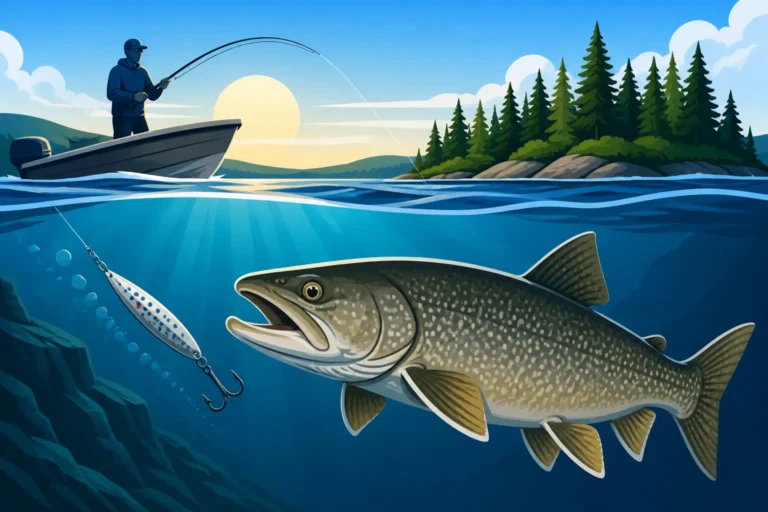
Lake trout thrive in cold, oxygen-rich water, typically preferring temperatures between 7 to 13 degrees Celsius (45-55 degrees Fahrenheit). As the epilimnion warms up, usually exceeding this range, the lake trout will push down, often positioning themselves directly within or just below the thermocline, in the cooler hypolimnion. This is their comfort zone, and knowing its depth is your first major clue. If the water gets too warm or too deoxygenated, they won't be there. That's why understanding What water temperature lake trout prefer is so critical.
Following the Food: Baitfish Movements
It's not just temperature that dictates where lake trout reside; it's also their stomach. Lake trout are opportunistic predators, and in summer, their primary forage base—like ciscoes, smelt, and alewives—also tends to prefer cooler waters. These baitfish will often congregate around the thermocline or near deep structure where they can find both food and safety.
Therefore, when you're looking for lake trout, you're often looking for their food source. If your sonar is showing dense schools of baitfish suspended at a certain depth, you can bet that the lake trout won't be far behind, actively feeding in those same temperature and depth zones. Their movements are intrinsically linked to these smaller fish, forming a deepwater ecosystem you need to decipher. Many anglers find their best success by paying close attention to these patterns.
Pinpointing the Depth: Key Factors for Summer Trolling Success
The biggest challenge in summer lake trout fishing is precisely determining how deep to present your lures. It's not a static number; it changes daily, hourly, and from one lake to another. Mastering this requires a combination of technology, observation, and a bit of trial and error.
The Indispensable Role of Sonar and Temperature Probes
Modern electronics are your most powerful allies for Lake Trout Fishing in Ontario in the summer. A good quality fish finder isn't just for spotting fish; it's for reading the underwater landscape. Look for features that show you:
- Thermocline: Many advanced fish finders can display the thermocline as a distinct band on the screen. This is an absolute game-changer, telling you exactly where the most comfortable water for lake trout lies. Even if it doesn't explicitly show "thermocline," you'll often see a dense band of plankton or baitfish congregating at that transition, marking its location.
- Baitfish Schools: Dense clouds or arcs of baitfish are strong indicators. Once you locate bait, pay attention to their depth; the lake trout will likely be nearby, either below them waiting to ambush or actively chasing them through the schools.
- Fish Arches: Of course, actual fish arches are what we're all after! When you see larger arches below the bait, within the thermocline, you've hit the jackpot. Note the depth precisely.
Beyond the sonar, a dedicated water temperature probe that can be lowered to specific depths is incredibly useful. Devices like the Fish Hawk or even simpler manual probes can confirm the exact temperature at various depths, allowing you to accurately locate the preferred 7-13°C zone. This removes a lot of guesswork and helps you fine-tune your presentation. For anyone serious about Best Fish Finders for Ontario Lakes, investing in a unit with excellent depth-finding capabilities is paramount.
Lake Structure and Time of Day
While temperature is king, underwater structure plays a significant role, even in deep water. Lake trout, like many predators, use structure for ambush points and navigation. Look for:
- Deep Humps and Reefs: Submerged islands or humps that rise up from the main lake basin can be magnets, especially if their peaks are still within or just above the thermocline.
- Deep Drop-offs and Ledges: These provide vertical relief and are natural highways for baitfish and trout moving between different depths.
- Main Lake Basins: In very deep, featureless lakes, trout might simply suspend in the open water of the hypolimnion, following schools of pelagic baitfish.
The time of day also has a subtle influence. While summer lake trout are predominantly deep, extremely early mornings, late evenings, or heavily overcast days with dark skies might see them push slightly shallower, perhaps even briefly venturing above the main thermocline to feed on baitfish that have also risen. However, "shallower" for lake trout in summer still usually means 30-60 feet, not 10-20 feet! The rule of thumb for these fish is generally to start deep and work your way up, rather than the other way around.
A Comparative Look at Depth-Achieving Methods
To give you a better idea of what tools are best for which situation, here’s a quick comparison of the most popular methods for getting your lures down to those summer lake trout.
| Method | Depth Precision | Ease of Use | Typical Depth Range | Advantages | Disadvantages |
|---|---|---|---|---|---|
| Downriggers | Excellent | Moderate (setup) | 20 – 200+ feet | Pinpoint accuracy, consistent depth, light line to lure | Expensive, requires boat rigging, heavy cannonballs |
| Dipsy Divers | Good | Easy | 15 – 80 feet | No boat rigging, covers wide area, portable | Depth affected by line type/speed, less precise |
| Lead Core Line | Fair | Easy (concept) | 10 – 60 feet (per 100 yds) | No specialized gear needed, simple, effective | Less precise depth, heavy line, long leads out |
| Snap Weights | Fair | Very Easy | 10 – 50 feet | Adjustable, portable, inexpensive | Can interfere with lure action, added drag |
Essential Gear and Techniques for Deep Trolling
Once you've got a handle on where the lake trout are hiding, you need the right tools and tactics to get your lures to them effectively. Deepwater trolling isn't like casting for bass; it requires specialized equipment and a methodical approach.
Downriggers: The Gold Standard for Precision
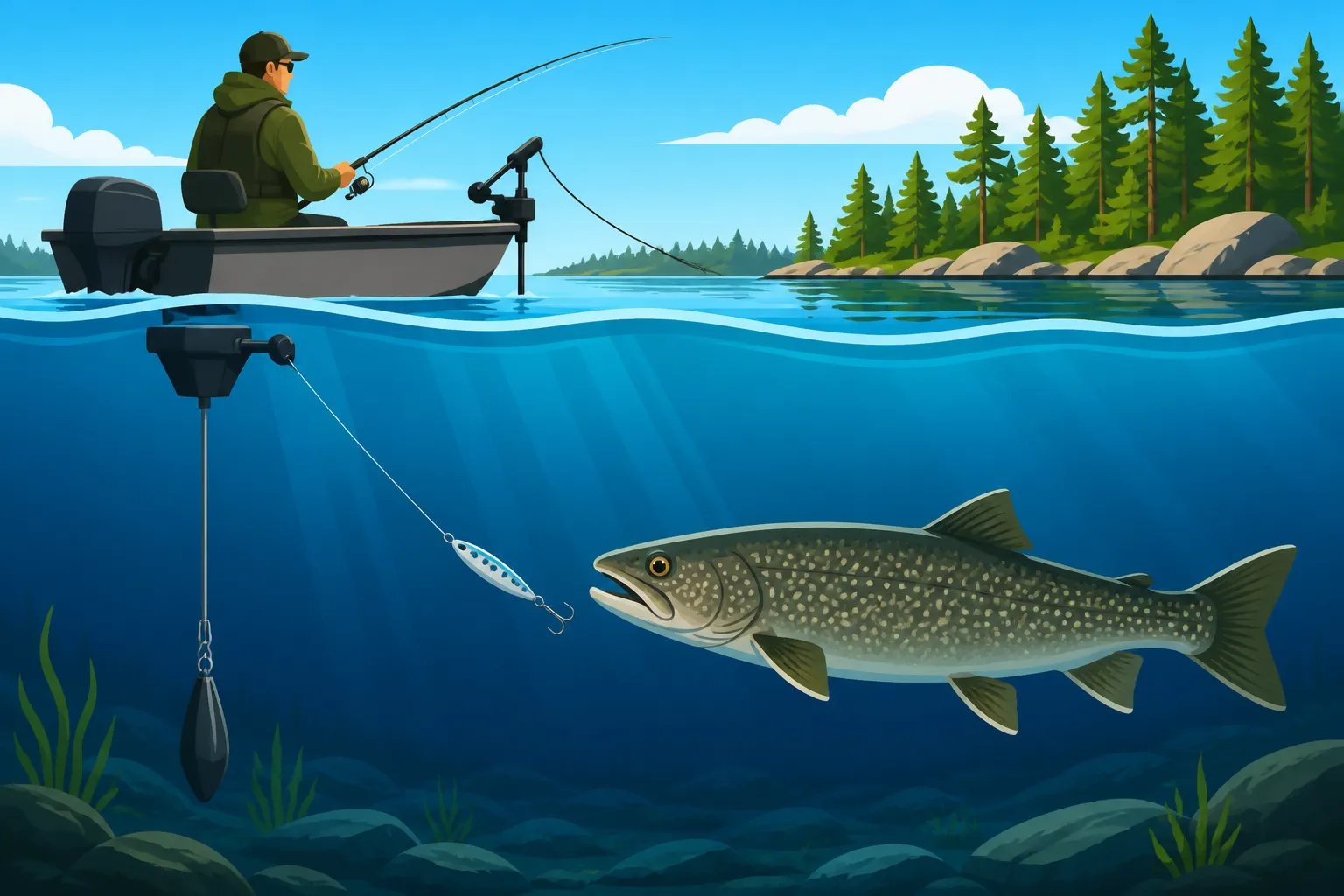
For serious deepwater lake trout anglers, downriggers are often considered indispensable. These ingenious devices allow you to run a heavy weight (called a cannonball) to a precise depth, with your fishing line attached to the cannonball via a release clip. When a fish strikes, the line pops free, and you fight the fish directly on your rod and reel, without the heavy weight.
This method offers unparalleled control over your lure's depth, which is absolutely critical when you're trying to stay within a narrow thermocline band. You can monitor your fish finder, see the thermocline, and then set your downrigger to within a foot or two of that exact depth. Brands like Scotty and Cannon are popular choices, offering reliable units that can handle the rigors of big lake trolling. You can often find a good selection of downrigger accessories, from extra release clips to replacement cables, on Amazon.
Dipsy Divers, Planer Boards, and Lead Core Line
If downriggers aren't in your immediate plans, or if you want to cover a wider spread, there are other effective methods:
- Dipsy Divers: These are disc-shaped diving devices that use water pressure to dive to a set depth. They also "plane" out to the side, allowing you to run multiple lines away from the boat, covering a larger swath of water. Dipsies are great for covering depths up to about 80 feet, depending on size, line out, and trolling speed.
- Planer Boards: Typically used in conjunction with other weights, planer boards pull your lines out to the side of the boat, creating a wide spread. They don't inherently take your lure deep, so you'll still need lead core, snap weights, or specialized diving crankbaits to get to the desired depth. They're fantastic for avoiding prop wash and presenting lures to spooky fish.
- Lead Core Line: This specialized line has a lead center wrapped in a braided sheath. Each color segment (usually 10 yards) adds a certain amount of depth, typically around 5-7 feet per color at a standard trolling speed of 2 mph. By letting out multiple colors, you can achieve substantial depth. While less precise than downriggers, it's a very effective and relatively inexpensive way to get lures deep, especially when used in combination with long-bodied spoons or deep-diving crankbaits. For instance, letting out 5 colours might get you 25-35 feet deep. It's a foundational technique for many Trolling Techniques for Ontario Lake Trout.
Lures and Rod/Reel Setups
When it comes to lures for deep lake trout, you're generally looking for something that has a good action at trolling speeds and can withstand the pressure of deep water.
- Spoons: Large, slender trolling spoons like Silver Streak, Dreamweaver, or Sutton spoons are perennial favorites. Their wobbling action is irresistible to lake trout. Experiment with colours; natural patterns on clear days, and brighter, reflective patterns on cloudy days or in stained water.
- Deep-Diving Crankbaits: Larger crankbaits designed to dive deeply can also be effective, especially those with rattles that call fish in.
- Rigged Bait: Some anglers swear by herring, ciscoes, or even large shiners rigged behind a flasher or dodger. This setup is incredibly enticing but can be more complex to manage.
For Best Gear for Ontario Trout Fishing, a sturdy rod and reel setup is crucial. You'll want medium-heavy to heavy power rods, typically 7 to 9 feet in length, with a moderate action to absorb the shock of a strike and handle the weight of the cannonball or diving device. Line counter reels are almost a necessity, allowing you to accurately repeat depths and know exactly how much line you have out. Look for reputable brands like Shimano, Daiwa, or Okuma. You can often find great deals on these workhorse reels on Amazon. Monofilament line in 20-25 lb test is common for its stretch and shock absorption, though some prefer braided line with a fluorocarbon leader for increased sensitivity and less water resistance.
Strategies for Maximizing Your Deep Lake Trout Success
Getting your gear down to the right depth is half the battle; the other half is knowing how to make those lures enticing and what to do once you're in the strike zone.
Mastering Your Trolling Speed and Boat Control
Lake trout often prefer a relatively slow presentation, especially when they're deep and conserving energy in cold water. A good starting point for trolling speed is usually between 1.5 to 3.0 miles per hour (mph). However, this is not a hard-and-fast rule. The optimal speed can vary depending on the lure type, water temperature, and the activity level of the fish. Sometimes, a slight increase or decrease in speed can trigger strikes. Pay close attention to your rod tips to ensure your lures are working correctly at your chosen speed.
Boat control is equally important. When trolling over underwater structure like humps or drop-offs, try to maintain a consistent speed and course to keep your lures in the productive zone for as long as possible. Using your boat's GPS and knowing your boat's capabilities is key to effective How to Catch Lake Trout in Ontario. On windy days, a bow-mounted electric trolling motor can be a lifesaver for fine-tuning your speed and direction, even on larger boats, letting you focus on the fish rather than constantly correcting your course.
The "Strike Zone" and Varying Your Presentation
Once you've identified the thermocline and located baitfish or lake trout arches, consider that entire depth range as your "strike zone." Lake trout might be anywhere within that band. Don't be afraid to experiment with your lure depth, even if it's just a few feet up or down. If your fish finder shows fish at 70 feet, try running one lure at 65 feet and another at 75 feet to pinpoint their exact preference.
Varying your presentation also includes:
- Lure Color and Size: Have a variety of spoons and crankbaits on hand. Natural baitfish patterns (silver, blue/silver, perch) are always a good bet, but don't shy away from brighter colors (chartreuse, orange) on darker days or in stained water. The size of the baitfish in the lake should also influence your lure selection.
- Adding Flashers or Dodgers: These inline attractors create flash and vibration that can draw lake trout in from a distance, especially in deeper, darker water. Your lure then trails behind, often sealed the deal.
- "S-Turns": Occasionally making gentle S-turns with your boat can be incredibly effective. As your boat turns, your outside lures speed up and rise slightly, while your inside lures slow down and drop. This change in speed and depth can often trigger a reaction strike from following fish. It's a classic Best Techniques for Deep Water Summer Lake Trout strategy.
Safety on Ontario's Large Lakes
Finally, always prioritize safety, especially when venturing out onto Ontario’s large, deep lakes. Conditions can change rapidly, and being prepared is paramount. Ensure your boat is equipped with all required safety gear, and always be aware of Ontario Boating Laws for Anglers. Let someone know your float plan, and check the weather forecast before heading out. The fishing will always be there, but your safety is most important. Many of Best Fishing Lakes in Ontario are vast and can get rough quickly.
H2 Disclaimer
Please note that fishing regulations, including season dates, catch limits, and licensing requirements, can change. Always consult the most current Ontario Fishing Regulations Summary before heading out. This guide provides general information and techniques and should not be considered a substitute for official regulations.