Ontario smallmouth bass slot limit
One of the most head-scratching moments for many anglers hitting the water in Ontario is when they reel in a beautiful smallmouth bass, only to wonder, "Can I keep this one, or do I have to let it go?" It's a common frustration, especially with the ever-evolving regulations designed to protect our precious fisheries. This guide is here to untangle the complexities of Ontario's smallmouth bass slot limits, helping you understand precisely what they are, why they're in place, and how to confidently comply every time you hook a bronzeback.
Understanding Smallmouth Bass Slot Limits in Ontario
There's nothing quite like the thrill of a smallmouth bass fight, those powerful headshakes and aerial acrobatics. But the excitement can quickly turn to confusion when you're trying to remember the specific rules for keeping your catch. Ontario's Ministry of Natural Resources and Forestry (MNRF) uses a variety of tools to manage fish populations, and slot limits are a particularly effective one for certain species, including smallmouth bass.
What is a Slot Limit, Anyway?
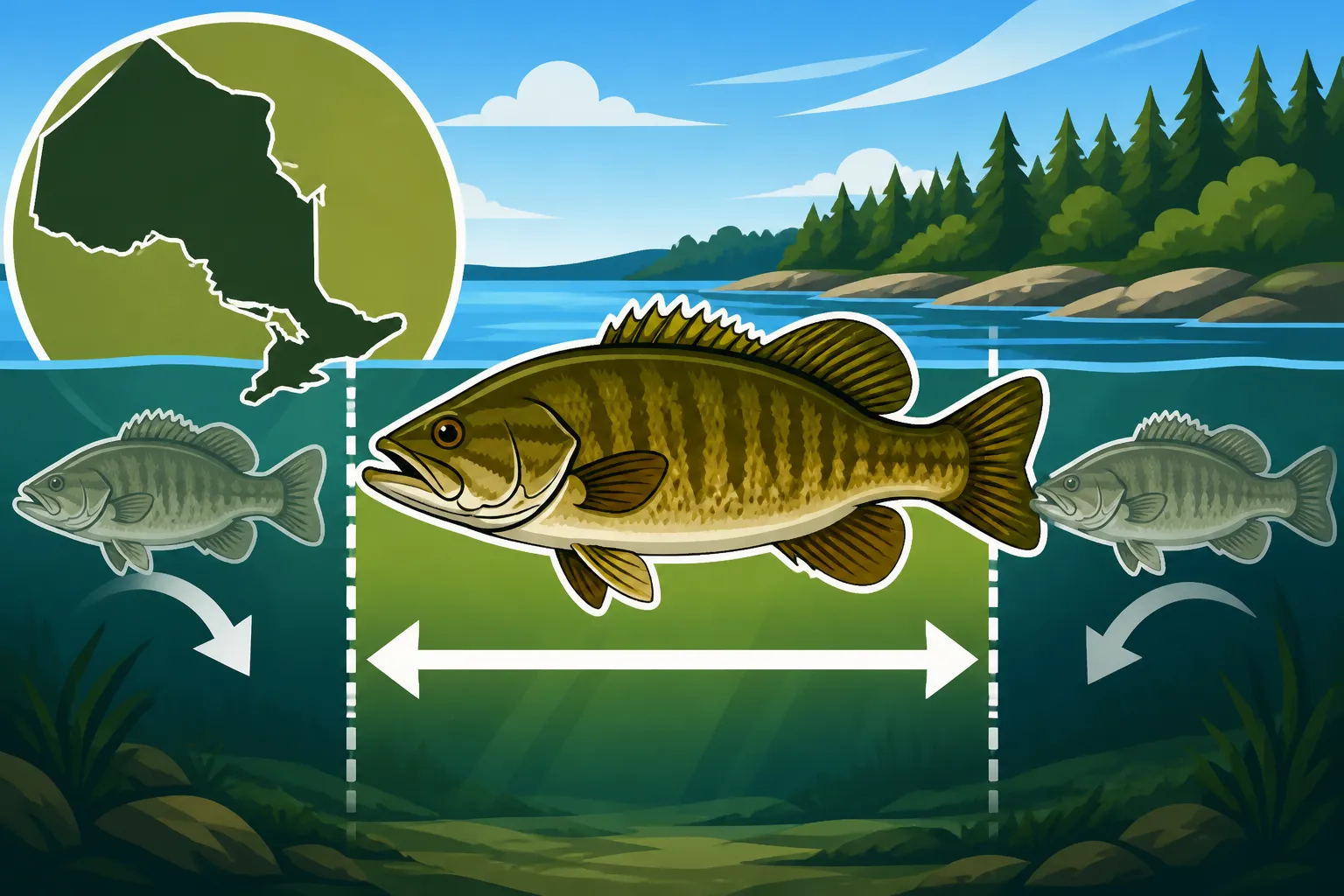
At its core, a slot limit means there's a specific size range of fish that you cannot keep. Any fish that falls within this "slot" must be immediately released back into the water. This is different from a minimum size limit (where you can only keep fish above a certain size) or a maximum size limit (where you can only keep fish below a certain size). A slot limit combines these concepts, creating a window of fish that are off-limits.
For example, a common smallmouth bass slot limit might state: "No person shall possess smallmouth bass from 35 cm (13.8 in.) to 45 cm (17.7 in.)." This means if you catch a smallmouth that measures 30 cm, you can keep it (assuming you're within your bag limit). If you catch one that's 40 cm, you must release it. And if you catch a real hog at 50 cm, you can also keep that one. It sounds a bit counter-intuitive at first, allowing the smaller and larger fish to be kept while protecting the middle-sized ones, but there's a very good reason for it.
The "Why" Behind the Slot: Conservation and Bigger Bass
The main goal of a slot limit isn't to make fishing harder, but to improve the fishery for everyone in the long run. Smallmouth bass slot limits are usually implemented for one or both of two key reasons:
- Protecting Spawning and Breeding Stock: The fish within the slot limit are often the prime breeders – the healthy, mature fish that are most vital for replenishing the population. By protecting these middle-sized fish, the MNRF aims to ensure a strong and consistent spawn each year. Think of them as the parents of the next generation of trophy bass. If too many of these crucial breeders are removed, the population can suffer, leading to fewer fish and smaller average sizes in the future.
- Allowing Growth to Trophy Size: By letting those strong, healthy middle-sized fish continue to grow, the slot limit encourages the development of larger, trophy-sized smallmouth bass. If anglers are allowed to keep all sizes, many of these potential giants might be harvested before they reach their full growth potential. Protecting them through a slot limit means they can continue to feed, grow, and contribute their superior genetics to the population, ultimately leading to a fishery known for its bigger fish. This strategy often results in a noticeable increase in the number of large smallmouth bass over time, which is certainly a win for any angler dreaming of a wall-hanger.
These limits are carefully determined by fisheries biologists who study the specific dynamics of a lake or river's fish population. They look at growth rates, spawning success, natural mortality, and fishing pressure to decide if a slot limit, or any other regulation, is necessary to maintain a healthy and vibrant fishery. It's all about balancing the desires of anglers with the long-term health of the fish.
Navigating Ontario's Smallmouth Bass Slot Limits
One of the biggest challenges for anglers in Ontario is that regulations aren't uniform across the entire province. What applies to Lake Simcoe might be completely different from what applies to a small lake up north in a different Fisheries Management Zone (FMZ). Smallmouth bass slot limits are no exception, so knowing how to find and interpret the rules for your specific fishing destination is absolutely crucial.
Deciphering the Regulations Summary
Your absolute go-to resource for any fishing regulation in Ontario, including smallmouth bass slot limits, is the annual Ontario Fishing Regulations Summary. This document is published by the MNRF and is available online and at most license vendors. It’s not just a suggestion; it’s the law. Each year, it's essential to review it because regulations can and do change.
Here’s how you'll usually find the information:
- Identify Your Fisheries Management Zone (FMZ): Ontario is divided into 20 distinct Ontario Fisheries Management Zones, Explained. Every body of water falls into one of these zones. You need to know which FMZ you're fishing in first. You can often find this information by looking at a map or using the excellent Fish ON-Line interactive map provided by the MNRF.
- Locate the Smallmouth Bass Section for Your FMZ: Once you know your FMZ, flip to the section that outlines the general regulations for that zone. Within this section, you'll find a table or list of species and their associated limits. Look specifically for "Smallmouth Bass."
- Check for Exceptions or Special Regulations: This is where it gets tricky. Many specific lakes or river systems within a broader FMZ might have additional or different regulations than the general zone rules. These are usually listed under "Exceptions to Zone Regulations" or "Special Regulation Waters in Ontario." For instance, a particular lake might have a slot limit for smallmouth bass even if the rest of the FMZ doesn't, or it might have a different slot limit than the general one. You absolutely must check this section for your exact body of water.
It can feel like a bit of a treasure hunt, but taking the time to Reading the Ontario Fishing Regulations Summary properly will save you a lot of grief (and potential fines!). Always double-check right before your trip, as regulations are updated annually.
Common Slot Limit Examples
While the specifics vary, let's look at some hypothetical examples of what smallmouth bass slot limits might look like to give you a clearer picture. Keep in mind these are illustrative and you should always check the official summary for your specific location.
- FMZ X – General Rule: No smallmouth bass from 35 cm (13.8 in.) to 45 cm (17.7 in.). S-5. C-2.
- This means you can keep up to 5 smallmouth bass (Sport license) or 2 smallmouth bass (Conservation license) total. However, none of them can be between 35 cm and 45 cm. You could keep smaller fish (e.g., 30 cm) or larger fish (e.g., 48 cm), as long as they aren't in the slot and you don't exceed your bag limit.
- Lake Y (within FMZ X) – Special Regulation: Smallmouth bass: No person shall possess smallmouth bass from 30 cm (11.8 in.) to 40 cm (15.7 in.). S-2. C-1.
- Here, Lake Y has a different and more restrictive slot limit, and also a lower bag limit, than the general FMZ rule. You'd have to follow the Lake Y rules specifically when fishing there.
- River Z (within FMZ X) – Catch and Release: Smallmouth bass: Catch and Release Only.
- In this scenario, River Z might be designated as Ontario Catch and Release Only Waters for smallmouth bass, meaning no fish can be kept regardless of size. This is often done for highly sensitive or recovering populations.
These examples highlight the importance of being precise when looking up regulations. A quick glance at the general FMZ rules isn't enough; you need to verify your specific water body.
| Type of Limit | What it Means for Smallmouth Bass | Example (Illustrative) |
|---|---|---|
| Minimum Size | You can only keep fish larger than a specific size. | No possession of smallmouth bass less than 30 cm (11.8 in.) |
| Maximum Size | You can only keep fish smaller than a specific size. | No possession of smallmouth bass greater than 40 cm (15.7 in.) |
| Slot Limit | You must release fish within a specific size range. Fish outside the range can be kept (up to bag limit). | No possession of smallmouth bass from 35-45 cm (13.8-17.7 in.) |
| Catch & Release | All fish of that species must be immediately released, regardless of size. | All smallmouth bass must be immediately released. |
Always check the official Ontario Fishing Regulations Summary for current, location-specific details.
How to Measure Your Catch Accurately
When dealing with slot limits, precise measurement is paramount. There's no room for guesswork. The official method for measuring fish in Ontario is from the tip of the nose to the tip of the tail, with the tail squeezed together.
Here’s a step-by-step guide to measuring your smallmouth bass:
- Be Prepared: Before you even cast, have a reliable measuring device easily accessible. A rigid ruler, a soft measuring tape (often found on a boat's gunwale), or a specialized fish measuring board are all great options. Ensure it's clearly marked in centimeters and inches. You can find excellent, easy-to-read measuring tapes and boards on sites like Amazon, perfect for attaching to your boat or tackle box.
- Handle the Fish Gently: When you land a fish you suspect might be near a slot limit, prioritize its well-being. Keep it in the water if possible, or support its full body horizontally if brought aboard. Minimize its time out of water.
- Lay the Fish Flat: Place the fish on your measuring device. Ensure its mouth is closed and its nose is against the starting point (e.g., the zero mark on the ruler or the bumper on a measuring board).
- Squeeze the Tail: Gently squeeze the tail lobes together to get the maximum length. Read the measurement at the very tip of the tail.
- Record and Release (if necessary): If the fish falls within the slot limit, record its length if you're tracking your catches, and then proceed with a careful and immediate release. If it's outside the slot and you plan to keep it, double-check your Ontario Bag and Possession Limits by Species.
Remember, it's better to err on the side of caution. If there's any doubt about a fish's measurement relative to a slot limit, release it. A slightly inaccurate measurement could lead to a fine, but more importantly, it could prevent a vital breeding fish from doing its job.
Practical Application: What to Do When You Catch a Slot Fish
So, you've landed a beautiful smallmouth, measured it, and confirmed it's right in the middle of a slot limit. This means it's time for a responsible catch and release. This isn't just about avoiding a penalty; it's about doing your part to ensure the health of the fishery that provides us with so much enjoyment.
The Art of Catch and Release with Slot Limits
Releasing a fish, especially one that's a key breeder, requires care to maximize its chances of survival. A fish's survival after release depends heavily on how it's handled.
Here's how to practice proper catch and release:
- Minimize Fight Time: The longer a fish fights, the more exhausted it becomes, reducing its chances of survival. Use appropriate tackle for the size of fish you're targeting. For Smallmouth Bass Fishing in Ontario, this often means a medium-light to medium-heavy spinning or baitcasting setup, which allows you to land fish efficiently without over-stressing them.
- Keep the Fish in the Water: The best place for a fish is in its natural environment. If possible, unhook and measure the fish while it's still in the water, especially if you're fishing from a boat.
- Wet Your Hands: If you need to handle the fish directly, wet your hands thoroughly first. Dry hands can remove the protective slime layer from a fish's skin, making it vulnerable to disease.
- Support the Fish Horizontally: Never hold a smallmouth bass vertically by the jaw if it's a larger fish, as this can dislocate its jaw and damage its internal organs. Support its full weight horizontally, cradling its belly with one hand and gently securing the jaw with the other.
- Use Barbless Hooks: Barbless hooks, or hooks with pinched barbs, make unhooking much easier and quicker, reducing damage to the fish's mouth. You can often buy barbless hooks, or simply pinch down the barb on your existing hooks with a pair of pliers.
- Use the Right Tools: A good pair of long-nosed pliers or a de-hooker is invaluable for quickly removing hooks, especially if the fish has swallowed the bait a bit deeper. Having a proper landing net with a rubberized or knotless mesh is also critical. Nets with knotted mesh can strip off a fish’s protective slime and damage fins. Look for rubberized nets, like those you can find on Amazon, which are much gentler on fish.
- Revive the Fish: If the fish seems sluggish after being unhooked, hold it gently upright in the water. If there's a current, face it into the current. If not, gently move it back and forth to force water over its gills until it swims away strongly on its own. Don't just toss it back; ensure it's ready to go.
By following these steps, you significantly increase the likelihood that your slot-sized smallmouth will survive to spawn another day and potentially grow into a true trophy.
Gear Considerations for Responsible Release
Beyond just your rod and reel, having the right accessories makes all the difference when you're diligently adhering to slot limits.
- Measuring Device: As mentioned, a reliable ruler or measuring board is essential. Options like the Hawg Trough measuring board are popular for their clear markings and built-in lip-bumpers, ensuring accurate measurement every time.
- Release Tools: Keep a pair of long-nosed pliers or hemostats close at hand for quick hook removal. For deeper hooked fish, a dedicated de-hooker can be a lifesaver, allowing you to extract the hook with minimal damage.
- Landing Net: A good quality, rubberized or knotless mesh landing net, like some models from Frabill or Ego S2, is a non-negotiable item for landing smallmouth bass safely. It cradles the fish, minimizes scale and slime loss, and reduces the risk of the fish flopping around on the deck of your boat. For larger bass, a net with a wider opening and deeper basket helps. A Best Landing Net for Trout could also be repurposed for bass, just ensure the size is adequate for the fish you expect.
- Gloves: Some anglers prefer to use specialized fishing gloves to protect their hands from fin spines and also to help maintain a good grip on slippery fish, reducing handling time. Just make sure they are wet.
Investing in these few pieces of gear not only shows respect for the fish but also makes your fishing experience smoother and more ethical, especially when practicing strict slot limit compliance.
The Consequences: Violating Smallmouth Bass Slot Limits
It might seem like a small detail to get wrong, but violating fishing regulations, including smallmouth bass slot limits, carries serious consequences in Ontario. The rules are in place for a reason, and enforcement is taken seriously by conservation officers.
Penalties and Enforcement
Conservation officers patrol Ontario's waterways diligently, and they are well-versed in the regulations. Ignorance of the law is never an excuse. If you are found to be in possession of a smallmouth bass that falls within a designated slot limit, or if you exceed the bag limit, you could face significant repercussions:
- Fines: The most common penalty is a monetary fine. These fines can be substantial, often hundreds of dollars, and they vary depending on the specific offense and the number of fish in question. For example, a single fish violating a slot limit could result in a fine, and if you have multiple fish, the penalties can escalate.
- Seizure of Equipment: Conservation officers have the authority to seize your fishing equipment, including your rods, reels, boat, motor, and even your vehicle if it was used in the commission of the offense. While not every violation results in such extreme measures, it’s a very real possibility, especially for repeat offenders or serious infractions.
- Loss of Fishing Privileges: You could have your fishing license suspended or revoked, meaning you wouldn't be allowed to fish in Ontario for a specified period. This is often an outcome for more serious or repeated violations.
- Court Appearances: Depending on the severity of the offense, you might be required to appear in court, adding legal fees and significant stress to the situation.
It's a stark reminder that these regulations are not suggestions; they are legally binding rules designed to protect the resource. Always ensure you have your valid Ontario Fishing License Guide for 2026 and Ontario Outdoors Card, Explained with you, and that you know the rules for the specific waters you're fishing. If you ever lose your license, understanding the Ontario Fishing License Refund and Replacement Policy can help you get back on the water legally.
Our Role as Responsible Anglers
As anglers, we are the first line of defense for our fisheries. Understanding and adhering to regulations like smallmouth bass slot limits is a fundamental part of responsible angling. It's not just about avoiding fines; it's about being good stewards of the environment and ensuring that future generations can enjoy the same incredible fishing experiences we do.
Consider these aspects of being a responsible angler:
- Continuous Learning: The regulations can be complex, and they change. Make it a habit to review the Ontario Fishing Regulations Explained every year, or at least before your first trip of the season. Don't rely on what you think you remember from last year.
- Ethical Practices: Beyond just the letter of the law, embrace ethical angling practices. This includes proper catch and release techniques for all fish, picking up your trash, respecting private property, and being courteous to other anglers. For instance, learning How to Catch Smallmouth Bass in Ontario often includes best practices for release as part of the technique.
- Reporting Violations: If you witness a fishing violation, it's our collective responsibility to report it. You can contact the MNRF TIPS line. While it might feel uncomfortable, turning a blind eye ultimately harms the resource we all cherish. The health of fisheries like those providing excellent Lake Erie Fishing Guide opportunities or the fantastic Lake Simcoe Fishing Guide relies on everyone playing by the rules.
- Advocacy: Get involved with local conservation groups or participate in public consultations when regulation changes are proposed. Your voice, informed by experience, can help shape the future of Ontario fishing.
Ultimately, the slot limit for smallmouth bass isn't a hurdle; it's a tool that allows these spirited fish to thrive. By understanding and respecting it, we contribute to a richer, more sustainable fishing future across Ontario, whether we're fishing for trophy Muskellunge Fishing in Ontario or chasing the feisty bronzebacks that call our lakes and rivers home.
Disclaimer
The information provided in this guide is for general informational purposes only and is not a substitute for the official Ontario Fishing Regulations Summary. Regulations can change annually and may vary significantly by Fisheries Management Zone and specific water bodies. Always consult the most current official Ontario Fishing Regulations Summary before engaging in any fishing activities.