Best nymph rig for freestone streams
There’s nothing quite like the challenge and reward of fly fishing for trout in Ontario’s freestone streams. Many anglers, myself included, have spent countless hours scratching their heads, wondering why our nymphs aren't getting eaten in those tumbling, rocky currents. This guide is all about demystifying the art of nymphing these beautiful, yet sometimes tricky, waters so you can confidently present your flies and hook into more fish.
Understanding Ontario's Freestone Streams for Nymphing
Before we even think about tying on a fly, it's crucial to understand the environment we're fishing. Ontario's freestone streams aren't like spring creeks or slow, meandering rivers. They have their own unique character that dictates how we approach them with a nymph rig.
What Makes a Stream "Freestone" in Ontario?
When we talk about a "freestone" stream in Ontario, we're generally referring to rivers and creeks whose flows are largely dictated by precipitation and snowmelt, and whose beds are composed predominantly of rocks, gravel, and boulders rather than fine silt or sand. Think of the tributaries feeding into the Great Lakes, or the countless streams winding through the Canadian Shield, like those you might find in Algonquin Park. These streams are characterized by their riffles, runs, pools, and pocket water, often changing dramatically with rainfall. The rocky bottoms provide fantastic habitat for aquatic insects – caddis, stoneflies, and mayflies – which are the primary food source for trout, making them prime targets for nymphing. The ever-changing current, however, can make presenting a nymph naturally a real puzzle.
The Challenges of Nymphing Freestone Waters
Nymphing freestone streams presents a specific set of challenges that can frustrate even seasoned anglers. The biggest hurdle is often the complex hydraulics. You've got multiple current seams, eddies, and conflicting flows that can drag your line in different directions, creating unnatural drift and making your nymph look completely wrong to a discerning trout. Identifying where trout hold in such dynamic environments is another skill in itself. Are they tucked behind that submerged boulder? Or are they actively feeding in that slower seam right next to the main current? Getting your nymph down to the fish's feeding lane, which might only be a few inches off the bottom, without snagging or dragging, is the name of the game. It takes a keen eye for reading water, precise casting, and excellent line management.
Key Trout Species You'll Encounter
Ontario's freestone streams are home to a variety of trout species, each with their own habits, but all share a love for a well-presented nymph. You'll most commonly be targeting Brook Trout, Ontario's official provincial fish, often found in the colder, smaller headwater streams and remote Crown land lakes. These beautiful, colourful fish are aggressive eaters, making them a joy to catch on nymphs. Then there are the Rainbow Trout, often stocked in larger rivers and streams, known for their powerful fights and acrobatic leaps. You might also encounter Brown Trout in some systems, particularly those with a mix of rocky and softer bottom sections, though they tend to be a bit more elusive. Understanding the typical holding lies and feeding habits of these species within a freestone environment will significantly improve your success rate. For more on these incredible fish, check out our guide on Brook Trout in Ontario's Crown Land Lakes.
Essential Components of a Freestone Nymph Rig
Building the perfect nymph rig for Ontario's freestone streams isn't about one-size-fits-all, but rather understanding the role each component plays. A well-balanced system gives you the control and sensitivity needed to detect those subtle takes in turbulent water.
The Right Rod and Reel Setup
For nymphing freestone streams, your rod choice is paramount. You want something that offers a good balance of length for line control and sensitivity for detecting strikes. A 9 to 10-foot rod in a 3 to 5-weight is generally ideal. The extra length, especially on a 10-foot rod, is a game-changer for mending line, keeping it off the water, and achieving longer, drag-free drifts. A medium-fast to fast action will give you the backbone to cast weighted rigs and fight larger fish in current, while still retaining enough sensitivity in the tip to telegraph subtle bumps. Many anglers specifically choose a softer tip for enhanced strike detection. As for the reel, it's primarily a line storage device for nymphing. Any reliable large arbor reel that balances your rod and holds your fly line and backing is perfectly sufficient. You won't be fighting fish off the reel too often, but a smooth drag is always a plus if you hook into a larger rainbow. For more recommendations, our Best Fly Rods for Ontario Trout Streams article dives deeper into rod choices.
Line Selection: Fly Line, Leader, and Tippet
This is where things get a bit more technical. Your fly line should typically be a weight-forward floating line (WF). The floating aspect is crucial for keeping as much line as possible off the water, which helps manage drag. Some anglers prefer specific nymphing lines with a longer front taper or even specialized lines for Euro nymphing, which we'll discuss later.
The leader is critical for transmitting energy from your fly line to your flies and for turning over weighted nymphs. For indicator nymphing, a 9 to 12-foot tapered leader is a great starting point, typically finishing with a 3X or 4X tippet section. The longer length helps keep your fly line further from your flies, reducing spooking.
When it comes to tippet, you'll usually be fishing 4X to 6X fluorocarbon. Fluorocarbon is key because it's nearly invisible underwater, much more abrasion-resistant than mono, and it sinks, helping to get your nymphs down faster. The ideal tippet size depends on water clarity, current speed, and fly size. For tiny nymphs in clear, low water, you might go as fine as 6X or 7X, but for larger, heavier flies in faster, murkier conditions, 4X or even 3X might be necessary. For specific advice, check out Best Tippet Material for Tiny Crown Land Stream Trout.
Weighting Your Rig Effectively
Getting your nymph down to the fish's feeding zone is non-negotiable in freestone streams. Trout rarely rise far for nymphs. There are a few ways to achieve this, and often, a combination works best:
- Weighted Nymphs: Many modern nymphs are tied with tungsten beads or lead wraps, making them sink quickly. Having a selection of nymphs with different weights (e.g., small nymphs with large beads, or larger nymphs with lighter beads) allows you to adjust on the fly.
- Split Shot: This is the most common external weight. Use lead-free split shot to be environmentally responsible. Start with a single small piece (e.g., BB or AB size) placed about 6-12 inches above your first fly. You want just enough weight to get your flies down without constantly snagging the bottom. The goal is to occasionally tick the bottom, not drag along it.
- Putty/Pinch-on Weights: These offer an adjustable weight option. Brands like Loon Outdoors make environmentally friendly tungsten putty that you can pinch onto your leader, adjusting the amount as needed.
The key is finding the balance. Too much weight, and you're snagging every third cast. Too little, and your flies are drifting over the fish's heads. Adjust frequently based on the depth and speed of the water you're fishing.
Popular Nymphing Rigs for Ontario's Freestone Streams
There's no single "best" nymph rig for all situations. The most effective approach depends on the water you're fishing, the conditions, and your personal preference. Here are the three most common and effective rigs you'll find anglers using on Ontario's freestone streams.
The Indicator Nymph Rig (Bobber Nymphing)
This is arguably the most common and easiest nymphing method for beginners to pick up, and it's highly effective. The indicator nymph rig, often (and somewhat pejoratively) called "bobber nymphing," uses a strike indicator to suspend your nymphs at a specific depth and signal strikes.
Explanation and Setup:
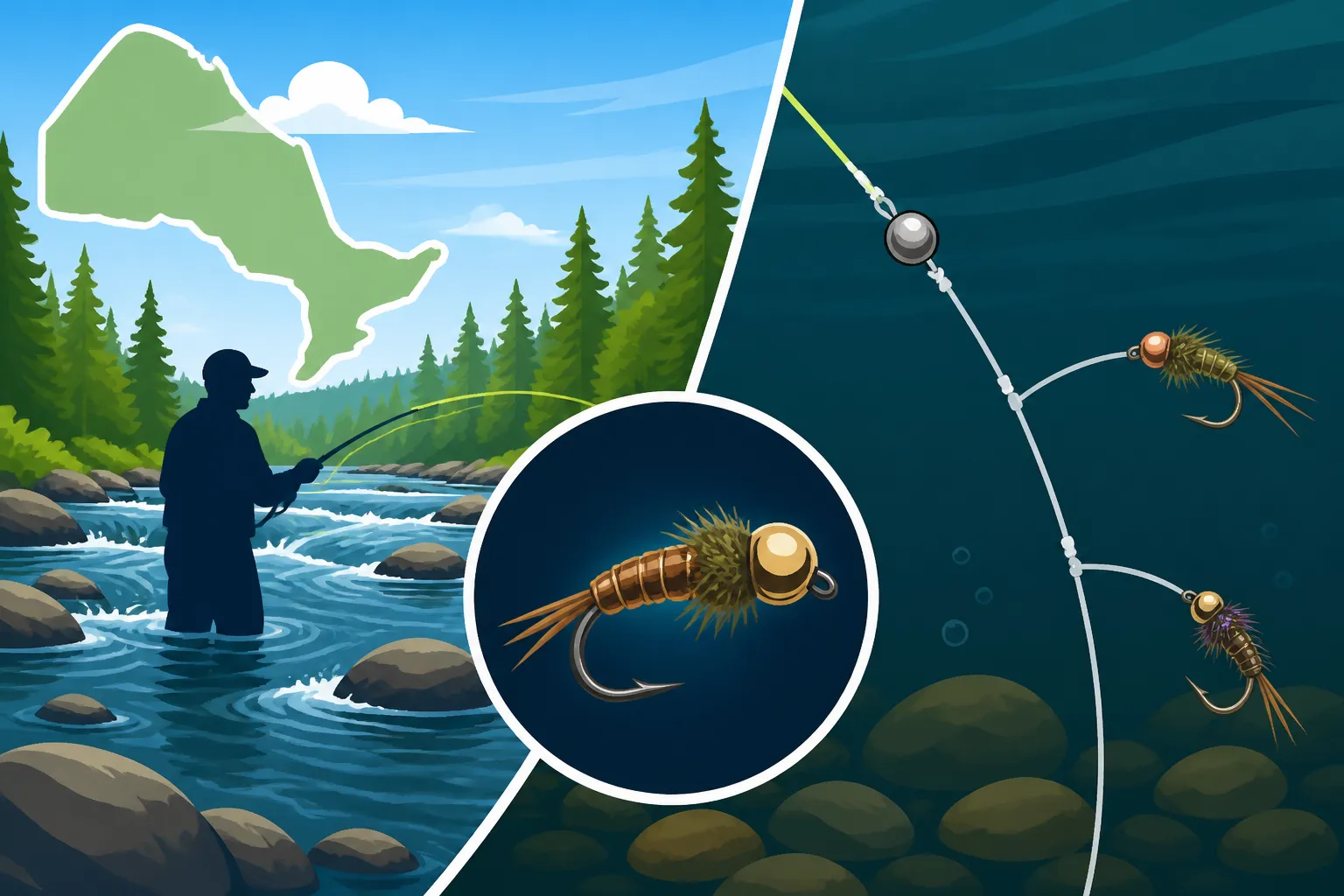
You start with your tapered leader, then attach a strike indicator a set distance above your first nymph. This distance should generally be about 1.5 to 2 times the depth of the water you're fishing. Below the indicator, you'll tie on your first nymph, and then usually, a second "dropper" nymph tied off the bend of the first hook or with a small tag end of tippet. You might add split shot above your first nymph to help get it down quickly.
When to Use It:
Indicator nymphing shines in situations where you need to suspend your flies at a consistent depth, especially in deeper runs, slow-moving pools, or when you're fishing a relatively consistent current seam. It's excellent for searching water when you're not sure exactly where the fish are holding.
Pros and Cons:
- Pros: Easy to learn and master, clear strike detection (the indicator dips or stops), allows for precise depth control, great for fishing varying depths by adjusting the indicator. It's also less physically demanding than some other methods.
- Cons: The indicator can create drag in complex currents, especially if it's too large for the conditions. Casting can be clunky with heavy indicators and multiple flies/weights. The indicator can also spook wary fish in very clear or shallow water.
European Nymphing Techniques (Euro Nymphing)
European nymphing, or "tight-line nymphing," has revolutionized trout fishing and is incredibly effective on freestone streams, though it has a steeper learning curve. It involves maintaining direct contact with your nymphs, eliminating the need for a floating indicator. Check out our detailed guide on Euro Nymphing Ontario Trout Streams for a deeper dive.
Explanation and Setup:
Instead of a traditional tapered leader, Euro nymphing uses a specialized, long, thin leader, often with a two-tone "sighter" section for visual strike detection. This leader is usually tied directly to your fly line (or a special Euro nymphing fly line). You fish with your rod tip high, keeping most of your fly line off the water and maintaining a tight, direct connection to your nymphs. You typically fish two or three weighted nymphs, sometimes with a heavier "point fly" to get the rig down and a lighter "dropper fly" to mimic smaller insects.
When to Use It:
Euro nymphing excels in faster, turbulent pocket water, riffles, and complex current seams where an indicator would constantly drag. It allows for incredibly precise drifts and immediate strike detection. It's also fantastic for fishing close-in cover and undercuts where fish often hold.
Pros and Cons:
- Pros: Unparalleled sensitivity and immediate strike detection, exceptional drag control in complex currents, highly efficient for covering broken water, less weight needed on your leader (as flies are typically tungsten weighted), and no indicator to spook fish.
- Cons: Requires excellent rod and line control, a longer learning curve, can be physically demanding holding the rod high, generally less effective in very deep or slow-moving water, and requires specialized leader setups. You might find specialized Euro nymphing leaders on Amazon that make getting started easier.
Dry-Dropper Rigs
The dry-dropper rig is a fantastic, versatile option for freestone streams, especially when fish might be looking up for dries, but also feeding on subsurface nymphs. It combines the best of both worlds.
Explanation and Setup:
This rig involves tying a nymph (the "dropper") off the bend of a floating dry fly. The dry fly acts as both your strike indicator and a potential target for rising fish. You can tie the nymph off a short tag of tippet (6-18 inches) or directly off the bend of the dry fly's hook.
When to Use It:
Dry-dropper rigs are ideal for shallower water, broken riffles, or when there's an active hatch of both surface and subsurface insects. If you see occasional rises but suspect more fish are feeding below, this is your go-to. It's also a great searching rig when you want to cover both depths simultaneously.
Pros and Cons:
- Pros: Extremely versatile, acts as a natural strike indicator, covers both surface and subsurface presentations, lighter and easier to cast than a traditional indicator rig, and can be very exciting when a fish takes the dry!
- Cons: Less effective in deep water (the dry fly can't suspend nymphs deep enough), can be harder to detect subtle nymph takes compared to a dedicated indicator or Euro nymphing setup, and the dry fly can get waterlogged and sink if it's too small for the dropper.
Here's a quick comparison of these popular nymphing rigs:
| Rig Type | Primary Use Case | Key Benefit | Drawback | Ideal Water Conditions |
|---|---|---|---|---|
| Indicator Nymphing | Deeper runs, consistent currents, searching | Precise depth control, easy strike ID | Can create drag, visible indicator | Medium to deep, moderate flow |
| European Nymphing | Fast pocket water, complex currents | Superior drag control, extreme sensitivity | Steeper learning curve, physically demanding | Fast, turbulent, broken water |
| Dry-Dropper | Shallower water, mixed feeding, prospecting | Versatile, natural indicator, covers two depths | Limited depth, subtle nymph strikes harder | Shallow to medium depth, varied flow |
Key Nymph Patterns and Presentation Strategies
Having the right rig is only half the battle. Knowing what nymphs to use and how to present them effectively is what truly unlocks success on Ontario's freestone streams.
Go-To Nymph Patterns for Ontario Freestones
Trout in freestone streams primarily feed on aquatic insects, so your nymph selection should mimic the prevalent bugs. While hatches can vary, a few "staple" patterns will serve you well across most Ontario waters. You can often find great selections of these on platforms like Amazon, making it easy to stock up.
- Pheasant Tail Nymph: This is a classic for a reason. It imitates a vast array of mayfly nymphs, which are a cornerstone of a trout's diet. Carry them in sizes #12-20, with and without beadheads.
- Hare's Ear Nymph: Another fantastic generalist, the Hare's Ear mimics various mayfly and caddis larvae. Its buggy, shaggy appearance is irresistible. Sizes #12-18 are usually effective.
- Prince Nymph: With its distinct white biots and peacock herl body, the Prince Nymph can imitate stoneflies, caddis, and even larger mayflies. It's a great attractor pattern. Sizes #10-16.
- Stonefly Nymphs: In many freestone systems, especially those with larger rocks and good current, stoneflies are a major food source. Patterns like Pat's Rubber Legs, Kaufmann's Stone, or other dark, segmented stonefly imitations in sizes #6-14 are crucial, particularly in colder water or after high flows.
- Caddis Larva/Pupa: Caddis are ubiquitous. Patterns like the LaFontaine's Sparkle Pupa, an X-Caddis (unweighted as a dropper), or simple green or tan caddis larva imitations in sizes #12-18 are excellent, especially during emergence.
Always carry a variety of sizes and weights (beadhead vs. unweighted) for each pattern. Sometimes a minor change in size or sink rate can make all the difference. For more ideas on what flies to pack, our Fly Patterns for Ontario Trout Streams guide has plenty of suggestions.
Reading the Water and Identifying Holding Lies
Knowing where trout should be holding is paramount to successful nymphing. Trout are energy efficient and seek out lies where food is abundant but the current isn't too strong.
- Current Seams: These are the lines where fast water meets slow water. Trout often sit in the slower water, darting into the faster current to grab food. Cast your nymph so it drifts naturally along or just inside these seams.
- Eddies and Back-eddies: Areas of slack water behind boulders or points are prime resting spots where trout can pick off food that swirls by.
- Pocket Water: This refers to the small, calm spots behind rocks in otherwise fast water. Trout love these pockets as they offer shelter from the current and funnel food right to them. Focus on short, accurate drifts into each pocket.
- Undercut Banks and Submerged Structure: These provide excellent cover and current breaks. Fish your nymphs close to these features.
- Runs and Riffles: These are feeding zones. Trout will position themselves in the deeper, slower sections of a run, or in the soft spots within a riffle, waiting for food. Don't overlook the "head" and "tail" of a pool, where currents are often more defined.
Approach the water cautiously. Trout are easily spooked. Stay low, move slowly, and try to fish "upstream" into the currents whenever possible, which allows you to drift your flies into untouched water. Understanding How to fish a run and pool trout stream will greatly enhance your ability to read the water effectively.
Mastering the Drift and Detecting Strikes
A natural, drag-free drift is the holy grail of nymphing. Any unnatural movement of your fly will immediately tell a trout it's not real food.
- High-Sticking: This technique involves holding your rod tip high to keep as much line as possible off the water, reducing surface tension and drag. It's particularly useful in Euro nymphing and tight-line scenarios.
- Mending: When your line begins to be pulled by conflicting currents, you need to "mend" your line. This means repositioning your fly line upstream without moving your fly, allowing it to continue its natural drift. It's a crucial skill for indicator nymphing.
- Line Control: Always aim to have just enough slack to allow a natural drift, but not so much that you can't detect a strike. Too much slack, and you'll miss fish.
- Strike Detection: This can be incredibly subtle with nymphs. With an indicator rig, any dip, stop, or unnatural movement of the indicator calls for a hookset. With Euro nymphing, you're looking for subtle pauses or twitches in your sighter or even feeling a slight bump through your line. Always set the hook if you suspect a strike – better a false set than a missed fish! Practice makes perfect here. Even a slight hesitation in your line's movement can mean a trout has inhaled your fly.
Essential Tips for Success on Ontario's Freestone Streams
Beyond the technical aspects of rigging and presentation, there are several key practices that will enhance your overall experience and success when nymphing Ontario's freestone waters.
Practicing Catch and Release Ethically
As responsible anglers, we have a duty to protect our fisheries, especially those delicate wild trout populations in freestone streams. Practicing ethical catch and release is paramount.
- Barbless Hooks: Crimp down the barbs on all your nymph hooks. This makes hook removal quicker and less damaging to the fish's mouth, increasing its survival chances. Many commercial nymphs now come barbless, and you can easily pinch down barbs with a good pair of pliers found on Amazon or at your local tackle shop.
- Minimize Handling: Try to keep the fish in the water as much as possible. If you must handle it for a quick photo, wet your hands first to protect its slime coat. Avoid squeezing the fish or touching its gills.
- Quick Release: Have your camera ready, snap a quick picture if desired, and then gently release the fish into a calm current. If the fish seems stressed, hold it facing upstream in a gentle current until it regains its strength and swims away on its own.
- Proper Netting: Use a rubberized or knotless landing net. These nets are much gentler on the fish's fins and slime coat than traditional knotted mesh nets, further aiding in safe release. For a good selection, look at Best Landing Net for Trout.
Safety Considerations When Wading
Wading freestone streams can be incredibly rewarding, but it also carries inherent risks due to slippery rocks, strong currents, and uneven bottoms. Safety should always be your top priority.
- Wading Staff: This is non-negotiable for me. A sturdy wading staff provides a crucial third point of contact and helps you probe the depth and stability of the stream bed before taking a step. It can prevent a nasty fall that could lead to injury or lost gear. For advice on choosing one, check out Best Wading Staff for Slippery Riverbed Rocks.
- Studded Wading Boots: Felt soles have been banned in some areas due to invasive species concerns, but rubber soles with carbide studs offer excellent grip on slick, algae-covered rocks. Ensure your boots fit well and provide good ankle support.
- Check Water Conditions: Before heading out, check local weather forecasts and stream gauges if available. Rapidly rising water levels or strong currents can make wading extremely dangerous. Never wade alone if possible, especially in unfamiliar waters.
- Layer Appropriately: Even in summer, freestone streams can be cold. Dress in layers, including proper insulating layers under your waders, to stay comfortable. Be mindful of potential hypothermia. You can find excellent layering options and comfortable Best Breathable Waders for Summer Fishing on Amazon.
- Know Your Limits: Never attempt to wade water that is too deep or currents that are too strong for your comfort level. It's always better to err on the side of caution.
Gear for a Comfortable Day on the Water
Being comfortable makes a huge difference in your ability to concentrate and enjoy your time fishing.
- Waders and Boots: As mentioned, good waders and boots are essential. Breathable waders are a must for comfort in warmer weather, while neoprene waders are better for colder seasons.
- Vest or Pack: A fly fishing vest or a sling pack (like many available on Amazon) keeps all your essential gear – fly boxes, tippet, nippers, hemostats, indicators, and snacks – organized and easily accessible.
- Polarized Sunglasses: These are vital. Not only do they protect your eyes from UV rays and errant hooks, but they also cut glare off the water, allowing you to see submerged rocks, structure, and even rising or holding fish.
- Water and Snacks: Staying hydrated and fueled is important. Carry enough water for your outing and some high-energy snacks.
- Sun Protection: A hat, sunscreen, and sun-protective clothing are crucial for long days on the water, especially during the brighter parts of the season.
By carefully considering your rig, mastering your presentation, and adopting responsible practices, you'll be well on your way to consistent success nymphing for trout in Ontario's incredible freestone streams.
Disclaimer
This article is for general informational purposes only and does not constitute professional advice. Laws, prices and regulations vary by location and change over time. Consult a qualified professional for guidance on your specific situation.