Best downrigger settings for summer lake trout
The summer sun blazing down on Ontario's vast, deep lakes can feel like a mixed blessing for lake trout anglers. On one hand, the weather is gorgeous, perfect for being out on the water. On the other, those elusive lake trout seem to vanish, retreating to the mysterious depths where temperatures are just right. If you've ever found yourself scratching your head, wondering how to consistently put a lure in front of these cold-water denizens during the dog days of summer, this guide is for you. We're going to dive deep into the world of downriggers and unlock the optimal settings to help you connect with summer lake trout.
Understanding Summer Lake Trout Behavior
When the surface waters of Ontario's lakes start to warm up in late spring and early summer, lake trout don't just disappear; they move. These magnificent fish are highly sensitive to water temperature, preferring cold, oxygen-rich environments. As the upper layers of the lake warm, a distinct thermal stratification occurs, creating a "thermocline." This is where the cooler, deeper water meets the warmer surface water, and it's essentially a temperature highway for lake trout.
The Summer Deep Dive
Think about it from a lake trout's perspective: as the water they've been comfortable in gets warmer and warmer, it starts to feel like a hot tub when you prefer a cool bath. Their metabolism, their comfort, and their very survival depend on finding that sweet spot of cold water, typically between 8 to 12 degrees Celsius (46-54°F). This means they're migrating from shallower areas they might have frequented in spring to the deeper parts of the lake. They're not just moving to any deep water; they're looking for areas that offer both the right temperature and access to their food sources.
This deep dive is why traditional shallow-water casting or even light trolling with surface presentations becomes largely ineffective during summer. The fish simply aren't there anymore. They've sought refuge in the cooler, darker realms, often near deep structure, drop-offs, or humps where they can ambush prey. Understanding this fundamental shift in behavior is the first step to successful summer downrigger fishing. You're essentially taking your bait to their comfort zone.
Following the Forage
Lake trout are predators, and like all predators, they go where the food is. In many Ontario lakes, their primary forage fish, such as ciscoes, smelts, or even alewives, also prefer cooler water. As these baitfish move deeper to find their ideal temperature and plankton, the lake trout follow right behind them. This creates a predictable pattern: find the bait, and you'll often find the trout.
Your sonar unit becomes your best friend in this scenario. You're not just looking for "fish" arches; you're looking for dense schools of baitfish, often appearing as clouds or tighter clusters on your screen, suspended at specific depths. If you see bait, and the temperature is right, you can bet lake trout are lurking nearby, ready to feast. Paying attention to these subtle movements of the food chain is paramount to putting your downrigger presentation exactly where it needs to be.
Key Downrigger Components and How They Work
Before we get into the nitty-gritty of settings, let's quickly review the basic components of a downrigger system. Understanding how each part contributes to your success will help you make informed adjustments on the water. A downrigger isn't just a fancy winch; it's a precision instrument.
Components Breakdown
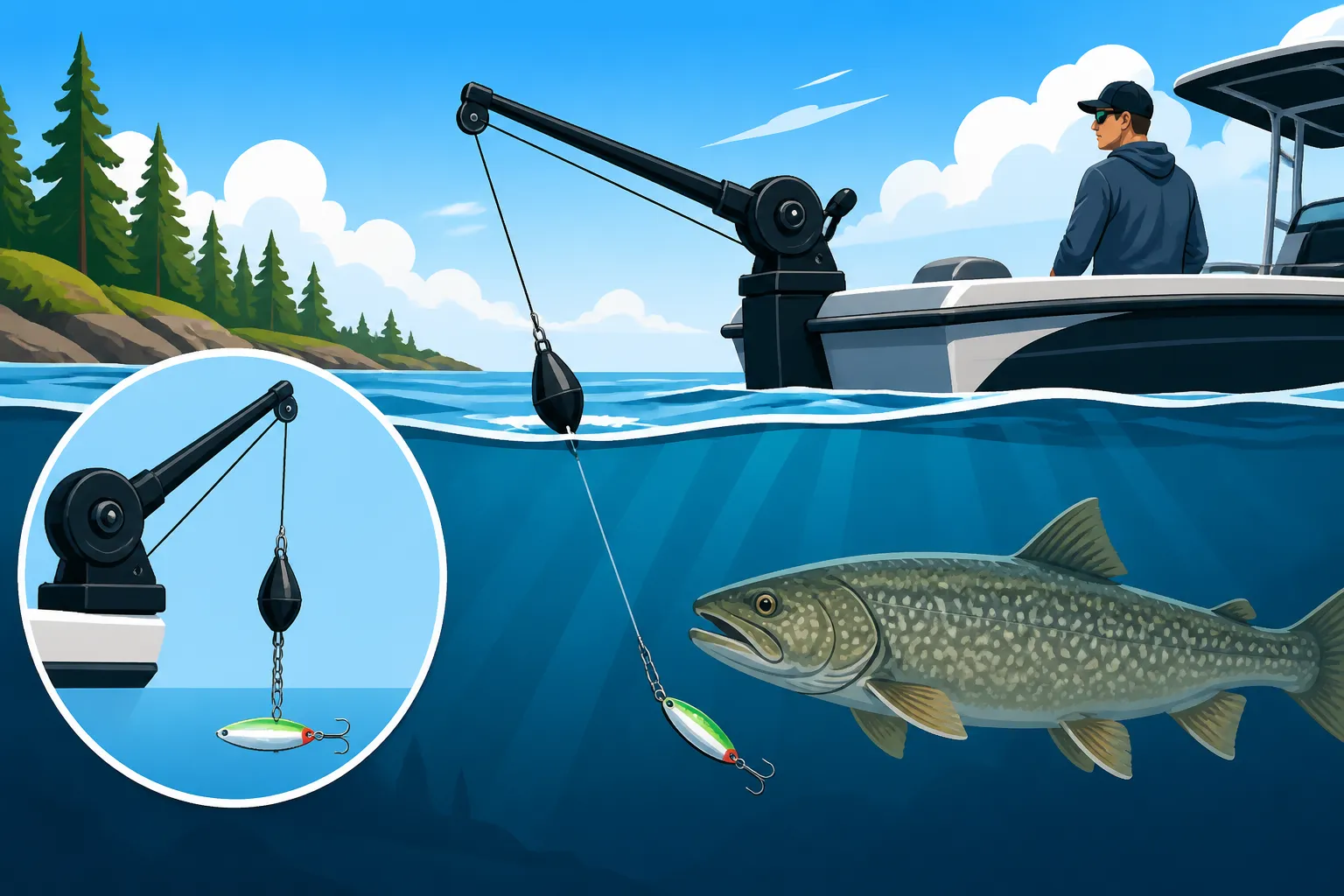
At its heart, a downrigger system consists of a few crucial parts:
- The Boom: This is the arm that extends out from your boat, positioning the downrigger weight away from the hull. Longer booms help prevent your fishing line from tangling with your prop or other lines.
- The Cable: A strong, usually stainless steel or braided line, that spools off the downrigger and carries the weight.
- The Weight (Cannonball): Typically a lead ball, often teardrop or flat-sided, ranging from 6 to 15 pounds. Its weight is critical for reaching and holding depth, especially when trolling at speed or in currents.
- The Release Clip: This is perhaps the most important component, as it's what connects your fishing line to the downrigger cable and weight. When a fish strikes, the tension pulls the line free from the clip, allowing you to fight the fish directly without the weight.
- The Line Counter: An essential feature that tells you precisely how much cable is out, thus indicating your depth. Without an accurate line counter, you're just guessing.
All these components work in harmony to present your lure at a specific, controlled depth. Many anglers source reliable downriggers and accessories from platforms like Amazon, ensuring they have robust gear for the challenges of Ontario's deep lakes.
How They Keep You in the Strike Zone
The magic of a downrigger is its ability to deliver your lure to a precise depth and keep it there, regardless of your trolling speed, for extended periods. Imagine trying to get a small spoon down to 80 feet using just weights on your line – the amount of line you'd need to let out would be incredible, and any turn or change in speed would drastically alter its depth.
With a downrigger, you attach your fishing line (with your lure already in the water, sometimes quite a distance behind the boat, known as "lead length") to the release clip, which is then clipped to the downrigger cable. You lower the downrigger weight to your desired depth, and your lure follows, running freely a set distance behind and above the heavy cannonball. This setup allows your lure to have its natural action, unencumbered by heavy weights on your main fishing line, making it much more appealing to a cautious lake trout. It’s about putting the bait in the fish’s face, not just in the general vicinity.
Essential Downrigger Settings for Success
Now for the main event: what are the optimal downrigger settings for summer lake trout? This isn't a one-size-fits-all answer, as conditions vary, but there are fundamental principles and adjustments that will dramatically increase your success rate.
Dialing in Depth
This is the absolute cornerstone of downrigger fishing for lake trout. As we discussed, they're temperature-sensitive. Your goal is to find the thermocline and target depths within or just above/below it where baitfish and trout are congregating.
Start by using your sonar unit to locate the thermocline. It often appears as a distinct band on your screen, sometimes with scattered baitfish arches associated with it. Once you've identified this depth, begin experimenting. A good starting point is to run your lures just above the top of the thermocline, right in the middle, and slightly below it. This gives you a spread to see where the fish are most active. Remember that the depth of the thermocline can vary not only from lake to lake but also within different areas of the same lake, and even throughout the day. Pay attention to structure as well; a deep point or underwater hump at the thermocline depth can be a real hotspot. Regularly checking your electronics for fish and bait schools is crucial, and the Best Fish Finders for Ontario Lakes article can offer guidance on optimizing your sonar.
Trolling Speed and Lure Action
The speed at which you troll your boat directly impacts your lure's action and its appeal to lake trout. There's no single "best" speed; it depends on the lure you're using and the mood of the fish.
- Spoons: Most trolling spoons (like William's Wobblers or Northern Kings) have an optimal speed range where they wobble, flash, and dart enticingly. Too slow, and they'll just drag; too fast, and they'll spin unnaturally. Generally, a speed between 1.8 to 2.5 mph (miles per hour) is a good starting point for spoons.
- Dodgers and Flies: When using a dodger or flasher in combination with a fly or small spoon, a slower speed is often preferred, typically between 1.0 to 1.8 mph. The dodger creates an erratic side-to-side motion that imparts action to the trailing fly, mimicking a fleeing baitfish.
- Stickbaits/Plugs: Larger stickbaits designed for trolling might require slightly higher speeds, sometimes up to 3.0 mph, to get their built-in wobbling action.
Always watch your rod tip: it's your window into what your lure is doing. A steady, rhythmic pulse indicates good action, while a lack of movement or erratic twitching might mean your lure is fouled or your speed is off. Don't be afraid to experiment with slight speed changes. A sudden acceleration or deceleration can sometimes trigger a strike from a following fish. If you're looking for more general insights, our guide on Trolling Techniques for Ontario Lake Trout offers deeper dives into these methods.
Lead Length and Release Clips
The "lead length" is the distance between your lure and the downrigger release clip. This isn't just an arbitrary measurement; it's critical for how your lure performs and how far it moves away from the downrigger weight.
- Lead Length: A shorter lead (10-20 feet) keeps your lure closer to the downrigger weight, which can be useful when fish are tightly schooled or when you want a more compact presentation. A longer lead (30-100 feet or more) allows your lure to swim further away from the downrigger weight and the boat, often resulting in a more natural presentation, especially in clear water or for spookier fish. The longer the lead, the more "blowback" (the upward angle of your line from the release clip) you'll experience, meaning your lure will be running shallower than the downrigger ball. For detailed adjustments, understanding how to compensate for blowback is key, which you can often learn through experience and by running specific lures.
- Release Clip Tension: The tension on your release clip dictates how easily your line pops out when a fish strikes. Too tight, and small fish might not trip it; too loose, and boat surges or even heavy weeds can cause premature releases. Experiment with adjustable clips; a good starting point is enough tension to hold your line securely while trolling, but light enough that a solid "take" will release it cleanly. Sometimes, the fish don't hit hard, they just "load up" the rod, so having a clip that releases at the right pressure is crucial. Many anglers will purchase a variety of release clips, often in multi-packs from Amazon, to ensure they have the right tension for various conditions and fish sizes.
Lure Selection and Color
While not strictly a "downrigger setting," your choice of lure and its color scheme plays a massive role in downrigger success.
- Lure Types: Spoons are perhaps the most popular choice for lake trout on downriggers. Their erratic wobble and flash are irresistible. Dodgers or flashers paired with a trailing fly (often a tube fly or a minnow imitation) are also highly effective. These combinations create a larger profile and more attraction, which can draw fish from a greater distance. Some anglers also use deep-diving crankbaits or even natural baits (like frozen smelts or herring) on special rigs.
- Color Considerations: Color is especially important in deeper, darker water. As light penetrates water, certain colors disappear faster than others. Red and orange fade quickly, while blue and green penetrate deepest. Bright, fluorescent colors (chartreuse, pink, orange) can be very effective in low light or deep water because they reflect what little light is available. Metallic finishes (silver, gold, copper) are also excellent for reflecting light and mimicking baitfish flash. On overcast days or in stained water, brighter or glow-in-the-dark lures can often outproduce natural patterns.
Fine-Tuning and Troubleshooting
Even with the best initial settings, the lake is a dynamic environment. Successful downrigger fishing often comes down to making subtle adjustments throughout the day.
Reading Your Electronics
Your fish finder is your eyes in the underwater world. Don't just set your downriggers and forget them. Constantly monitor your sonar for signs of fish, bait, and changes in the thermocline.
- Marking Fish: If you see fish arches at a particular depth, immediately adjust one or more of your downriggers to that exact depth. If those arches are associated with baitfish schools, even better! Pay attention to whether the fish are tightly schooled or scattered.
- Thermocline Shifts: Wind, currents, and even large boat traffic can cause the thermocline to "bounce" or shift in depth. If you stop marking fish at your previous depths, re-scan to confirm the thermocline's position and adjust accordingly.
- Bottom Contours: Your chartplotter or GPS unit (often integrated with your fish finder) is invaluable for identifying underwater structure like humps, reefs, and steep drop-offs. These are prime lake trout holding areas, especially if they intersect the thermocline. Running your lures along these contours can be incredibly productive. Our guide to Best Fish Finders for Ontario Lakes provides excellent detail on maximizing your electronics.
Staggering Depths and Lures
If you're running multiple downriggers or using stacking clips (which allow you to run two lines off one downrigger cable), you have the opportunity to cover more of the water column and test different presentations simultaneously.
- Depth Staggering: If you have two downriggers, set them at slightly different depths. For example, if the thermocline is at 60 feet, run one ball at 55 feet and the other at 65 feet. If you get a strike on one, adjust the other to that productive depth. With stacking clips, you can run one lure at 60 feet and another 10-20 feet above it, maximizing your coverage from a single downrigger.
- Lure Variety: Don't be afraid to experiment with different lure types and colors across your setup. One downrigger might have a silver spoon, while another runs a dodger with a chartreuse fly. This "trolling spread" helps you quickly identify what the fish are keying in on that particular day. If one setup consistently out-performs the others, switch your other lines to match it.
Current, Wind, and Boat Speed Adjustments
Lake fishing in Ontario isn't always on calm, flat water. Wind and current can significantly impact your downrigger presentation.
- Wind and Waves: Strong winds can create "blowback" on your downrigger cables, causing your weights to rise. They also make it harder to maintain a consistent boat speed. You may need to increase your downrigger weight or reduce your trolling speed to compensate and keep your lures at the desired depth.
- Currents: Some deeper lakes, especially those with significant inlets or outlets, can have subsurface currents. These currents can also cause blowback or push your lures off course. Using heavier weights and constantly checking your line counters against your sonar depth can help.
- Boat Speed Consistency: Maintaining a consistent trolling speed is paramount. Use your boat's throttle and, if equipped, a good autopilot or electric trolling motor to keep your speed steady, especially when making turns. Many advanced boaters use a bow-mounted trolling motor as a "kicker" for precise speed control. You can find excellent options for these on Amazon, allowing for very subtle adjustments.
Practical Downrigger Setup Scenarios
Let's look at a few common scenarios and how you might adjust your downrigger settings. These are starting points, remember, the fish will tell you what works!
| Scenario | Target Depth Strategy | Lead Length (Lure to Clip) | Trolling Speed (MPH) | Lure Type (Examples) | Notes |
|---|---|---|---|---|---|
| Clear, Sunny Day | Deep in or just below thermocline | Long (50-100 ft) | 2.0 – 2.8 | Natural colored spoons | Fish can be spooky; longer leads and natural colors often work best. |
| Overcast/Low Light | Upper part of thermocline or slightly above | Medium (20-40 ft) | 1.8 – 2.5 | Bright/Glow spoons, dodger/fly | Fish often move shallower; increased visibility with brighter lures. |
| Fish Marked on Bottom | Just above bottom, contouring structure | Short-Medium (15-30 ft) | 1.5 – 2.2 | Heavy spoons, bottom bouncers | Precision depth control is key to avoid snags. |
| Dense Bait Schools | Right within the bait school's depth | Short (10-20 ft) | 1.0 – 1.8 | Smaller spoons, dodger/fly | Mimic a lone baitfish separated from the school. |
| Aggressive Fish | Anywhere in the thermocline | Medium (20-50 ft) | 2.5 – 3.0 | Larger, flashier spoons | Higher speeds can trigger reactionary strikes. |
| Finicky Fish | Staggered depths around thermocline edges | Long (60-100 ft) | 1.0 – 1.5 | Smaller, subtle dodger/fly | Slower speeds and more natural, smaller presentations. |
This table provides a snapshot of how you might approach different conditions. Remember to constantly adapt and experiment.
The Patience and Persistence Factor
Finally, while having the "best" downrigger settings is important, perhaps the most crucial ingredient for summer lake trout success is patience and persistence. These fish aren't always easy, and sometimes it takes hours of trolling and dozens of adjustments to figure out their mood and location on any given day.
Don't get discouraged if you're not getting bites immediately. Keep an eye on your electronics, continue to vary your depths, speeds, and even your lure choices. Talk to other anglers (if you see them having success), check local forums, or refer to guides like our comprehensive How to Catch Lake Trout in Ontario to pick up new tips. Understanding the Ontario Lake Trout Limit and Possession Rules before you head out is also a smart move, ensuring you're compliant with regulations.
Also, consider the time of day. While lake trout are often active in low light, deeper water makes them less sensitive to overhead sun. However, early mornings and late evenings can still see increased activity levels as other species might be more active then, stirring up the food chain. Remember that you need an Ontario Sport vs Conservation Fishing License to be out there, so make sure your papers are in order! And knowing the Ontario Fishing Season Dates by Zone is crucial for ensuring you're fishing legally. If you're wondering How long lake trout live in Ontario, you might be surprised at their longevity, a testament to their adaptability and often deep-water existence.
Successful summer downrigger fishing for lake trout in Ontario is a blend of science, art, and experience. By understanding their behavior, mastering your gear, and making informed adjustments, you'll be well on your way to enjoying some incredible catches from the depths of our beautiful lakes.
Disclaimer
This article is for general informational purposes only and does not constitute professional advice. Laws, prices and regulations vary by location and change over time. Consult a qualified professional for guidance on your specific situation.