Panfish Species Identification Guide for Ontario
It can be incredibly frustrating to be out on a beautiful Ontario lake, catching fish left and right, only to pull one up and scratch your head, wondering exactly what kind of panfish you've just landed. With so many species inhabiting our waters, some of them looking quite similar, it's easy to get them mixed up. This comprehensive guide will help you confidently identify the most common panfish species in Ontario, from the various sunfish to crappie and perch, ensuring you know exactly what's at the end of your line.
The Elusive Crappie: Black and White Distinctions
Crappie are a beloved panfish across Ontario, known for their delicious fillets and feisty fights. However, many anglers struggle to distinguish between the two main types: black crappie and white crappie. While they share many similarities, understanding their subtle differences can greatly improve your understanding of their habits and preferred habitats. Knowing which one you're targeting can even influence your choice of bait or presentation.
Spotting the Black Crappie: Patterns and Proportions
Black crappie are often described as having a "peppered" appearance due to their irregular, dark spots scattered over their silvery-gold to olive bodies. These spots don't typically form distinct vertical bars, which is a key differentiator from their white crappie cousins. Look closely at the dorsal fin (the fin on their back) – a black crappie will usually have 7 or 8 spines. This count is a very reliable way to identify them. Their body shape tends to be more round or disc-like compared to the white crappie, giving them a deeper profile. The mouth is relatively large, extending back to the middle of the eye. They often have a slightly concave curve above their eyes, giving their face a distinct look. You might find some excellent field guides on Amazon that illustrate these features perfectly.
These fish are commonly found in clear, vegetated waters, often congregating around submerged timber, weed beds, and brush piles. They prefer areas with lots of cover, making them a fantastic target for anglers who enjoy fishing structure. You'll find them cruising these areas, particularly during the spring spawn, searching for small minnows, insects, and crustaceans. Their preference for cover often means you're casting into tighter spots, so a shorter, more sensitive rod is ideal. For more on how to specifically target these speckled beauties, check out our guide on Black Crappie in Ontario Lakes.
Unmasking the White Crappie: Stripes and Snouts
White crappie, on the other hand, boast a more uniform appearance with several distinct dark vertical bars running down their sides. These bars are usually quite noticeable, especially on larger specimens. Count the dorsal fin spines here too: white crappie almost always have 5 or 6 dorsal spines. This is the single most reliable characteristic to differentiate them from black crappie. Their body tends to be more elongated and less "round" than a black crappie, giving them a somewhat slimmer profile. Their snout also appears longer and more pointed, with their mouth extending only to the front edge of the eye, not past it.
White crappie are often found in larger, muddier, or more turbid waters than their black crappie relatives. They're also less dependent on heavy cover and might be found in more open water, though they still appreciate structure like submerged brush or docks. They can tolerate a wider range of water conditions and are often plentiful in larger river systems and impoundments across southern Ontario. Their schooling behaviour makes them a blast to catch once you find them, often leading to rapid-fire action.
Crappie Confusion: Separating the Two
When you've got a crappie in hand, the easiest way to tell which species it is without a doubt is to count those dorsal fin spines. Seven or eight spines? It's a black crappie. Five or six spines? It's a white crappie. Beyond that, observing the pattern of spots versus bars, and the overall body shape and snout length can confirm your identification. Both species are fantastic for fishing, and sometimes you'll even find them coexisting in the same body of water, though often occupying slightly different niches.
| Feature | Black Crappie | White Crappie |
|---|---|---|
| Dorsal Fin Spines | 7-8 (most reliable) | 5-6 (most reliable) |
| Body Pattern | Irregular dark spots, "peppered" appearance | 6-10 distinct dark vertical bars |
| Body Shape | Deeper, more rounded, disc-like | More elongated, less deep |
| Mouth Position | Extends past middle of eye | Extends to front edge of eye or slightly past |
| Preferred Habitat | Clearer water, heavy cover (weeds, timber) | More turbid water, less dependent on heavy cover |
Whether you're after a meal or just enjoying the fight, both crappie species offer a lot of fun on the water. Make sure you're familiar with the Ontario Bag and Possession Limits by Species for crappie in your specific zone.
Sunfish Spectacle: Bluegill and Pumpkinseed
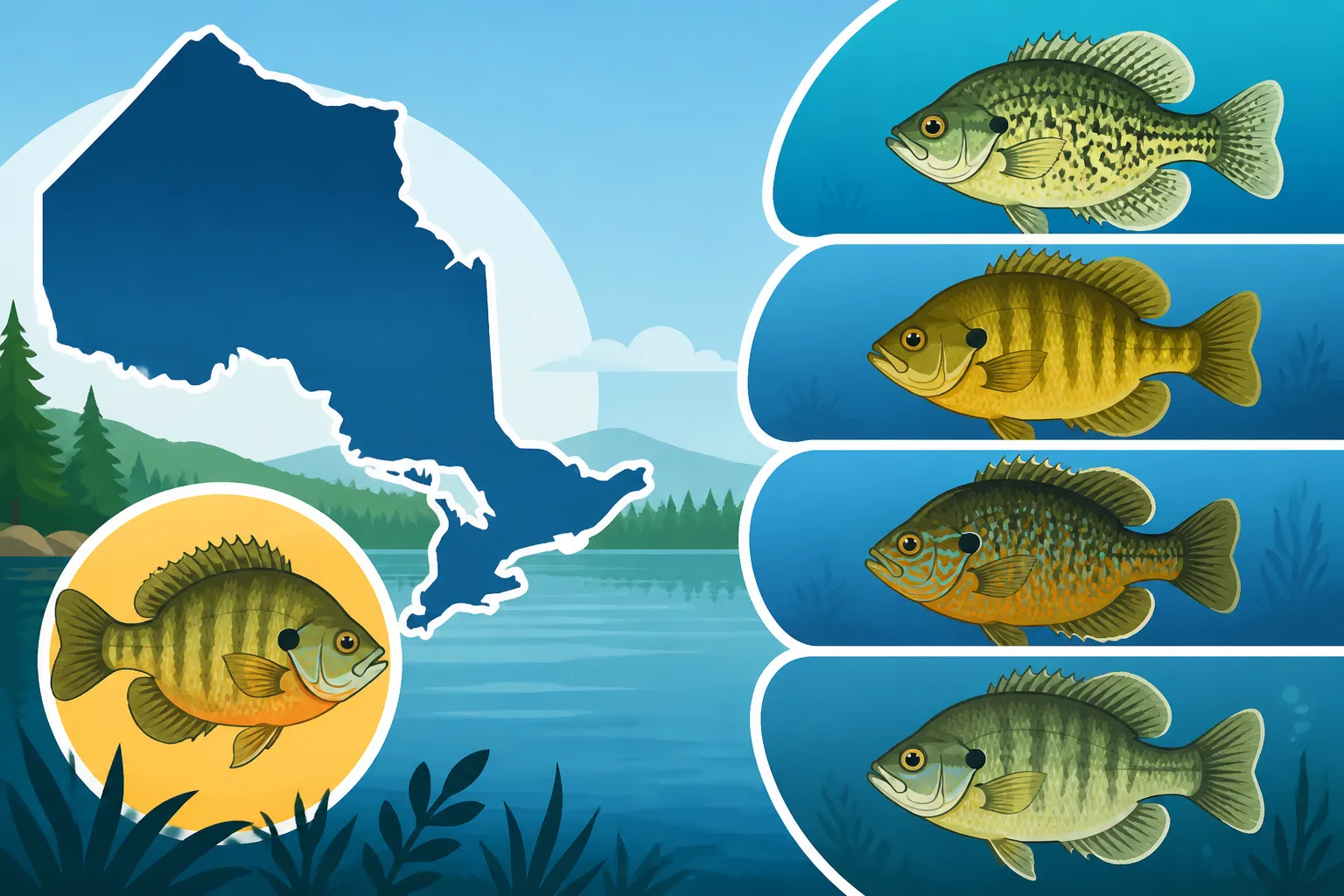
Ontario is home to several sunfish species, but the bluegill and pumpkinseed are perhaps the most commonly encountered and, at times, most easily confused. They're both iconic panfish that bring joy to anglers of all ages, especially those just starting out. Learning to tell them apart adds another layer of appreciation to your time on the water.
Bluegill Basics: Gills, Spots, and Size
The bluegill is a truly classic panfish, easily recognized by its deep, disc-shaped body and small mouth. Their colour can vary dramatically depending on the water clarity and bottom composition of their habitat, ranging from dark olive-green on their back to yellowish-green on their sides, often with several faint vertical bars. The most defining feature, and the one that gives them their name, is the prominent dark blue or black "ear flap" on their gill cover. This flap lacks any distinct colourful trim, unlike the pumpkinseed. Another good clue is a dark spot at the base of the dorsal fin. During spawning season, males can develop an orangish-red belly, adding to their vibrant appearance.
Bluegill thrive in warm, shallow lakes, ponds, and slow-moving rivers with plenty of aquatic vegetation. They are schooling fish and often found in large numbers, making them a prime target for anglers looking for consistent action. They feed on insects, small crustaceans, and even tiny minnows. For beginners, a simple worm under a bobber is often all it takes. To learn more about where to find these eager biters, take a look at our guide on Bluegill Habits in Ontario Ponds.
Pumpkinseed Particulars: Ornate Fins and Red Spots
The pumpkinseed sunfish is arguably one of the most beautiful fish in Ontario waters. While sharing the deep, disc-shaped body of the bluegill, the pumpkinseed is adorned with vibrant, almost iridescent markings. Their sides are typically olive or golden-green, often with wavy blue-green lines, and frequently speckled with small, orange, or reddish spots. The most striking identification mark is the bright red or orange spot on the rear edge of their black "ear flap." This small, jewel-like spot is almost always present and is the easiest way to confirm a pumpkinseed. Their pectoral fins (the ones on their sides) are also quite pointed and can sometimes be quite ornate.
Pumpkinseeds prefer similar habitats to bluegill: shallow, weedy areas of lakes, ponds, and slow rivers. They are particularly fond of clear water where their vibrant colours can truly shine. They're bottom feeders, often nipping at small insects, snails, and aquatic invertebrates. Their smaller mouths compared to bluegill mean you might need smaller hooks and baits to effectively catch them. When you're out fishing along the shore, trying to identify these smaller, colourful fish, a good pair of polarized sunglasses available on Amazon can really help you see their patterns more clearly.
Telling Sunfish Apart: A Side-by-Side Look
The key to distinguishing bluegill from pumpkinseeds lies primarily in the ear flap and body markings. If there's a bright red or orange spot on the black ear flap, it's a pumpkinseed. If the ear flap is entirely dark or black, with no coloured trim, it's a bluegill. Also, look for the intricate wavy lines and orange/red spots on the pumpkinseed's body, which are generally absent or much fainter on a bluegill. Both are smaller panfish, rarely exceeding 8-10 inches, making them perfect targets for light tackle.
| Feature | Bluegill | Pumpkinseed |
|---|---|---|
| Ear Flap | Solid dark blue/black, no distinct coloured spot | Black with a distinct bright red/orange spot |
| Body Colour/Marking | Olive to yellowish-green, faint vertical bars often | Olive/golden-green, wavy blue lines, orange/red spots |
| Mouth Size | Small, does not extend past eye | Small, does not extend past eye |
| General Appearance | More subdued colouration | More vibrant and ornate colouration |
Both these sunfish are a joy to catch, offering consistent action and a great way to introduce new anglers to the sport. They're often found together, making it fun to see which one you'll land next. These small fighters are a big part of the Panfish Fishing in Ontario experience.
The Stubborn Rock Bass: Reds, Browns, and Big Eyes
Rock bass are another widespread panfish in Ontario, often overlooked but offering a spirited fight and readily hitting a variety of baits. They can sometimes be confused with juvenile smallmouth bass due to their similar habitat and overall shape, but a few distinct characteristics will help you identify them instantly.
Rock Bass Rundown: Body Shape and Eye Color
The rock bass has a stout, somewhat stocky body, typically olive-brown to brassy in colour, often with dark spots that form faint horizontal rows. They possess large, striking red eyes – a characteristic that almost immediately sets them apart from other panfish. Their mouth is relatively large for a panfish, extending back to the middle of the eye. Like the crappie and sunfish, they are members of the sunfish family, sharing that general deep, compressed body shape. They have distinct spiny dorsal and anal fins, another common trait among their relatives.
Rock bass are, as their name suggests, connoisseurs of rocky environments. You'll find them around rocky shorelines, shoals, riprap, submerged boulders, and log jams in both lakes and rivers. They are opportunistic feeders, preying on insects, crayfish, and small minnows. They're often quite aggressive and not shy about hitting a lure. If you're fishing a rocky point for smallmouth, don't be surprised to encounter a few rock bass as well! Their willingness to bite makes them a great target for those days when other fish are finicky.
Where to Find Rock Bass: Rocky Bottoms and Structure
Rock bass are almost exclusively associated with rocky structures. If you're fishing a shoreline littered with rocks, a river with a gravel bottom, or a lake with extensive rock shoals, you're in prime rock bass territory. They use these rocks for cover from predators and as ambush points for their prey. This preference makes them predictable targets, especially for shore anglers or those exploring new waters. A simple jig with a small grub or a spinnerbait cast near these structures can be incredibly effective. For those seeking shore-based adventures, our guide on Best Shore Fishing Spots in Ontario might point you to some great rock bass locales.
They are quite tolerant of different water temperatures and can be found throughout Ontario, from the Great Lakes to smaller inland lakes and rivers. Their hardy nature means they can often thrive in areas where more sensitive species might struggle. They don't typically grow very large, usually topping out around 10-12 inches, but what they lack in size, they make up for in eagerness to bite.
Avoiding Confusion: Rock Bass vs. Smallmouth Juveniles
The most common mix-up for rock bass is with juvenile smallmouth bass, especially given their shared habitat. However, a few critical differences will help you tell them apart. Smallmouth bass, even juveniles, will typically have a more elongated, torpedo-shaped body compared to the deeper, stockier rock bass. The most obvious difference is the eye colour: smallmouth bass have golden or brown eyes, not the prominent red eyes of the rock bass. Additionally, smallmouth bass often have vertical bars or blotches on their sides, which are different from the more uniform dark spots found on rock bass. Smallmouth also have a more pronounced lateral line and their mouth, while large, often extends further back on the head compared to the rock bass when fully grown. For serious anglers looking to enhance their gear, a high-quality tackle box available on Amazon can help organize the various jigs and lures perfect for catching both species.
| Feature | Rock Bass | Juvenile Smallmouth Bass |
|---|---|---|
| Eye Colour | Distinctive red | Golden or brownish |
| Body Shape | Deep, stocky, relatively compressed | More elongated, torpedo-shaped |
| Body Colour/Marking | Olive-brown to brassy, dark spots in faint rows | Brownish to bronze, often with vertical bars or blotches |
| Mouth Position | Relatively large, extends to middle of eye | Large, often extends past eye (especially in adults) |
| Dorsal Fin | Single, continuous dorsal fin, spiny and soft parts connected | Two distinct dorsal fins (though often appear connected) |
Once you learn to spot those red eyes, identifying a rock bass becomes second nature. They're a fun and feisty addition to any angler's day, and a great way to fill out your Panfish Fishing in Ontario creel.
The Ubiquitous Yellow Perch: Stripes of Gold
Yellow perch are arguably one of Ontario's most popular panfish, cherished for their delicious taste and widespread availability. They're a staple for both open-water and ice fishing anglers. While generally easy to identify, understanding their key features ensures you're always sure of your catch.
Yellow Perch Hallmarks: Bars and Brilliant Colour
Yellow perch are truly distinctive. Their most prominent feature is their vibrant golden-yellow sides, interrupted by 6 to 8 dark, broad vertical bars that extend from their back almost to their belly. These bars are usually very clear and unmistakable. Their dorsal fins are separated: the first dorsal fin is spiny, and the second is soft-rayed. The lower fins – pelvic, anal, and caudal (tail) – are often tinged with orange or reddish colour, especially during spawning season or in colder water, adding to their striking appearance. They have a somewhat elongated, compressed body, with a noticeable hump behind their head.
Yellow perch thrive in a wide range of aquatic environments, from the vast expanse of the Great Lakes to smaller inland lakes, ponds, and even some rivers. They prefer cool, clear water with some vegetation or structural elements but are highly adaptable. They are schooling fish, often found in large aggregations, which makes them a fantastic target for anglers. When you find one, you're likely to find many more! This schooling behavior is why they're so popular for Ice Fishing in Ontario – once a school passes under your hole, the action can be non-stop.
Perch Habitat and Habits: Schooling in Shallows
Yellow perch are highly social fish and almost always found in schools, ranging from small groups to massive aggregations. They prefer relatively shallow waters during the warmer months and often move to deeper basins during the winter, though they will still feed actively on transitional structures. Their diet consists primarily of small fish, insects, and crustaceans. They are often seen feeding in the low light conditions of dawn and dusk, but can be caught throughout the day, especially when actively searching for food. For specific tactics, our guide on Jigging for Perch Through the Ice offers some fantastic insights.
They are particularly abundant in large bodies of water like Lake Erie and Lake Simcoe, where they support significant recreational fisheries. Their prolific nature and tendency to school make them an excellent species for targeting with various techniques, from small jigs to live minnows. They are a favourite table fare, known for their flaky, white meat.
Differentiating Perch from Other Striped Fish
While the yellow perch is quite distinct, sometimes new anglers might confuse its vertical bars with those of a white bass or even juvenile walleye. However, the differences are quite clear. White bass have a more silvery body with thinner, often broken or irregular horizontal stripes, and typically lack the vibrant yellow and orange/red fins of the perch. Walleye, especially younger ones, can have some faint vertical markings, but their body shape is much more elongated and cylindrical, their eyes are large and milky (often called "walleyed"), and they entirely lack the brilliant yellow and prominent vertical bars of the perch. The separation of the two dorsal fins on a perch is also a unique identifier within panfish.
When fishing for perch, you'll often use lightweight gear. Our article on Best Tackle for Panfish provides recommendations that are perfect for these striped beauties. Whether you're targeting them specifically or just happy to land them as part of a mixed bag, the yellow perch is a truly iconic Ontario fish.
Tips for On-the-Water Identification
Even with all the knowledge in the world, identifying fish in the moment can be a challenge, especially when they're flopping around in your hand or darting in and out of the water. Here are a few tips to make your on-the-water identification easier and more accurate:
Observe Carefully and Handle Gently
When you land a fish, take a moment to observe its key features before immediately unhooking it. Look at the overall body shape, the colour patterns, the size of the mouth relative to the eye, and especially the dorsal fin spines or gill plate markings. If you're unsure, keep the fish in a net or a livewell (if legal and you plan to release it) while you consult a field guide. Handle all fish gently, especially if you intend to release them, to minimize stress and maximize their survival chances. Wet your hands before touching the fish to protect its slime coat.
Use a Reliable Field Guide
A good waterproof field guide is an angler's best friend. These guides often feature detailed illustrations or photographs and highlight key identification markers for various species. Keep one in your tackle box or boat. Many are compact and designed for easy reference. You can find excellent, province-specific fish identification guides that fit right into your fishing vest pocket on Amazon, which can be a real lifesaver when you're facing a tricky ID.
Take a Photo for Later Review
If you're still stumped and can't hold the fish long enough for a thorough review, snap a quick, clear photo. Try to get a shot of the whole fish, including its head and fins, against a plain background (like your hand or the side of the boat). You can then refer to your field guide or online resources later at home to make a definitive identification. This is especially helpful if you're trying to identify a rare or unusual catch.
Understand Local Regulations
Always remember that knowing your fish isn't just for curiosity; it's also crucial for adhering to fishing regulations. Different species have different size limits, bag limits, and open seasons. Misidentifying a fish could lead to accidental violations. Familiarize yourself with the Ontario Fishing Regulations Explained and keep a copy (digital or physical) handy. The Ontario Fish ON-Line Interactive Zone Map, Explained is also an invaluable tool for checking specific rules in your fishing zone.
By taking these steps, you'll not only become a more knowledgeable angler but also ensure you're fishing responsibly and enjoying the rich diversity of Ontario's panfish. Happy fishing!
Disclaimer
This article is for general informational purposes only and does not constitute professional advice. Laws, prices and regulations vary by location and change over time. Consult a qualified professional for guidance on your specific situation.