Best technique for winter smallmouth bass
Many anglers in Ontario tend to pack away their bass gear once the chill sets in, assuming smallmouth bass disappear into an inactive state. However, that couldn't be further from the truth! While these feisty fish certainly slow down, they remain catchable throughout the colder months for those willing to brave the elements and adapt their tactics. This comprehensive guide will walk you through the very best techniques for targeting and landing winter smallmouth bass in Ontario, helping you find success when others have given up.
The Allure and Challenge of Winter Smallmouth Fishing in Ontario
There's something uniquely satisfying about hooking into a strong smallmouth bass when the air is crisp and the water is frigid. It's a testament to patience, skill, and understanding the subtle nuances of cold-water angling. While it presents its own set of challenges, the rewards, from fewer crowds to potentially larger fish, are absolutely worth the effort.
Why Smallmouth Bass are Still Active in Winter
Unlike some species that truly hibernate, smallmouth bass remain active, albeit at a much slower pace, during the winter. Their metabolism drops significantly as water temperatures fall, meaning they don't need to feed as frequently or aggressively. Instead of chasing down prey, they become opportunistic feeders, conserving energy and waiting for an easy meal to come to them. This is why you'll often find them grouped tightly together in specific wintering areas, where they can survive on minimal caloric intake. Think of it like us during a bad winter storm – we might still venture out for a snack, but we're not running marathons!
The Rewards of Cold-Water Bass Fishing
One of the biggest advantages of winter smallmouth fishing in Ontario is the solitude. Many fair-weather anglers are tucked away, leaving prime waters significantly less pressured. This can lead to some incredible fishing, especially on lakes that see heavy summer traffic. Furthermore, the smallmouth you do catch in winter often tend to be larger, well-conditioned fish. They've survived the summer and fall, growing robust, and are simply harder to trick. Landing a bronzeback through the ice or on a chilly open-water day feels like a true accomplishment and offers a unique connection to the resource that warm-weather fishing sometimes can't. Plus, that satisfying tug on the line after a long, quiet wait can truly make your day.
Understanding Winter Smallmouth Behavior and Habitat
To successfully target winter smallmouth, you need to think like them. Their world shrinks considerably as the temperatures plummet, and their instincts dictate conservation and finding stable, comfortable environments. This means focusing on very specific types of structure and understanding their collective movements.
Deep Water Structure is Key
When the surface water cools to near freezing, smallmouth bass migrate from shallow flats and rocky points to deeper, more stable environments. Look for distinct structures in the main lake basins, especially those near sharp drop-offs, submerged humps, deep rock piles, and points that extend into deeper water. These areas provide thermal stability and often hold schools of baitfish, even if those baitfish are also lethargic. A classic scenario is finding a sheer rock wall dropping into 40-60 feet of water, with a slight ledge or crevice at 30 feet that holds a concentration of fish. Understanding these underwater contours is paramount, and a good fish finder becomes an invaluable tool for pinpointing these specific holding areas. Best Fish Finders for Ontario Lakes can make all the difference here.
Schools and "Pod" Fishing
Smallmouth bass are highly social fish, and this trait intensifies in winter. They'll form dense schools or "pods" in their preferred deep-water haunts. This means that if you find one smallmouth, you're likely sitting on a whole group of them. The challenge, of course, is finding that initial pod. This often involves systematically graphing likely deep-water structures with your electronics, looking for congregations of fish suspended slightly off the bottom or tucked right into the contours. Once you locate a pod, the fishing can be fast and furious until they either move on or become spooked. This "feast or famine" nature of winter smallmouth fishing is what makes it so exciting and, at times, frustrating!
The Slow Metabolism and Finicky Bites
With their metabolism slowed, winter smallmouth don't want to expend much energy chasing food. They're looking for an easy meal. This translates into much more subtle, almost imperceptible bites. You won't often get that aggressive thump you might feel in summer. Instead, it might be a slight weight, a faint tick, or just a feeling of "mush" on your line. This requires extreme sensitivity in your rod, reel, and line, along with heightened awareness from you. Patience is also key; you might need to leave your bait sitting motionless for much longer than you'd expect, letting the bass investigate and eventually commit. Remember, every ounce of energy counts for them.
Essential Finesse Techniques for Winter Smallmouth
Given their lethargic state and finicky nature, traditional power fishing techniques are largely ineffective in winter. This is where finesse reigns supreme. These techniques are designed to present small, subtle baits in a way that minimizes effort for the bass and maximizes your chances of a gentle take.
Drop Shotting: The Cold Water Champion
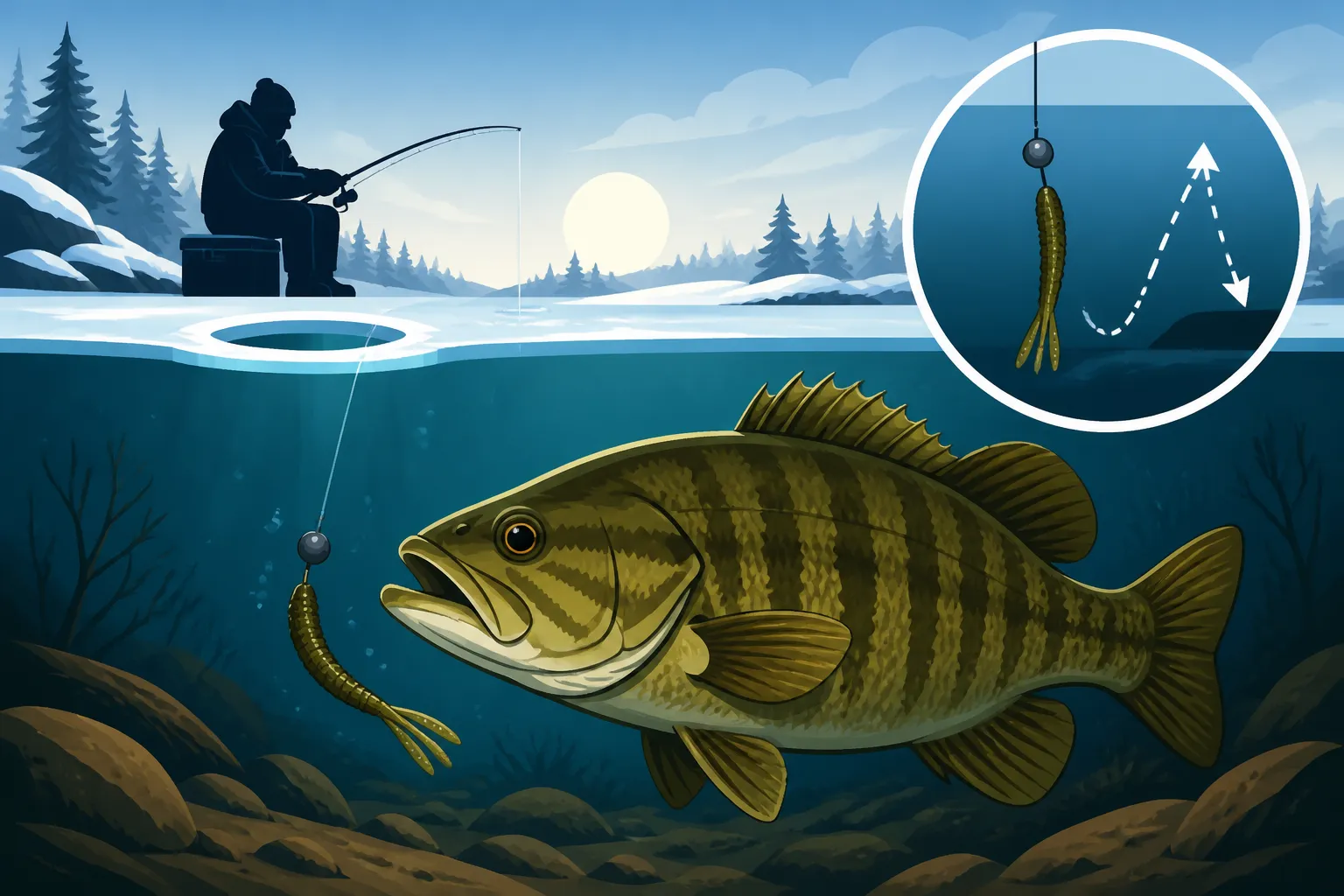
If there's one technique that truly shines for winter smallmouth bass, it's drop shotting. This rig allows you to present a small, soft plastic bait horizontally at a precise depth, suspended above a lead weight. This means your bait can hover enticingly right in the fish's strike zone without constantly dragging on the bottom, where lethargic fish might miss it.
To rig a drop shot, tie a Palomar knot (or similar strong knot) to your hook, leaving a long tag end. Thread the tag end through the hook eye again from the top, and then tie your drop shot weight directly to the tag end. The length of the tag end determines how far off the bottom your bait sits. When fishing for winter smallmouth, keeping your bait just a foot or two off the bottom, right in front of their faces, is usually ideal.
The key to drop shotting is minimal movement. Cast to your target area, let the weight sink, and then use your rod tip to subtly shake the bait. Think of tiny vibrations, not large sweeps. Soft plastics like small tube baits, tiny minnow imitations, or straight-tailed worms work wonders. Brands like Berkley Gulp! or Z-Man's ElaZtech baits are excellent choices due to their lifelike action and durability. You can find a fantastic selection of drop shot weights and soft plastics on Amazon, making it easy to experiment with different profiles and colors to see what the fish prefer on any given day.
Ned Rig: Subtle and Effective
The Ned Rig, originating from the Midwest, has gained immense popularity for its incredible effectiveness on finicky bass, especially in cold water. It's a remarkably simple setup: a small, mushroom-shaped jig head paired with a short, buoyant soft plastic worm (often referred to as a "TRD" style bait). The buoyancy of the plastic, combined with the jig head's design, causes the bait to stand upright on the bottom, mimicking a foraging creature or a dying baitfish.
The retrieve is crucial for the Ned Rig. Cast it out, let it sink to the bottom, and then retrieve it with an ultra-slow drag or subtle hops, punctuated by long pauses. Think of it as barely moving the bait along. The small profile and subtle action are exactly what lethargic smallmouth are looking for. It's incredibly versatile and can be fished effectively in depths ranging from 10 to 40 feet, depending on where the smallmouth are holding. For those tricky days, a Ned Rig can often coax a bite when nothing else will. Best Tackle for Panfish can provide some crossover insights for lighter jig heads suitable for Ned rigs.
Blade Baits and Small Jigs: When They Need a Trigger
While finesse plastics are often the go-to, there are times when a smallmouth needs a little more encouragement. This is where blade baits and small jigging spoons come into play. Blade baits, like the Johnson Thinfisher or the Rapala Rippin' Rap, are thin, metal lures designed to produce significant vibration and flash on the retrieve. They mimic baitfish incredibly well and can trigger a reaction strike, even from a sluggish smallmouth. The key is vertical jigging them directly over suspected fish, lifting and dropping with short, controlled movements.
Similarly, small jigging spoons, like those from Northland Fishing Tackle or Swedish Pimple, are excellent for vertical presentations. Their erratic flutter on the fall can be irresistible. When fishing these, pay close attention to your line; many bites will occur on the drop as the lure flutters down. It's often a case of "less is more" with these baits – a quick lift, a short pause, and letting it fall on a semi-slack line is more effective than aggressive, continuous jigging. These vibrating and flashing options provide a different stimulus that can be the ticket to activating a pod of otherwise inactive bass.
Crucial Gear and Safety Considerations
Success in winter smallmouth fishing isn't just about technique; it's also about having the right tools and, more importantly, prioritizing safety. Ontario winters are no joke, and preparation is key, whether you're fishing from a boat or through the ice.
Rods, Reels, and Line for Sensitivity
For any finesse technique, sensitivity is paramount. You need to feel those incredibly subtle bites. Opt for light to medium-light power spinning rods with a fast or extra-fast action. A sensitive graphite blank will transmit even the slightest tap up the line. A rod in the 6'6" to 7'2" range is versatile for both open water and ice. Pair this with a high-quality spinning reel in the 1000 to 2500 size range, ensuring smooth drag and a good retrieve ratio.
For line, a thin, low-stretch braided mainline (6-10 lb test) is highly recommended for its sensitivity. Tie a fluorocarbon leader (6-10 lb test, often 4-8 feet long) to your braid using an FG knot or an Albright knot. Fluorocarbon is nearly invisible underwater, offers good abrasion resistance against rocks, and has less stretch than monofilament, further enhancing sensitivity. You can find excellent quality braided lines and fluorocarbon leaders on Amazon from brands like PowerPro and Seaguar. Best Fluorocarbon Line for Clear Lake Water provides more insights into leader choices.
| Technique | Common Bait Type | Typical Depth (ft) | Retrieve Style | Key Feature |
|---|---|---|---|---|
| Drop Shot | Small soft plastic minnows, worms | 15-60 | Subtle shakes, long pauses, minimal movement | Precise depth control |
| Ned Rig | Buoyant soft plastic worms (TRD style) | 10-40 | Ultra-slow drag, slight hops, long pauses | Stands upright on bottom |
| Blade Bait | Metal vibrating lure | 20-70+ | Vertical jigging, sharp lifts, controlled drops | Vibration and flash |
| Small Jigging Spoon | Metal spoon, often with a treble hook | 20-70+ | Vertical jigging, fluttering fall | Erratic flutter on drop |
Navigating the Ice and Cold
If you're targeting smallmouth through the ice, safety is non-negotiable. Always prioritize checking ice thickness rigorously before venturing out, especially in early or late winter. A minimum of 4 inches of clear, solid ice is generally recommended for walking, but 5-7 inches is better for peace of mind and heavier gear. How thick ice needs to be to fish safely in Ontario is crucial reading. Carry ice picks, a spud bar for testing, and wear a flotation suit or life jacket. Layers of warm clothing, insulated boots, and proper hand/head protection are essential to prevent hypothermia. Portable ice shelters can provide a welcome respite from the wind and cold, making your day much more enjoyable. For open water winter fishing, ensure your boat is properly maintained, safety equipment is onboard, and you dress even warmer than you think you need to. A fall into frigid water can be life-threatening.
Electronics for Locating Fish
In the vastness of Ontario's deep lakes, finding those small, lethargic pods of smallmouth without good electronics is like finding a needle in a haystack. A quality fish finder, whether it's a traditional sonar unit, a flasher for ice fishing, or modern live-scanning sonar, is your best friend. These tools allow you to identify deep-water structure, mark baitfish, and most importantly, pinpoint those tell-tale schools of smallmouth.
For ice fishing, a dedicated ice flasher like a Vexilar or Marcum shows you real-time returns of fish and your bait, allowing for precise presentation. For open water, side-scanning and down-scanning capabilities can reveal those deep humps and rocky ledges that hold winter bass. Some of the newer live sonar systems, while an investment, can literally show you how fish react to your bait in real-time, which is a game-changer for finicky cold-water fish. You can often find fantastic deals on advanced fish finders on Amazon, ranging from basic models to high-tech units. Understanding How to use the Fish ON-Line interactive zone map can also help identify prime deep water structural features before you even leave home.
Winter smallmouth bass fishing in Ontario is a challenging, yet incredibly rewarding pursuit. By understanding their cold-water behavior, employing precise finesse techniques, and prioritizing safety, you can unlock a unique and exciting fishery that many anglers overlook. So, don't put away your bass gear just yet – bundle up, grab your sensitive rod, and get ready to experience the thrill of a winter bronzeback!
Disclaimer
This article is for general informational purposes only and does not constitute professional advice. Laws, prices and regulations vary by location and change over time. Consult a qualified professional for guidance on your specific situation.