Ontario Senior Fishing License Exemption at 65
Navigating fishing regulations can feel like a maze sometimes, especially when you're just looking to enjoy a peaceful day on the water and aren't sure if you still need to jump through all the same hoops as everyone else. For many seniors in Ontario, there’s a common question that pops up around fishing licenses: do I still need one once I hit a certain age? This comprehensive guide is here to clear up that very confusion, diving deep into Ontario's senior fishing license exemption at 65, so you can spend less time worrying about paperwork and more time casting your line.
Understanding Ontario's Fishing License System
Before we get into the specifics of the senior exemption, it's really helpful to understand the basic structure of how fishing licenses work here in Ontario. It can seem a bit convoluted at first, but once you get the hang of it, it's pretty straightforward.
The Basics of Fishing Licenses in Ontario
At its heart, fishing licenses in Ontario are about conservation and sustainable management of our incredible aquatic resources. Every dollar generated from license sales goes directly back into programs that support healthy fish populations, protect habitats, and ensure future generations can also enjoy the thrill of reeling in a big one. It's not just about collecting fees; it's about investing in the future of fishing.
For the vast majority of anglers, regardless of their experience level, a valid fishing license is a fundamental requirement to legally fish in Ontario waters. This applies whether you're targeting trophy walleye on Lake Erie, chasing smallmouth bass on Georgian Bay, or simply enjoying some panfish action on a quiet inland lake. Without one, you could face fines and penalties, which is definitely not how anyone wants to end their fishing trip.
The Outdoors Card and Fishing License Distinction
This is where some of the confusion often begins, because there are actually two key pieces of documentation that most anglers need: an Outdoors Card and a fishing license. Think of your Outdoors Card as your personal identification with the Ministry of Natural Resources and Forestry (MNRF). It’s a plastic card, much like a driver's license, that holds your unique customer number and confirms you're a registered angler or hunter in the province. It's valid for a set number of years, usually three or five, and it's something you generally need to renew periodically.
The actual fishing license, on the other hand, is generally a piece of paper or a digital document that's associated with your Outdoors Card. It specifies the type of license you have (Sport or Conservation, which we'll talk about later), its validity period (one-day, annual, or three-year), and the species you're allowed to target. You can't just buy a fishing license; you need a valid Outdoors Card first. The Outdoors Card acts as a prerequisite, a sort of foundational ID upon which your actual fishing privileges are built. For a complete rundown on this, you might find our guide on the Ontario Outdoors Card, Explained incredibly useful.
The Senior Fishing License Exemption at 65
Now for the good news that many Ontario seniors are eager to hear about! There's a fantastic exemption in place that makes fishing more accessible and affordable for our seasoned anglers.
Who Qualifies for the Exemption?
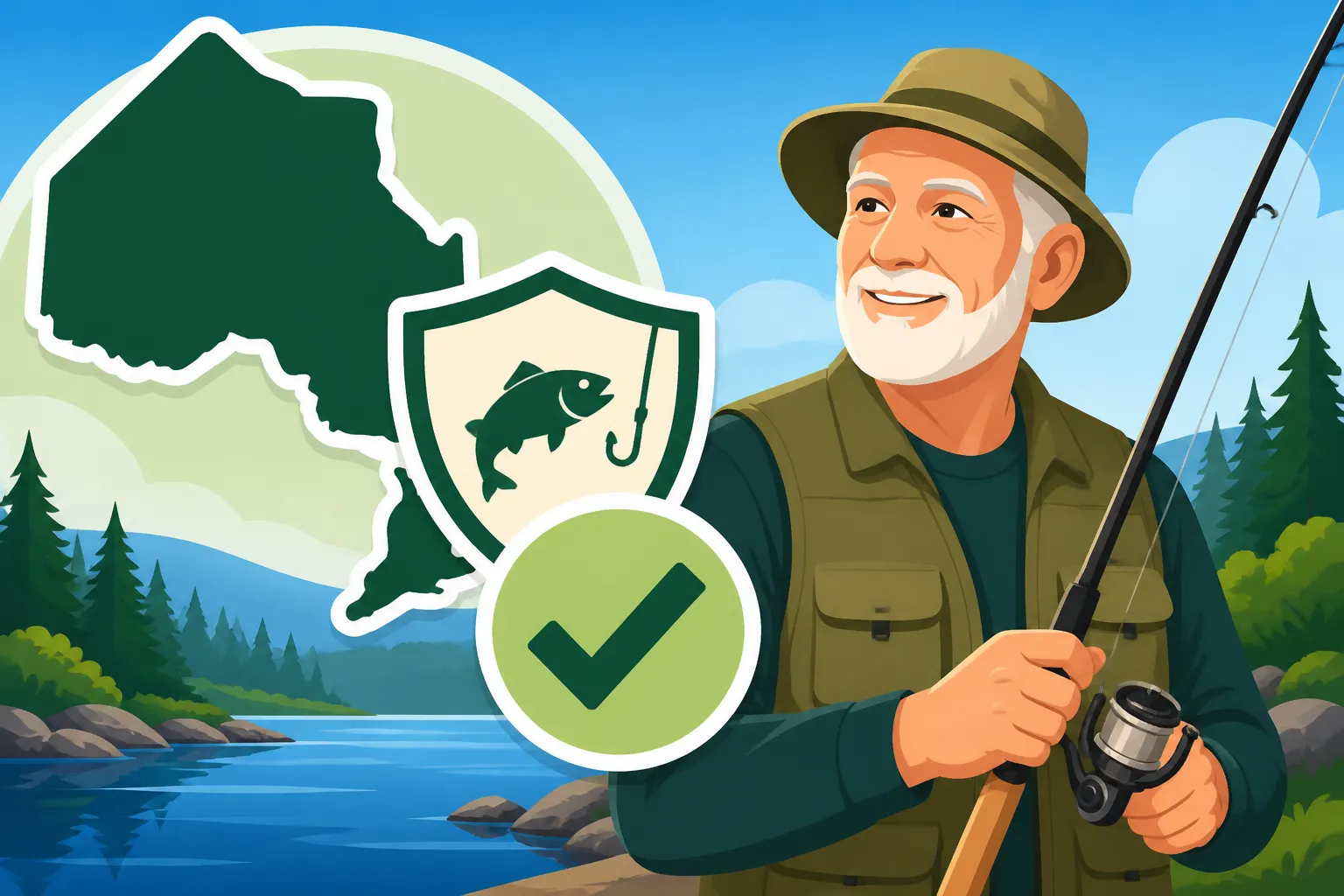
To qualify for this exemption, the rules are quite specific, but thankfully, they're also very clear. You must be an Ontario resident, and you must be 65 years of age or older. That's it! If you meet both of those criteria, you're in.
Let's break down what "Ontario resident" really means in this context. It's not just about owning property here; it means that Ontario is your primary place of residence, and you have resided in the province for at least six consecutive months of the year. So, if you're a snowbird who spends winters down south but your main home is in Ontario and you're here for the majority of the year, you absolutely qualify. This exemption is designed specifically for those who call Ontario home and have contributed to its community over the years. This aligns perfectly with the broader Ontario Fishing License Age Requirements, which outline all age-related rules.
What the Exemption Means for Anglers
For qualifying Ontario residents aged 65 and over, the exemption means one very important thing: you do not need to purchase an annual or multi-year fishing license. That's right, you can save those hard-earned dollars for new tackle, a better cooler, or perhaps a trip to a dream fishing spot instead!
While you don't need to buy a fishing license, you absolutely still need to possess a valid Outdoors Card. Your Outdoors Card serves as your official proof of age and residency, validating your exemption status. When out fishing, it's crucial to have this card with you, whether it's the physical card or a digital copy on your phone. Fisheries officers may ask to see it, and it's your way of demonstrating that you meet the exemption criteria. The practical implications are fantastic – fewer costs, less administrative hassle, and the freedom to enjoy Ontario's waters without the annual license fee. Just remember that while the fee is waived, the rules still apply, which we’ll cover in more detail shortly.
Essential Documents and Proof of Age/Residency
Even with the exemption, you can't just head out the door with a rod and reel. There are still a couple of key things you need to have on hand to ensure your fishing experience is legal and hassle-free.
Carrying Your Outdoors Card
As we just touched on, your Outdoors Card is paramount, even for exempt seniors. While you're not paying for a fishing license, your Outdoors Card acts as the primary form of identification that validates your age and residency status. It links you to the provincial system and confirms your eligibility for the exemption. Think of it as your "free pass" to fish, but you still need to show the pass!
It's not enough to simply have an Outdoors Card; you must carry it with you at all times while fishing. This means either the physical card in your wallet, or a digital copy on your smartphone or other device. In today's digital age, carrying a digital version is increasingly common and convenient. Our guide on Printing or Carrying a Digital Fishing License in Ontario offers excellent advice on how to ensure you're compliant, whether you prefer paper or digital proof. Should a conservation officer approach you, presenting your Outdoors Card immediately will clarify your status and prevent any unnecessary questioning or potential issues.
Acceptable Forms of Identification
While your Outdoors Card is the primary document to verify your eligibility, it's always a good idea to have another form of government-issued photo identification with you as well, especially when you first activate or renew your Outdoors Card. This could be your Ontario Driver's License, a valid Canadian passport, or a provincial health card (though for ID purposes, a driver's license or passport with a photo is usually preferred).
In situations where there might be a question about your residency or age, having these additional documents can provide irrefutable proof. While rare, a conservation officer might request further identification if your Outdoors Card information is unclear or if they need to cross-reference details. Being prepared with these documents ensures that your fishing outing remains enjoyable and free from administrative hitches.
Navigating Fishing Regulations for Exempt Seniors
This is a critical point that sometimes gets overlooked. The senior exemption applies only to the cost of the fishing license; it does not exempt you from following the comprehensive fishing regulations that govern Ontario's waters. Ignorance of the rules is not a defense, and conservation officers are just as diligent with exempt anglers as they are with those who've purchased a license.
Rules Still Apply: Bag Limits, Seasons, and Zones
Every angler, regardless of age or license status, is responsible for knowing and adhering to all applicable fishing regulations. This includes:
- Bag and Possession Limits: These are the rules about how many fish of a certain species you can catch in a day (bag limit) and how many you can have in your possession, including those at your camp, car, or home (possession limit). These limits vary widely by species and by the specific Fisheries Management Zone (FMZ) you are fishing in. Our article on Ontario Bag and Possession Limits by Species is an excellent resource to familiarize yourself with these crucial numbers.
- Open and Closed Seasons: Most fish species have specific times of the year when they can be legally caught, and times when they cannot (to protect spawning fish, for example). These "openers" and "closers" are also determined by species and FMZ. Check out Ontario Fishing Season Dates by Zone for detailed information.
- Fisheries Management Zones (FMZs): Ontario is divided into 20 distinct FMZs, each with its own unique set of regulations based on the specific fish populations and ecological characteristics of that area. Understanding which FMZ you are in and its particular rules is absolutely essential. We have a detailed guide on Ontario Fisheries Management Zones, Explained that can help clarify this.
- Size Restrictions: For certain species, there might be minimum or maximum size limits, or even "slot limits," which mean you can keep fish within a certain size range but not those larger or smaller.
Always consult the most current Ontario Fishing Regulations Summary before heading out. This publication is your bible for what's allowed and what's not, and it's updated annually. Our dedicated piece, Ontario Fishing Regulations Explained, goes into much greater detail about understanding these rules.
Sport vs. Conservation Limits for Exempt Anglers
This is another area where confusion can easily arise for exempt seniors. When you purchase a fishing license in Ontario, you usually have a choice between a Sport Fishing License and a Conservation Fishing License.
- Sport Fishing License: This license allows for a higher daily catch and possession limit for most species. It's for those who want to keep more fish within sustainable limits.
- Conservation Fishing License: This license has reduced catch and possession limits, typically about half of the Sport license limits. It's for anglers who want to minimize their impact, perhaps focusing more on catch-and-release.
For Ontario residents aged 65 and over who are fishing under the exemption, it's important to know that you are automatically subject to the Sport Fishing License limits. You do not automatically default to the Conservation limits. This means you can keep the higher number of fish allowed under the Sport limits for the species you're targeting, provided you stay within all other regulations. However, if you personally prefer to practice more conservative harvesting, you are certainly welcome to adhere to the Conservation limits on your own initiative.
To illustrate the difference, here's a general comparison (always refer to the current regulations summary for precise, species-specific details for your FMZ):
| Regulation Type | Sport Fishing Limits (for exempt seniors) | Conservation Fishing Limits (if purchased) |
|---|---|---|
| Daily Catch | Higher bag limits for most species | Lower bag limits (approx. 50% of Sport) |
| Possession | Higher possession limits | Lower possession limits |
| Annual Fee | Exempt (no fee) | Requires purchase of Conservation license |
| Purpose | Recreational fishing with higher harvest | Recreational fishing with reduced harvest |
For a deeper dive into these license types, our article on Ontario Sport vs Conservation Fishing License provides a thorough comparison. Understanding this distinction is vital for every angler, including those fishing under the senior exemption, to ensure legal and responsible fishing practices.
Special Considerations for Senior Anglers
Fishing should be an enjoyable, relaxing, and safe experience for everyone, especially for our seniors. There are a few unique points to keep in mind to ensure that the experience is as comfortable and rewarding as possible.
Non-Resident Seniors and the Exemption
It's absolutely crucial to emphasize this point: the senior fishing license exemption in Ontario is strictly for Ontario residents. If you are visiting Ontario from another province within Canada, or from any other country, this exemption does not apply to you, regardless of your age.
For example, a senior angler from Quebec or Alberta visiting their family in cottage country will still need to purchase a non-resident fishing license. The same applies to our American friends coming up from states like Michigan or New York to enjoy our beautiful Great Lakes. While the spirit of the exemption is to recognize long-term Ontario residents, it doesn't extend beyond our provincial borders. If you are a Canadian resident from outside Ontario, our article on the Ontario Canadian resident (outside Ontario) fishing license cost will provide the details you need. Similarly, for international visitors, you can find specific information on the Non-Resident Annual Fishing License Cost in Ontario. Always ensure you have the correct license for your residency status to avoid any unpleasant surprises.
Preparing for a Senior-Friendly Fishing Trip
Beyond the regulations, practical preparation can make all the difference for a senior angler's comfort and enjoyment. Fishing isn't just about catching fish; it's about the entire experience, and making that experience comfortable and accessible is paramount.
- Comfortable Gear: Consider lightweight rods and reels that reduce strain on arms and shoulders. Ergonomic handles can be a real game-changer. For those who enjoy shore fishing or sitting on a dock, a comfortable, portable fishing chair can make hours fly by. You can find a fantastic array of such gear, including high-quality ergonomic fishing rods and comfortable chairs, on Amazon. A well-organized tackle box or bag that's easy to access and carry is also a must-have, and many excellent options are available on Amazon that cater to various needs and budgets.
- Safety First: Always prioritize safety. If you're heading out on a boat, ensure you have properly fitting life jackets for everyone on board. Even if you're a strong swimmer, unexpected situations can happen on the water. Our guide on Life Jacket Requirements for Ontario Boaters is an essential read for anyone venturing out in a boat. Dress in layers, wear a wide-brimmed hat, and use plenty of sunscreen, even on cloudy days. A reliable first-aid kit is also a wise addition to your gear.
- Accessibility: Look for fishing spots that offer easy access. Many provincial parks and conservation areas have accessible docks or shoreline fishing platforms. Searching for "accessible fishing Ontario" can yield great results, and our guide on the Best handicap-accessible fishing piers in Ontario highlights some excellent options designed with ease of access in mind. Planning ahead for shorter trips, especially during extreme weather, can also contribute to a more enjoyable experience.
- Vision Aids: As our eyes age, small details can become harder to see. Investing in a good pair of polarized sunglasses not only protects your eyes from harmful UV rays but also cuts glare off the water, helping you spot structure or even cruising fish. Many reputable brands offer excellent polarized sunglasses, which you can easily browse and purchase on Amazon. Some anglers also find reading glasses helpful for tying knots or reading small print on lure packaging.
Taking these extra steps ensures that your focus remains on the joy of fishing, rather than on discomfort or safety concerns.
Where to Find More Information and Support
Even with all this information, sometimes you just need to check a specific detail or clarify a tricky regulation. Thankfully, Ontario provides excellent resources to help anglers stay informed.
Official Resources for Regulations
Your primary and most reliable source for all fishing regulations in Ontario is the Ontario government itself, specifically the Ministry of Natural Resources and Forestry (MNRF). They publish the annual Ontario Fishing Regulations Summary, which is the definitive guide. This summary is available online as a PDF download, and physical copies are often available at ServiceOntario locations, tackle shops, and provincial park offices.
I can't stress enough how important it is to consult the most current summary. Regulations can change from year to year, or even within a year for specific zones or species, so relying on outdated information could lead to issues. For a deep dive into how to effectively use this critical document, our article Reading the Ontario Fishing Regulations Summary offers invaluable tips and guidance. Make it a habit to review it before your first trip of the season, and certainly before venturing into any new FMZ.
Accessing the Fish ON-Line Map
In addition to the written summary, Ontario provides an incredibly powerful digital tool called Fish ON-Line. This interactive map allows you to zoom in on specific lakes, rivers, and areas throughout the province and instantly see the regulations that apply to that precise body of water. It's a game-changer for planning your fishing trips, especially if you're exploring new areas.
Fish ON-Line displays information on:
- Fisheries Management Zones (FMZs)
- Species-specific regulations
- Special regulation waters (e.g., catch-and-release only, fly-fishing only)
- Lake contour maps and depth information for many lakes
- Boat launch locations
- Fish stocking information
Using a tool like Fish ON-Line, perhaps on a tablet or smartphone, can complement your fishing experience. While not a substitute for knowing the regulations, it makes on-the-spot verification much easier. Consider enhancing your fishing setup with a portable fish finder, many of which can sync with mapping applications and are readily available on Amazon, giving you an edge in locating fish and understanding underwater structure. Our comprehensive guide on the Ontario Fish ON-Line Interactive Zone Map, Explained will walk you through all its features and how to make the most of this fantastic resource.
Disclaimer
The information provided in this guide is for general informational purposes only and is not legal advice. Fishing regulations in Ontario are subject to change. Always consult the most current official Ontario Fishing Regulations Summary and relevant government websites (such as the Ontario Ministry of Natural Resources and Forestry) for the most up-to-date and accurate information before engaging in any fishing activities.